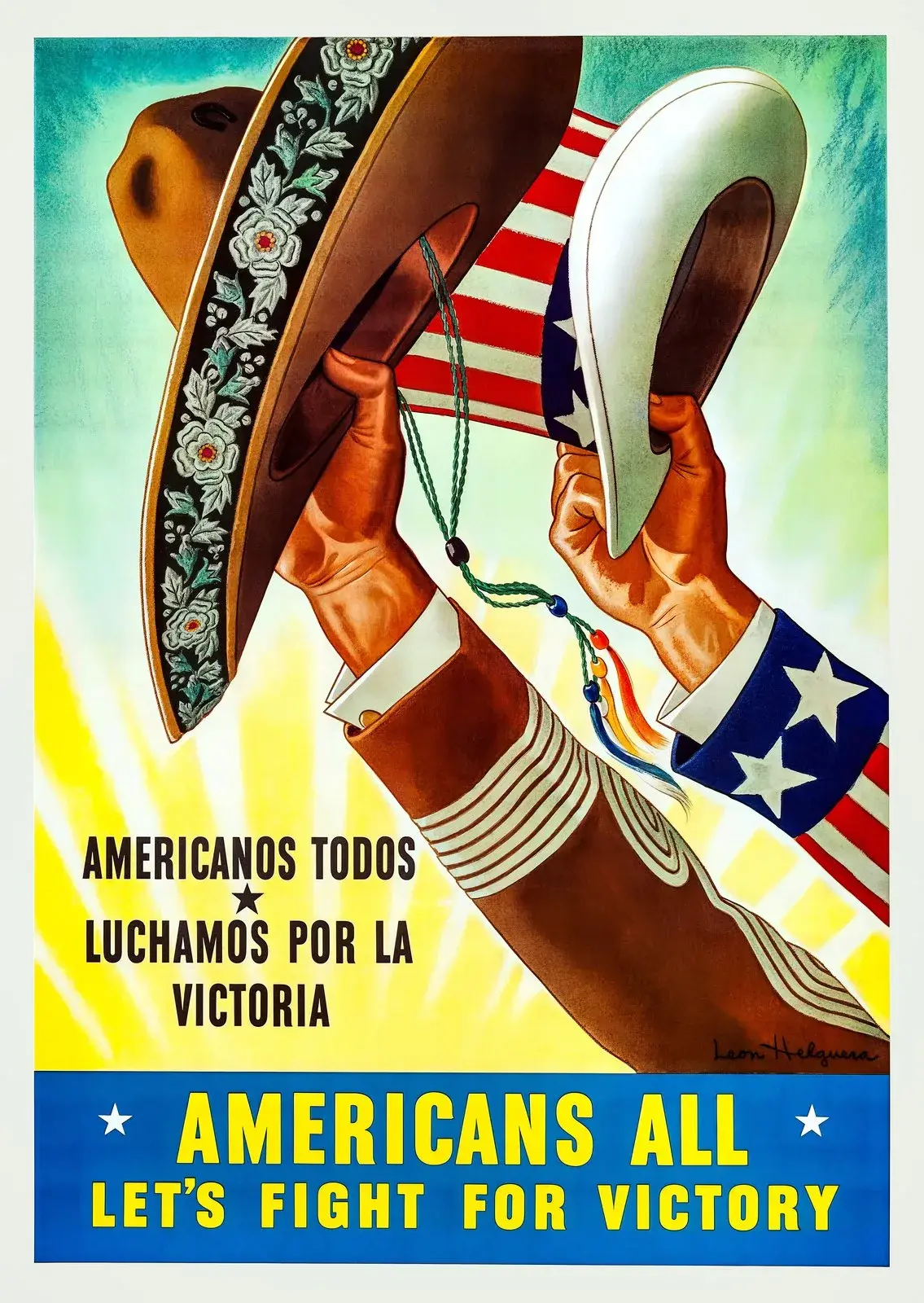
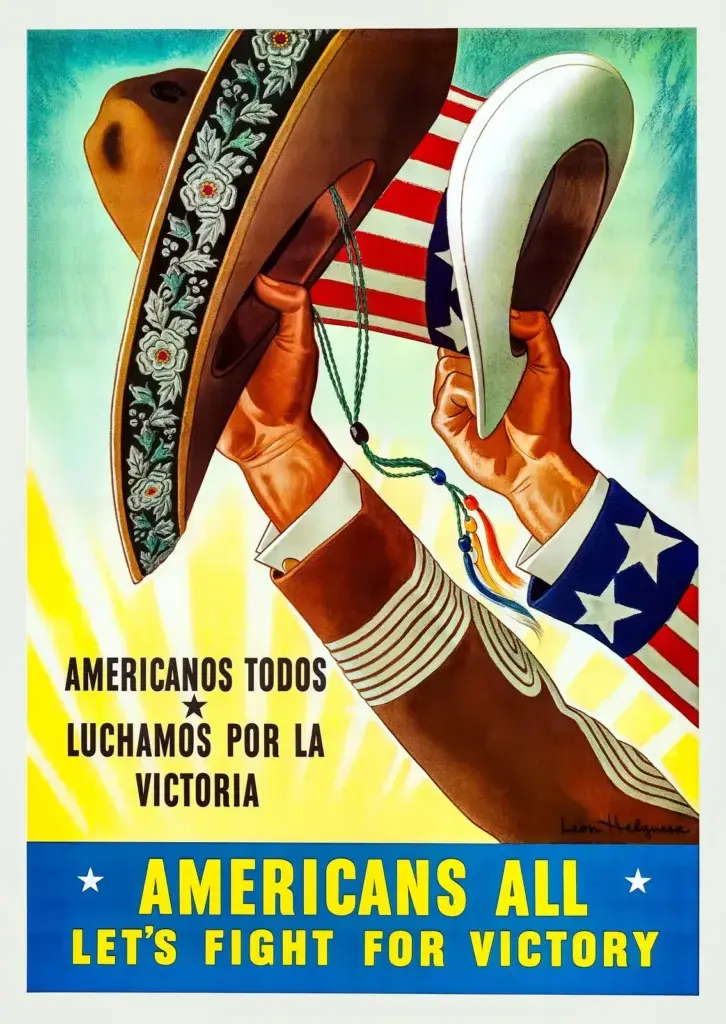
Two arms rise from the corner of the picture into a sunburst sky. One wears a brown jacket trimmed with cream braid and lifts a charro sombrero, its brim embroidered with roses. The other wears Uncle Sam’s stars and stripes and lifts his tall white hat. The hats meet in the middle, raised in the same salute. Below, the message comes twice, in Spanish first: Americanos todos, luchamos por la victoria. Then in English: Americans all, let’s fight for victory.
A poster for Spanish-speaking America
Most American wartime posters spoke English to a general audience. This one was made for a particular community. In January 1943 the Office of War Information’s Foreign Language Division commissioned a set of posters from Leon Helguera aimed at Mexican Americans and Spanish-speaking people in the Southwest, asking that they be bilingual and show the community as part of the national effort. Americans All was issued as OWI Poster No. 65 and printed by the U.S. Government Printing Office in 1943.
The timing mattered. In Los Angeles, the Sleepy Lagoon murder case of 1942, in which a group of young Mexican Americans were tried together for the death of José Díaz, had inflamed tensions, and Axis radio was using stories of discrimination against Mexican Americans as propaganda. The OWI’s Alan Cranston, who visited Los Angeles after the trial, pushed for Spanish-language posters and radio that would say plainly that Mexican Americans were needed, valued and already fighting.
The Good Neighbor in a hat
The phrase “Americans All” worked on two levels. At home it meant a multi-ethnic nation pulling together. Across the hemisphere it echoed President Roosevelt’s Good Neighbor Policy toward Latin America, and the new wartime alliance with Mexico, which declared war on the Axis powers in May 1942. Helguera put both ideas into one image: no flags or weapons, just two hats raised as equals.
Leon Helguera, an artist between two countries
León Helguera was born in Chihuahua, Mexico, in 1899, went to an American school in Mexico City and arrived in New York at seventeen, already describing himself as an artist. He became a U.S. citizen and worked as a commercial artist in Manhattan, and in 1942 joined a group of volunteer artists offering their services to the government.
His wartime work reached millions. Besides the Spanish-language posters, he drew the stern, finger-pointing Uncle Sam of I’m Counting on You!, which became the official insignia of the Security of War Information campaign and was reproduced on posters, advertisements and even restaurant menus. He designed the United Nations postage stamp issued in January 1943 and later U.S. stamps for U.S.–Canada friendship and New York City’s 300th anniversary. He led a New York club for friendship between the United States and Latin America, and late in life returned to live in Mexico. He died in 1970.
The restored edition
Our edition was restored from a scan of an original 1943 print. The paint was cleaned and the colour brought back, with creases, stains and wear removed. The lettering in both languages and Helguera’s signature are kept from the original; the small government printing credit lines in the bottom margin have been left off. Compare the two below, or drag the before and after slider on the product page.
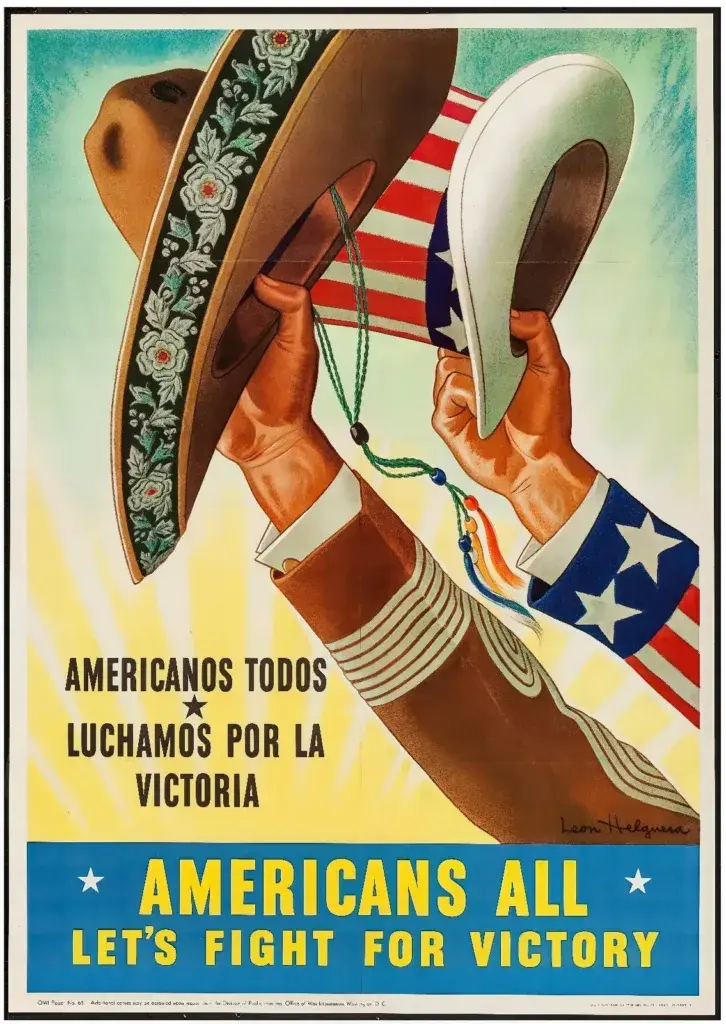
The restored poster is available as a paper print in three sizes or framed in black, white or natural wood, printed to order in the USA.
Frequently asked questions
Who made the Americans All poster?
Leon Helguera (1899 to 1970), a Mexican-born commercial artist who became an American citizen and worked in New York. He painted it for the Office of War Information in 1943.
Who was the poster for?
Mexican Americans and Spanish-speaking communities, especially in the Southwest. The Office of War Information’s Foreign Language Division commissioned it to encourage them to support the war effort and to say that they were full partners in it.
What does the Spanish text say?
“Americanos todos, luchamos por la victoria” means “Americans all, we fight for victory.” The English line underneath reads “Americans all, let’s fight for victory.”
Why is there a sombrero and Uncle Sam’s hat?
The two hats stand for Mexican and Anglo America raised together in one salute. The idea echoed the Good Neighbor Policy between the United States and Latin America, and the wartime alliance with Mexico, which declared war on the Axis in May 1942.
What else did Leon Helguera design?
His best-known image is the “I’m Counting on You!” Uncle Sam, which became the insignia of the government’s Security of War Information campaign in 1943. He also designed U.S. postage stamps, including the 1943 United Nations stamp.
How big is the restored print?
Our restored edition is available as a paper print up to 23.4 x 33.1 inches, or framed up to 23 x 33 inches, printed to order in the USA.
Historical sources
- National Archives, The Text Message: Americans All by Leon Helguera, appealing to Hispanics on the home front in World War II
- National Archives, The Text Message: I’m Counting on You by Leon Helguera
- Imperial War Museums: Americans All, Let’s Fight for Victory (Art.IWM PST 3116)
- FDR Presidential Library: Americans All, Let’s Fight for Victory
- UNT Libraries catalogue record