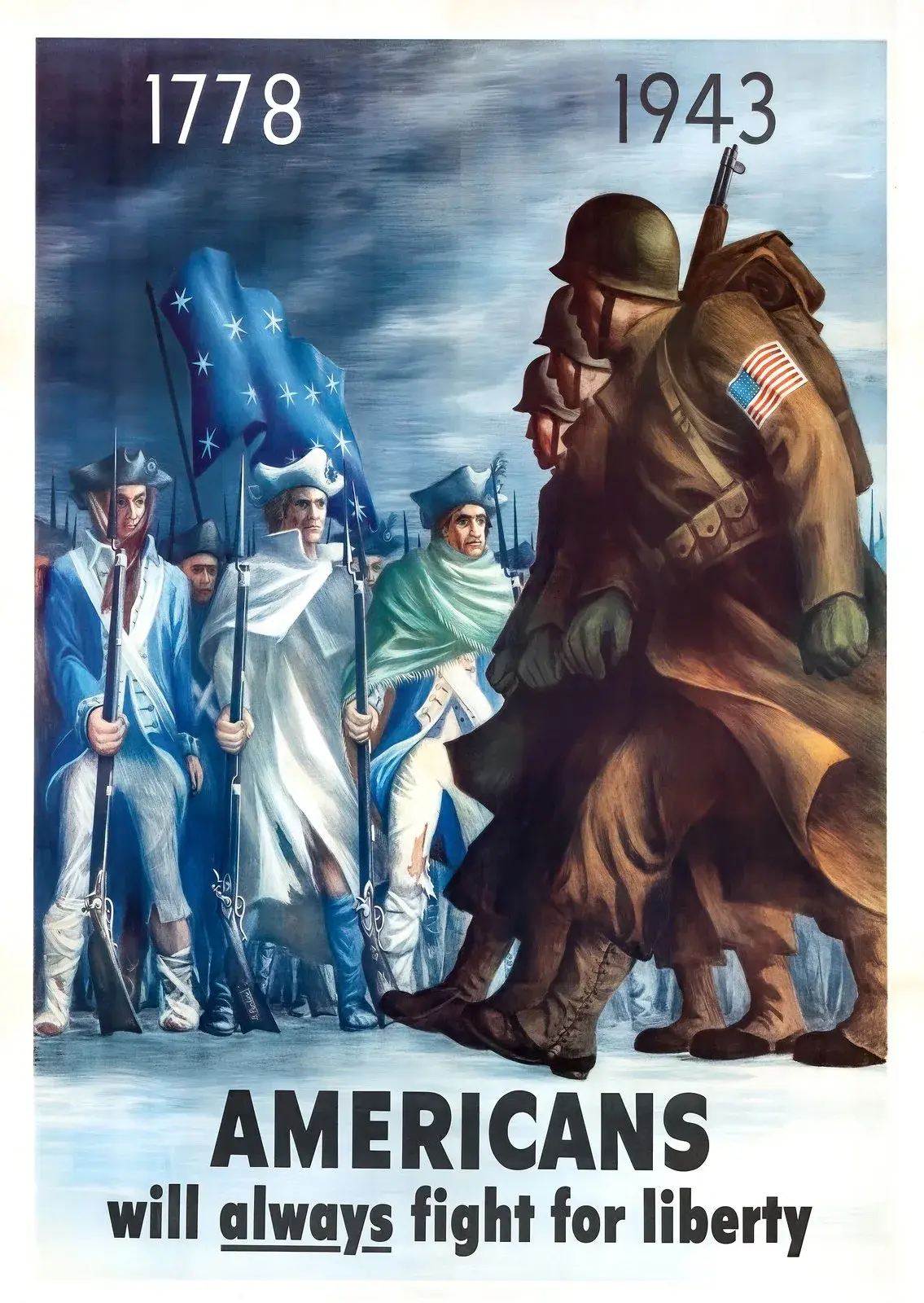
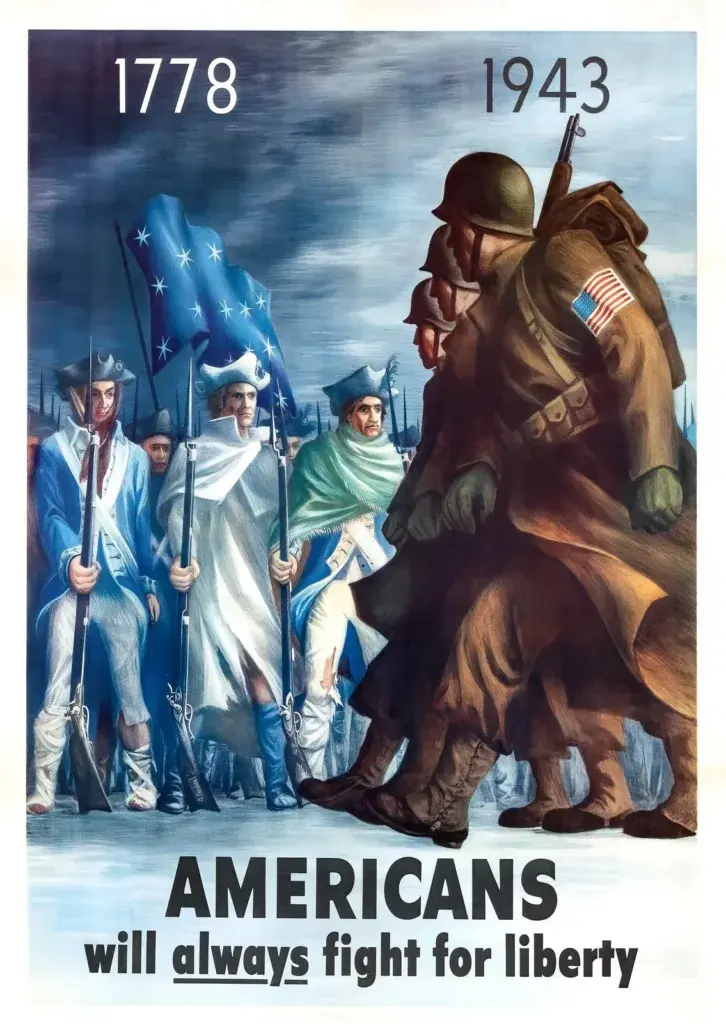
“1778 – 1943: Americans will always fight for liberty.” In 1943 the Office of War Information needed Americans to see the war against the Axis as more than a distant conflict. Bernard Perlin’s answer was to put two armies in one picture: the soldiers of the Second World War marching past the ragged men who had fought for independence more than 160 years earlier.
What the poster shows
Three American soldiers in steel helmets and long olive-brown overcoats, rifles slung over their shoulders and a flag patch on the sleeve, stride from left to right across the foreground. Behind them stands a line of Continental soldiers in tricorn hats and worn blue and white coats, some wrapped in scarves and blankets, their legs bandaged against the cold. A blue flag with a circle of white stars rises above them against a dark, stormy sky, and snow covers the ground.
The dates 1778 and 1943 sit at the top, one over each army. At the bottom the message is set in heavy black capitals, AMERICANS, with the line “will always fight for liberty” beneath and the word always underlined for emphasis.
1778 and the memory of Valley Forge
The poster does not name a battle, but its snowbound, half-clothed Continentals call up the winter of 1777 to 1778 at Valley Forge, when George Washington’s army endured cold, hunger and disease and came out of the winter better trained. By 1943 Valley Forge was one of the country’s most powerful images of sacrifice and endurance, and Perlin used it to tell a new generation that hardship in the cause of liberty was an American tradition.
The Office of War Information
The Office of War Information was created in June 1942 to coordinate the government’s wartime messages at home and abroad. Its graphics division commissioned artists to design posters that were printed by the Government Printing Office and distributed free to post offices, schools, libraries, factories and stores. This design was issued as OWI Poster No. 26, and its imprint invited readers to request additional copies from the OWI’s Division of Public Inquiries in Washington. Historians often cite it as a classic example of transfer propaganda, linking the ideals of the Revolution to the fight against fascism.
Bernard Perlin, the artist
Bernard Perlin (1918 to 2014) was born in Richmond, Virginia, and trained in New York at the National Academy of Design and the Art Students League. He worked in the Office of War Information’s graphics division in 1942 and 1943, then went overseas as an artist-correspondent for Life magazine and later worked for Fortune. After the war he became known for magic realist paintings such as Orthodox Boys, now in the Tate collection, and his work is held by the Museum of Modern Art, the Smithsonian and the Whitney Museum.
The restored edition
Our edition was restored from an archival scan of an original 1943 print. The comparison below shows the difference: fading, stains, creases and paper wear were repaired and the colours brought back, while Perlin’s brushwork and the original lettering were kept intact.
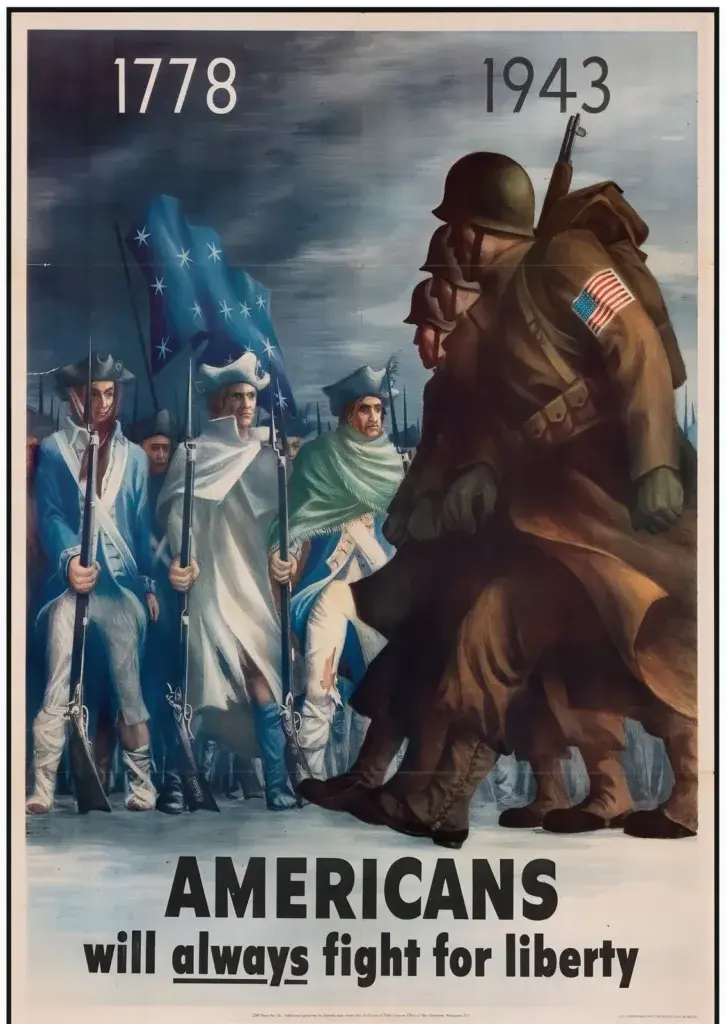
The restored poster is available as a paper print in three sizes or framed in black, white or natural wood, printed to order in the USA.
Frequently asked questions
Who designed the Americans Will Always Fight for Liberty poster?
The poster was painted by American artist Bernard Perlin (1918 to 2014), who worked in the graphics division of the Office of War Information in 1942 and 1943. It was issued in 1943 as OWI Poster No. 26 and printed by the U.S. Government Printing Office.
What do the dates 1778 and 1943 mean on the poster?
1778 stands for the Revolutionary War, when the Continental Army fought for American independence, and 1943 for the Second World War. The poster places the two generations of soldiers side by side to say that Americans have always fought for liberty.
Does the poster show Valley Forge?
The poster does not name a place, but the ragged Continental soldiers standing in snow with bandaged legs strongly recall the winter of 1777 to 1778 at Valley Forge, the best-known image of Revolutionary hardship.
What kind of propaganda is this poster?
It uses what is often called transfer: it links the respected ideals of the American Revolution to the fight against fascism in World War II, so that support for the war feels like a continuation of the country's founding struggle.
How big was the original poster?
The OWI issued it in more than one size. The large version measures about 40 x 28.5 inches, and a smaller 28 x 22 inch version is held by the Smithsonian. Our restored edition is available as a paper print up to 23.4 x 33.1 inches and framed up to 23 x 33 inches.