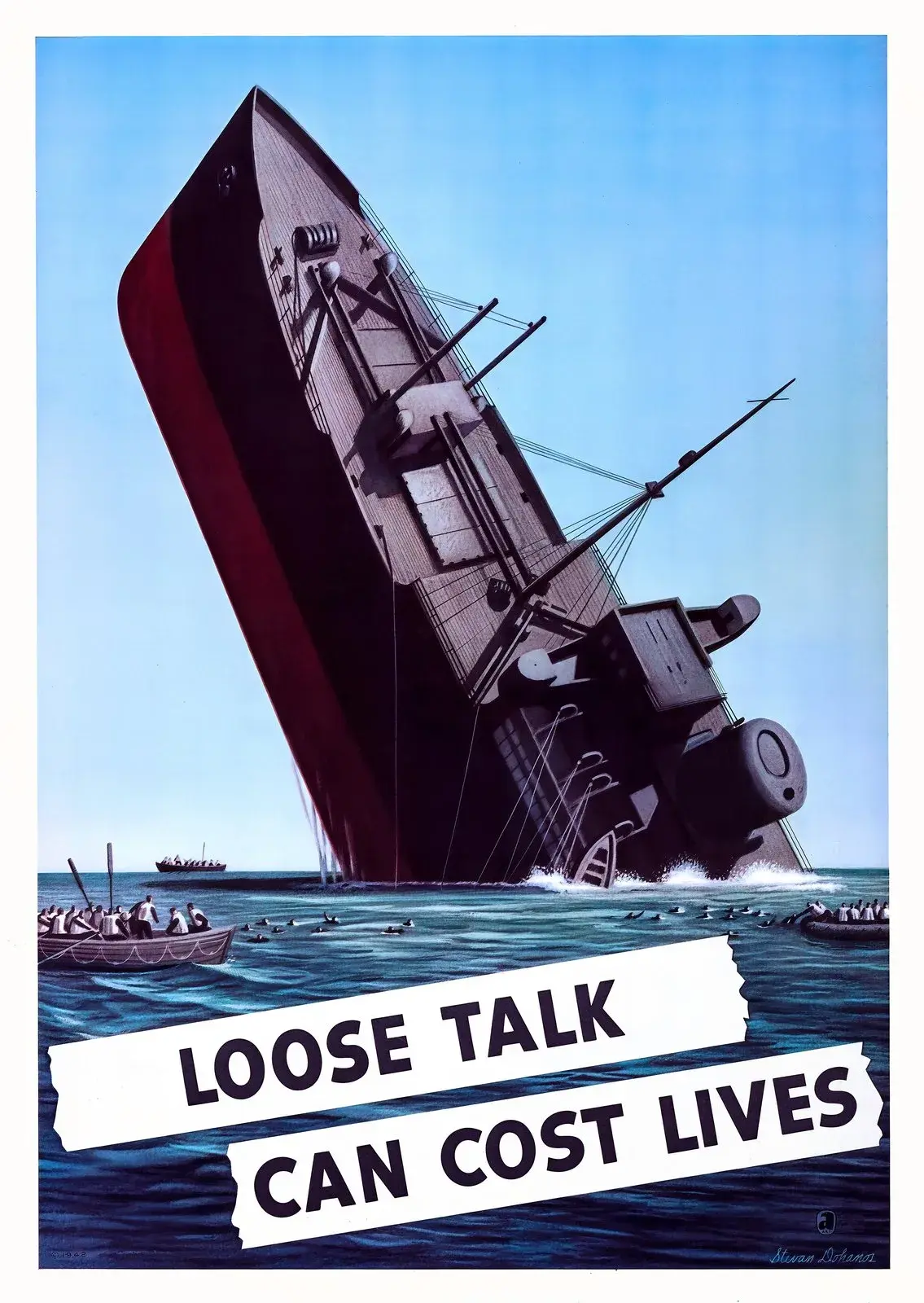
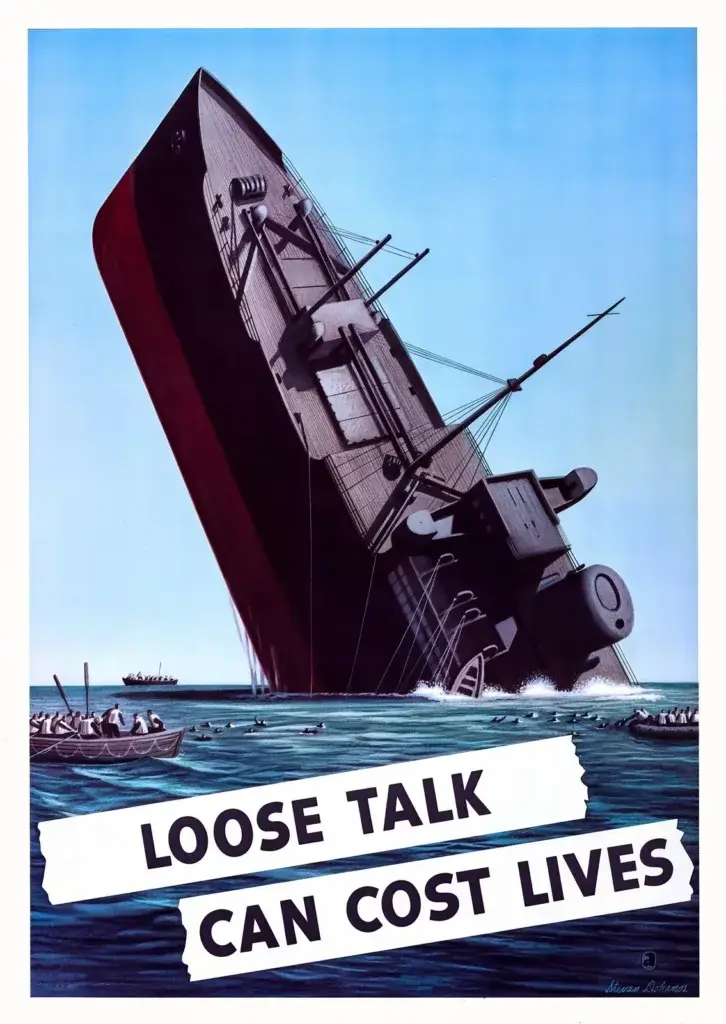
A freighter stands on end, its bow pointing at the sky, as it slides beneath a calm sea. Around it, sailors swim for the lifeboats. Across the water, two strips of paper spell out the cause: Loose Talk Can Cost Lives. Stevan Dohanos painted this warning in 1942, the year German U-boats turned the waters off the American coast into a killing ground for merchant shipping.
What the poster shows
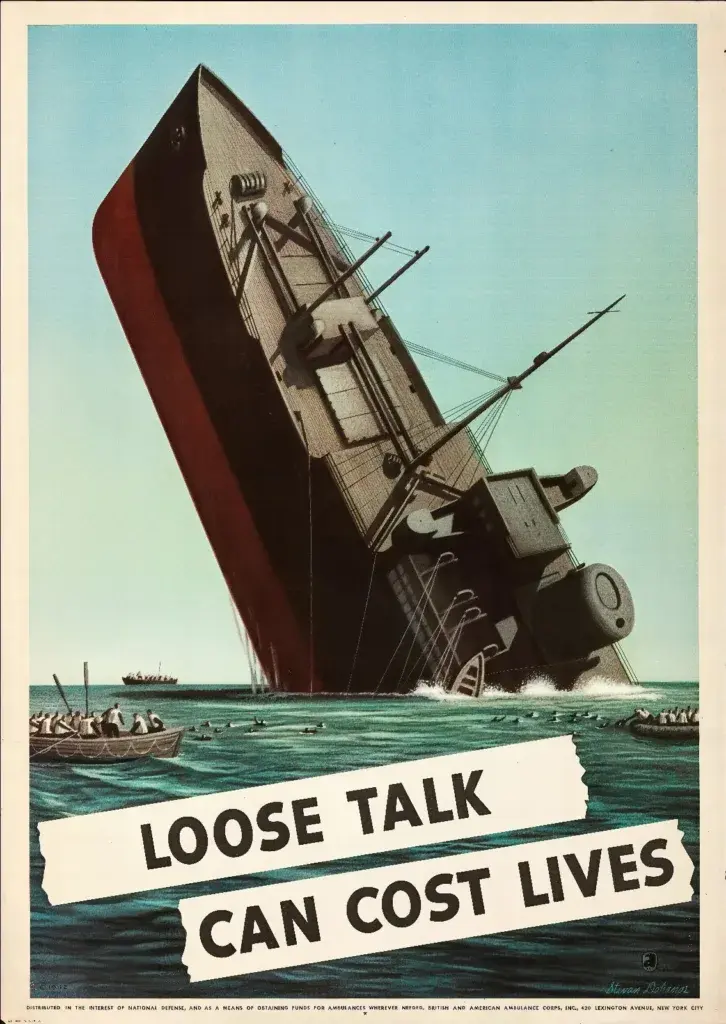
Dohanos gives the sinking ship almost all of the sheet. Its hull, painted red below the waterline, rises at a steep diagonal, with the deck gear, rigging and funnel pitched toward the waves. There is no enemy in sight and no explosion, only the aftermath: a lifeboat crowded with survivors, a second boat further off, and a line of heads in the water. The slogan is lettered on what look like torn paper labels, as if pasted over the scene, tying an ordinary conversation at home to the disaster at sea.
The careless-talk campaign
Once the United States entered the war, a sailing date, a cargo or a destination overheard in a bar or written in a letter could, in theory, reach enemy agents. Posters warning against loose talk became one of the most common themes of the American home front. This design belongs to a 1942 series distributed by the British and American Ambulance Corps, a New York wartime charity, and printed, as the imprint on the original says, “in the interest of national defense, and as a means of obtaining funds for ambulances wherever needed.” The Victoria and Albert Museum holds ten posters from the series, by artists including John Falter, William Steig, Otto Soglow, Adolph Treidler and R. John Holmgren.
Stevan Dohanos
Stevan Dohanos (1907 to 1994) was born in Lorain, Ohio, and studied at the Cleveland School of Art. He painted federal post office murals in the 1930s and went on to create more than 125 covers for The Saturday Evening Post, specialising in carefully observed scenes of everyday American life. Later he chaired the Citizens’ Stamp Advisory Committee, helping choose the artwork for more than 300 U.S. postage stamps. His calm, exact realism is what gives this poster its force: the sinking ship is painted as plainly as one of his small-town street scenes.
The restored edition
Our edition was restored from a scan of an original 1942 lithograph. Fading, stains and paper wear were removed and the sky and sea brought back to clear blues, while the fine detail of the hull, rigging and waves was kept. The small distribution imprint printed in the lower margin of the original is not part of the restored image. Drag the before and after slider on the product page to compare.
The restored poster is available as a paper print in three sizes or framed in black, white or natural wood, printed to order in the USA.
Frequently asked questions
Who made the Loose Talk Can Cost Lives poster?
It was painted by American illustrator Stevan Dohanos (1907 to 1994) in 1942, and distributed by the British and American Ambulance Corps.
What does the poster show?
A torpedoed merchant ship sinking bow-first into a calm sea, with its crew swimming for lifeboats. Two torn strips of paper across the water carry the warning Loose Talk Can Cost Lives.
What was the British and American Ambulance Corps?
A New York-based wartime charity. It issued a series of careless-talk posters by leading American illustrators in 1942, both in the interest of national defense and to raise funds for ambulances.
Why were careless-talk posters so common in WWII?
Details such as a ship’s sailing date, cargo or destination could reach enemy agents. With U-boats sinking merchant ships off the American coast in 1942, the government and private groups urged the public not to repeat what they heard.
How big is the restored print?
Original copies measure about 20 x 14 inches. Our restored edition is available as a paper print up to 23.4 x 33.1 inches, or framed up to 23 x 33 inches, printed to order in the USA.