An alliance expressed without a battle scene
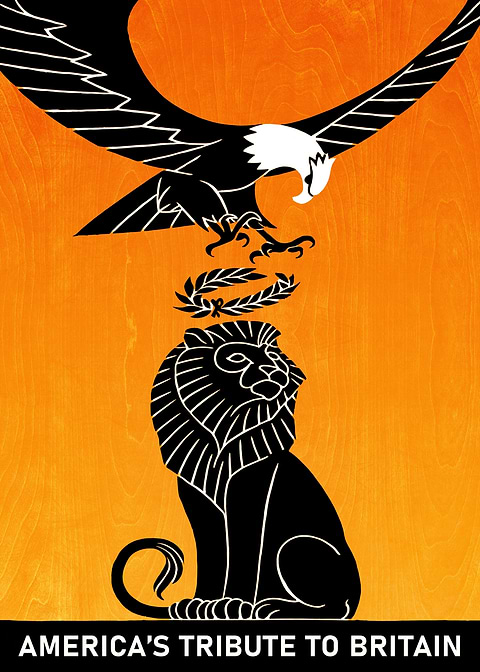
The Museum of Modern Art lists America’s Tribute to Britain as a 1918 work by Frederick George Cooper. The New York State Library describes its central action: a bald eagle lowering a laurel wreath toward a lion. Its record also identifies the Marchbanks Press in New York.
The two animals stand in for the countries named in the title. The wreath supplies the gesture of recognition. No portrait or detailed explanation is needed for the design to communicate a relationship between allies.
Reading the graphic language
The dark animals against the orange field give the poster an unusually strong silhouette. The eagle’s spread wings occupy the upper space; the lion provides a stable base below. Their meeting point is the wreath, where the composition’s movement and meaning come together.
This is a useful companion to La Fayette Year. Both celebrate international connections, but one uses national emblems and the other a historical individual. Their different dates also show why “Allied poster” should not be treated as one single wartime style or campaign.
Sources and further reading
- Museum of Modern Art: Frederick George Cooper
- New York State Library: England general posters, ENG GEN 08