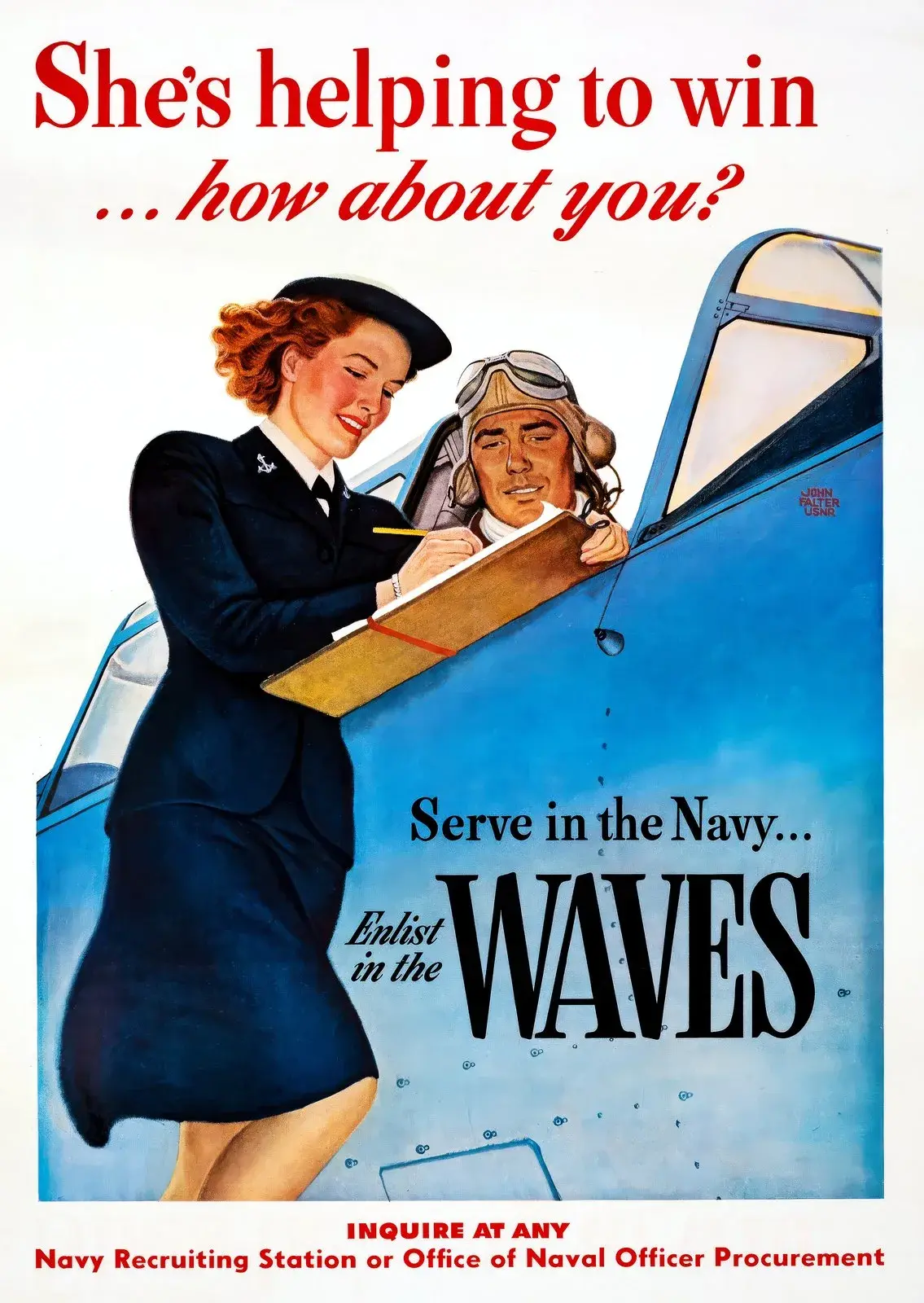
“She’s helping to win … how about you?” John Falter’s 1943 recruiting poster puts a woman at work in the middle of naval aviation and then turns the question on the viewer. Naval History and Heritage Command dates it to 1943.
What the poster shows
A WAVE in a dark navy uniform and cap stands on the wing of a blue Navy aircraft, holding a clipboard with a chart and pointing something out to the pilot, who leans out of the open cockpit in his flying helmet. The red script headline sits in the white sky above, and the lower right reads “Serve in the Navy … Enlist in the WAVES”, with directions to inquire at any Navy Recruiting Station or Office of Naval Officer Procurement.
Who were the WAVES?
WAVES stood for Women Accepted for Volunteer Emergency Service, the women’s branch of the U.S. Naval Reserve. President Franklin D. Roosevelt signed the law creating it on July 30, 1942, and Wellesley College president Mildred McAfee became its first director. Officers trained at Smith College and most enlisted women at Hunter College in New York. By July 1945 the WAVES had reached a peak of more than 86,000 women, serving at about 900 shore stations in jobs from clerical and communications work to parachute rigging, aviation instruction and computing.
Competence as the message
The woman in the poster is shown doing a real job, not simply posing. Her chart, her pointing hand and the pilot’s attention make skill and responsibility the heart of the recruiting argument. The aircraft ties her work directly to the war in the air, while the simple exchange between two people keeps the message easy to read at a glance.
John Falter
John Falter (1910 to 1982) was a Nebraska-born illustrator who served in the Navy during the war, signing his posters “John Falter USNR”. He produced many of the Navy’s best-known recruiting posters and later painted more than 100 covers for The Saturday Evening Post.
The restored edition
Our edition was prepared from a restored image of an original 1943 poster and rebuilt as a high-resolution 300 dpi print file, keeping the navy blues, the red headline and Falter’s painted figures sharp at every size.
The restored poster is available as a paper print in three sizes or framed in black, white or natural wood, printed to order in the USA.
Prefer metal? View the Displate edition ↗
Frequently asked questions
Who designed the She’s Helping to Win WAVES poster?
It was painted by John Falter, who served in the Navy and signed his wartime posters "John Falter USNR". Naval History and Heritage Command dates it to 1943.
What did WAVES stand for?
Women Accepted for Volunteer Emergency Service, the women’s branch of the U.S. Naval Reserve created on July 30, 1942.
How many women served in the WAVES?
At its peak in July 1945 the WAVES had more than 86,000 members, serving at about 900 shore stations across the United States and in Hawaii.
What sizes is the print available in?
Paper prints are available at 11.7 x 16.5, 20 x 28 and 23.4 x 33.1 inches, and framed prints at 12 x 17, 20 x 28 and 23 x 33 inches.