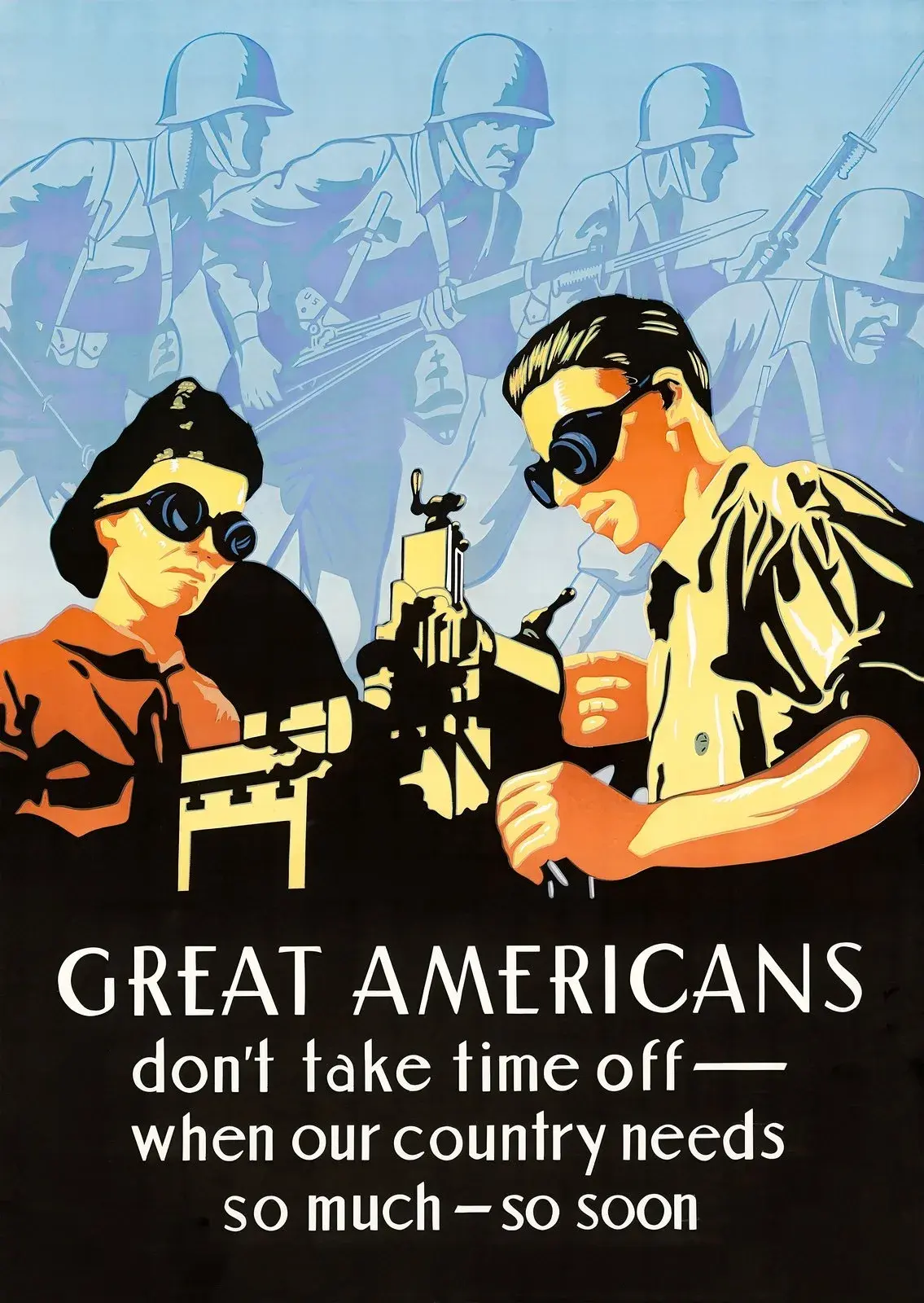
“Great Americans don’t take time off, when our country needs so much, so soon.” Published in 1943, at the height of American war production, this poster carried one of the home front’s least glamorous but most urgent messages: turn up for every shift. It was issued by the Think American Institute of Rochester, New York, and printed by Kelly-Read & Co. as No. 182 in the Institute’s numbered series.
What the poster shows
In the foreground a man and a woman in dark welding goggles bend over a machine, their faces lit in warm cream and orange against a black shop floor. Above and behind them, in pale blue, a column of helmeted soldiers advances with rifles and fixed bayonets. The two scenes are joined in one picture: the work at the bench and the fight at the front are the same effort.
The headline GREAT AMERICANS sits in clean capitals on the black base, with the rest of the message set below in lighter type. There is no flag, no eagle and no villain. The appeal is to pride, and to the idea that every hour on the line matters to the men overseas.
The problem of absenteeism
By 1943 war plants were running around the clock, and unscheduled absence had become a national concern. A War Production Board handbook printed that year, Ways of Dealing with Absenteeism as Part of the War Production Drive, reported absence rates from about 1.5 percent to 15 percent or more, highest on Mondays, Saturdays and the day after payday. It blamed long hours, crowded housing, poor transport, shopping and childcare, as well as simple fatigue, and urged labor-management committees, car pools, better services for working mothers and recognition for good attendance.
Posters were part of that effort. Government agencies, unions and companies all produced attendance posters, and many, like this one, connected a missed shift directly to the soldier waiting for ammunition. The goggled woman at the machine is also a reminder of how many of those shifts were now worked by women.
The Think American Institute
The Think American Institute was founded by industrialists in Rochester, New York, to put patriotic posters on factory and office walls. Its posters were printed by Kelly-Read & Co. of Rochester and numbered in sequence, and the series ran from 1939 into the early 1960s. Chester Raymond Miller served as its art director and was its most prolific designer. During the war the Institute’s posters promoted production, thrift and free enterprise; after the war the same series turned against communism. This design is unsigned, so its individual artist has not been confirmed.
The restored edition
Our edition was restored from an archival image of an original 1943 poster and rebuilt as a high-resolution 300 dpi print file. Creases, scuffs and paper wear were removed and the sky blue, orange and cream tones brought back, with the lettering kept crisp at every size.
The restored poster is available as a paper print in three sizes or framed in black, white or natural wood, printed to order in the USA.
Frequently asked questions
Who made the Great Americans Don't Take Time Off poster?
The poster was published in 1943 by the Think American Institute, a patriotic poster program backed by Rochester, New York industrialists, and printed by Kelly-Read & Co. of Rochester. It carries the number 182 in the Institute's series. The design is unsigned.
What does Great Americans don't take time off mean?
The poster asked war workers not to miss shifts. In 1943 unscheduled absence from war plants was a serious problem, and the poster links a day off at the factory to the soldiers at the front who were waiting for weapons and supplies.
Why was absenteeism a problem in World War II?
Absence rates in war plants could run from about 1.5 percent to 15 percent or more, according to a 1943 War Production Board handbook. Long hours, crowded housing, poor transport and childcare all played a part, and every missed shift slowed the output of ships, aircraft and munitions.
What was the Think American Institute?
The Think American Institute was an organization set up by Rochester industrialists that produced numbered patriotic posters for workplaces. Its series ran from 1939 into the early 1960s, with hundreds of wartime designs promoting production, free enterprise and the war effort.
How big was the original poster?
Original copies measure about 20 x 27 inches. Our restored edition is available as a paper print up to 23.4 x 33.1 inches and as a framed print up to 23 x 33 inches.
Historical sources
- United States Holocaust Memorial Museum: Think American Institute poster record
- War Production Board: Ways of Dealing with Absenteeism as Part of the War Production Drive (1943)
- Wikimedia Commons: World War II absenteeism posters from the United States
- Heritage Auctions: Think American Institute poster No. 206 (1943)