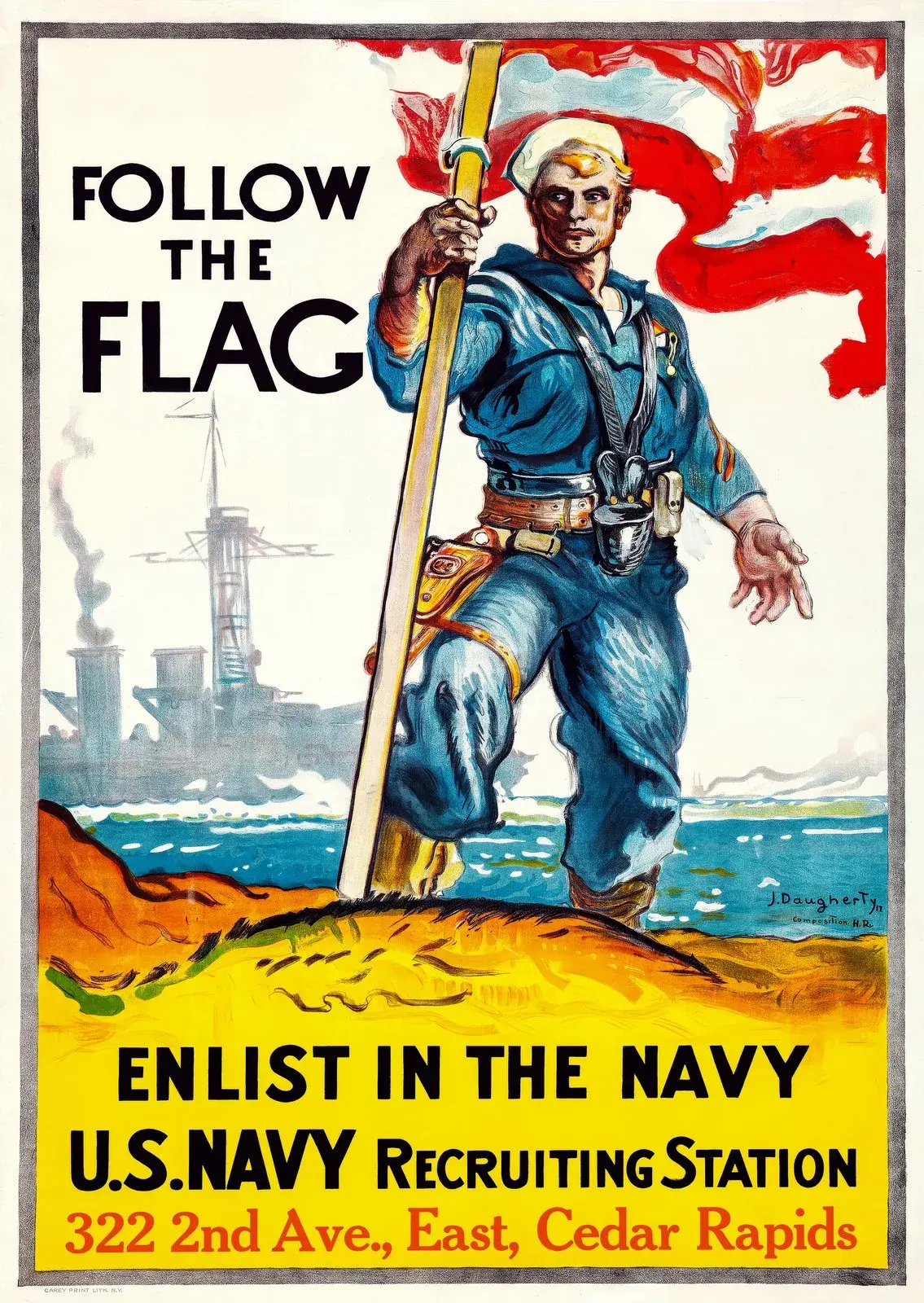
A young sailor climbs up from the beach in blue dungarees, cartridge belt and white cap, a tall staff over his shoulder and the flag cracking in the wind above him. His free hand reaches back toward the viewer, as if waving the next man forward. Behind him a grey battleship steams across a bright blue sea. Below, in heavy black capitals on yellow: Enlist in the Navy. James Daugherty painted it in 1917, the year America went to war.
What the poster shows
Daugherty was a modernist, and it shows in the drawing: the sailor is built from bold, rhythmic strokes, the flag is a swirl of red and white rather than a neat banner, and the beach is a band of hot orange and yellow. It is less a portrait of one man than a picture of movement, the whole figure leaning forward out of the frame. The battleship behind is drawn in cool greys, a reminder of the fleet he is heading to join.
The words do the rest. “Follow the flag” is both an order and an invitation: the sailor has already gone ahead, and the viewer is asked to follow him.
A poster for every recruiting station
When the United States declared war in April 1917, the Navy needed to expand fast, and it recruited through local stations in towns and cities across the country. Posters like this were printed with the bottom left open for a local address. This copy was overprinted for the U.S. Navy Recruiting Station at 322 2nd Avenue East in Cedar Rapids, Iowa, a long way from any ocean. The Library of Congress holds one addressed to 146 Tremont Street in Boston, and the University of Missouri one for two stations in St. Louis.
The poster was printed by the Carey Print Lithograph Company of New York, whose name appears in small type in the lower left margin. Beneath Daugherty’s signature is a second small credit, “composition H.R.”, most likely for the person who arranged the lettering and layout.
James Daugherty
James Henry Daugherty was born in Asheville, North Carolina, in 1889 and grew up in Washington, D.C., where he studied at the Corcoran School of Art before training in London under the muralist Frank Brangwyn. Back in New York he became one of the early American modernists, painting bold, colourful abstractions. In the First World War he made posters for government agencies, including the United States Shipping Board.
He went on to paint large public murals, among them four for Cleveland’s State Theatre, and to write and illustrate children’s books about American history. His Daniel Boone won the Newbery Medal, and Gillespie and the Guards received a Caldecott Honor in 1957. He died in 1974.
The restored edition
Our edition was restored from an original 1917 print: the paper and colours cleaned, and creases, stains and wear removed, with the lettering, the Cedar Rapids address and Daugherty’s signature kept. We don’t have a usable scan of this print before restoration, so there is no before and after comparison.
The restored poster is available as a paper print in three sizes or framed in black, white or natural wood, printed to order in the USA.
Frequently asked questions
Who painted Follow the Flag?
James Daugherty (1889 to 1974), an American modernist painter and muralist who made posters for the U.S. government in the First World War. His signature is at the lower right of the picture. He later became a celebrated children’s author and illustrator.
When was the poster made?
In 1917, the year the United States entered the First World War. It was printed by the Carey Print Lithograph Company of New York.
Why does it name a recruiting station in Cedar Rapids?
The poster was printed with space at the foot for a local address, so the same design could serve recruiting stations across the country. This copy names the U.S. Navy Recruiting Station at 322 2nd Avenue East, Cedar Rapids, Iowa. Other surviving copies name stations in Boston and St. Louis.
What does “composition H.R.” mean?
Beneath Daugherty’s signature is a small credit, “composition H.R.”, which appears on library records of the poster too. It most likely credits the person who laid out the lettering and design around the painting; the initials have not been identified.
What else is James Daugherty known for?
He painted large murals, including four for Cleveland’s State Theatre, and wrote and illustrated many children’s books. His Daniel Boone won the Newbery Medal, and Gillespie and the Guards, which he illustrated, received a Caldecott Honor in 1957.
How big is the restored print?
Our restored edition is available as a paper print up to 23.4 x 33.1 inches, or framed up to 23 x 33 inches, printed to order in the USA.
Historical sources
- Library of Congress: Follow the flag, enlist in the Navy, U.S. Navy recruiting station, 146 Tremont St., Boston
- Imperial War Museums: Follow the Flag, Enlist in the Navy (Art.IWM PST 17194)
- Missouri Over There: Follow the Flag, Enlist in the Navy, 1917 (St. Louis copy)
- James Daugherty biography
- Naval History and Heritage Command: Follow the Flag
- USS LST Ship Memorial: later reprint
- Metal poster edition of this design on Displate ↗