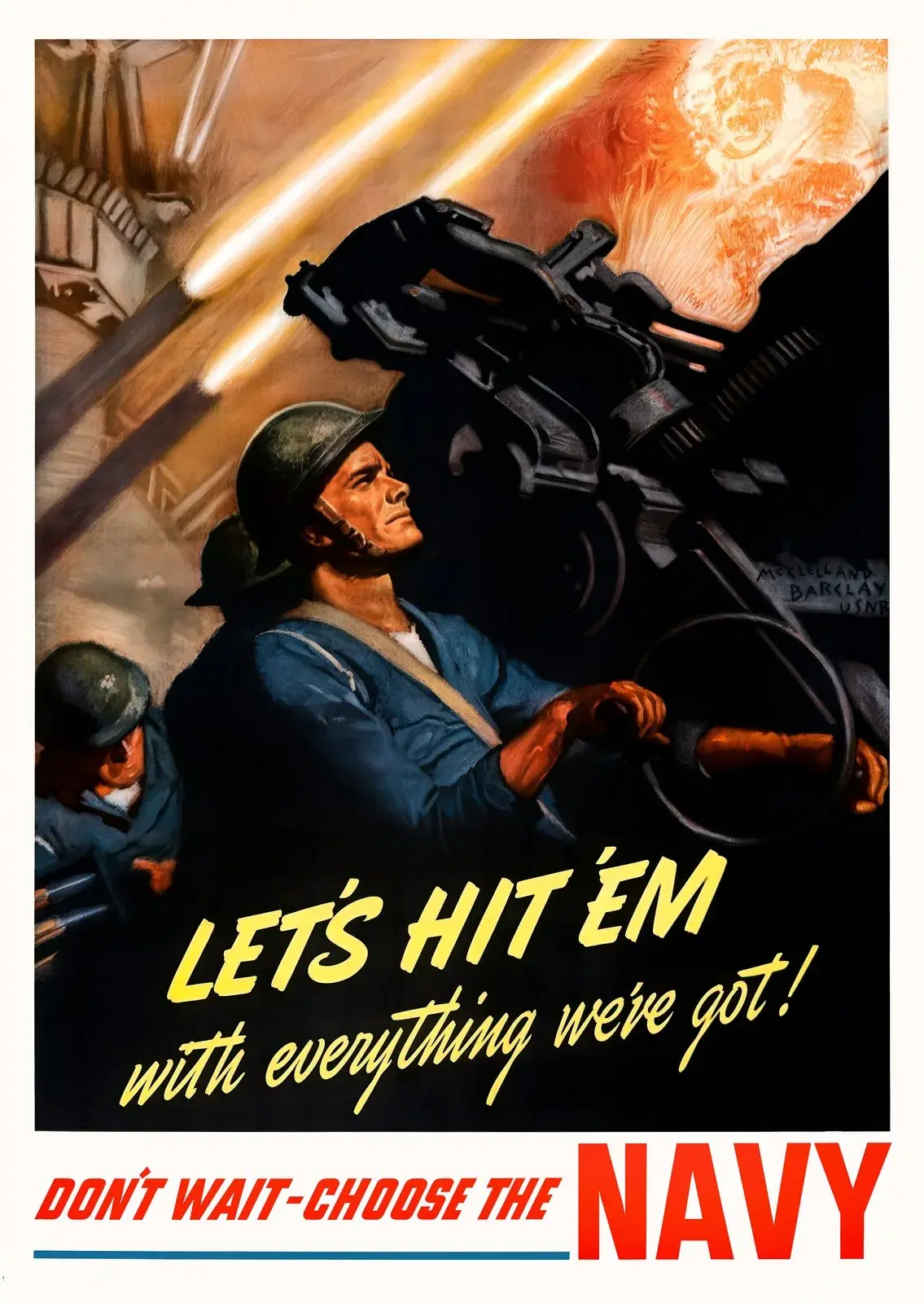
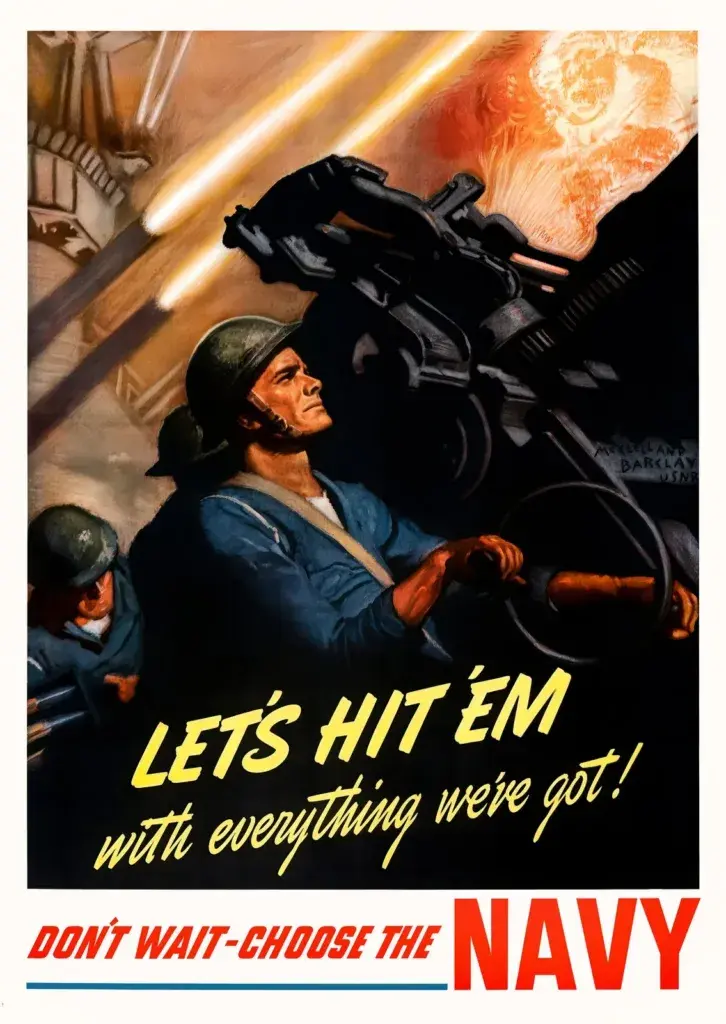
A sailor in a steel helmet leans into the handwheel of an anti-aircraft gun, jaw set, eyes on the sky. Shells streak upward past him in bright yellow lines; a burst of fire blooms in the corner of the picture; behind him another man hauls up ammunition. Across the bottom, in red and blue: Don’t wait, choose the Navy. McClelland Barclay painted the poster in 1942, in the year America went to war, and signed it as a serving naval officer.
What the poster shows
Barclay builds the picture on a diagonal. The gun barrels, the tracer streaks and the gunner’s gaze all point up and to the right, so the whole poster seems to be firing. The sailor is lit warm against the black steel of the mount, his blue dungarees and the canvas strap across his chest picked out like a magazine illustration, which is exactly what Barclay’s training made them.
The words are split in two voices. “Let’s hit ’em with everything we’ve got!” is painted in loose yellow script inside the scene, as if shouted over the guns. The recruiting message sits apart on the white margin in hard poster capitals, with NAVY set largest of all.
Why anti-aircraft guns
Pearl Harbor and the sinking of the British warships Prince of Wales and Repulse in December 1941 showed that aircraft could destroy battleships. Through 1942 the U.S. Navy crowded its ships with anti-aircraft guns and needed tens of thousands of men to crew them. A gunner hitting back at attacking planes was the perfect image for a recruiting poster that year: active, defiant, and true to the job many recruits would actually do.
“Don’t wait”
The tag line carried a real deadline. In 1942 a young man could still volunteer and choose his service, but the draft was taking more men every month. In December 1942 voluntary enlistment was closed to men of draft age, and from then on most new sailors came through Selective Service. Barclay’s posters of that year, this one and Dish it Out With the Navy with its “Choose now while you can”, both press the same point: pick the Navy before the choice is made for you.
McClelland Barclay, USNR
McClelland Barclay was born in St. Louis in 1891 and trained at the Art Institute of Chicago and the Art Students League in New York. By the 1930s he was one of the country’s best-known illustrators, above all for the elegant “Fisher Body Girl” he painted for General Motors. He joined the Naval Reserve in 1938 and was called to active duty in October 1940, first at the Navy’s recruiting office in New York, where he produced a run of recruiting posters including this one.
Barclay then went to sea as a combat artist and rose to lieutenant commander. On 18 July 1943 he was aboard the tank landing ship LST-342 in the Solomon Islands, sketching and photographing, when the ship was torpedoed by a Japanese submarine. His body was never recovered. He was awarded the Purple Heart and later elected to the Society of Illustrators Hall of Fame.
The restored edition
Our edition was restored from a scan of an original 1942 print. The yellowed paper was cleaned back to white and the colour of the painting brought back, with creases, stains and wear removed. The lettering and Barclay’s signature are kept from the original. Compare the two below, or drag the before and after slider on the product page.
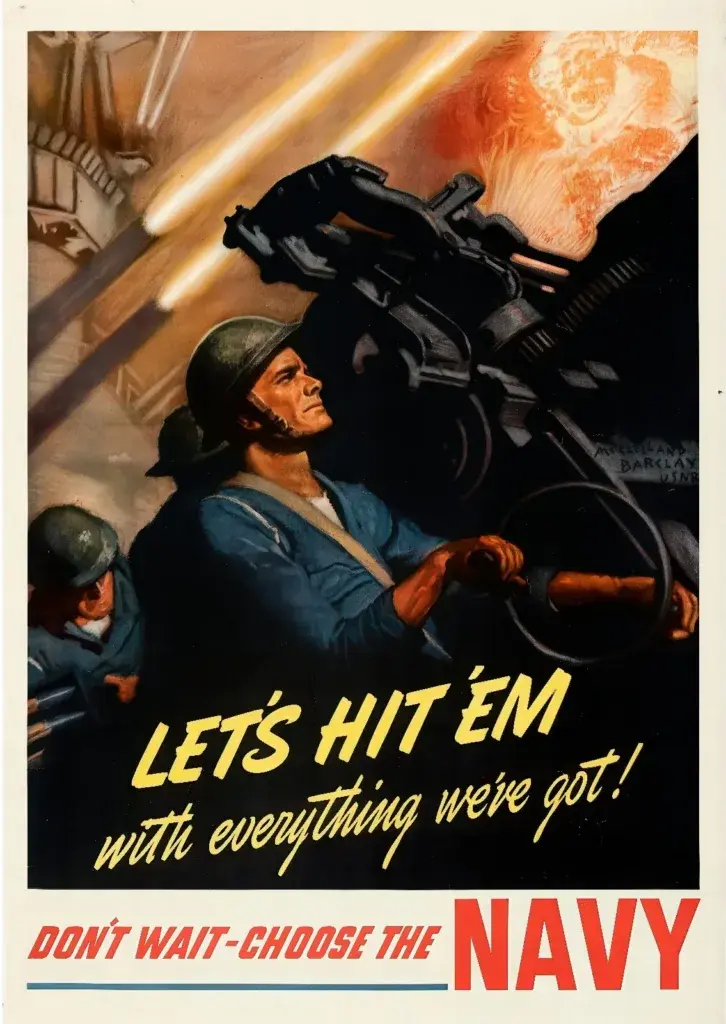
The restored poster is available as a paper print in three sizes or framed in black, white or natural wood, printed to order in the USA.
Frequently asked questions
Who painted Let’s Hit ’Em With Everything We’ve Got?
McClelland Barclay (1891 to 1943), the illustrator famous for the Fisher Body Girl advertisements. He was an officer in the U.S. Naval Reserve and signed the painting “McClelland Barclay USNR”.
When was the poster made?
In 1942, during the first year of America’s war. It was one of a series of action recruiting posters Barclay painted for the Navy that year, alongside Dish it Out With the Navy.
What does “Don’t wait, choose the Navy” mean?
It urged young men to volunteer before the draft decided for them. A volunteer could still choose his branch of service in 1942. In December 1942 voluntary enlistment was ended for men of draft age, and from then on most recruits came through Selective Service.
What kind of gun is shown?
A shipboard anti-aircraft gun, trained upward by the gunner on the handwheel while shells streak into the sky. Air attack was the great new danger to warships after Pearl Harbor, and anti-aircraft crews became a symbol of the Navy fighting back.
How big were the original posters?
Large. Surviving copies in libraries and archives measure roughly 26 by 37 inches up to 28 by 42 inches, depending on the printing and how much of the margin survives.
How big is the restored print?
Our restored edition is available as a paper print up to 23.4 x 33.1 inches, or framed up to 23 x 33 inches, printed to order in the USA.