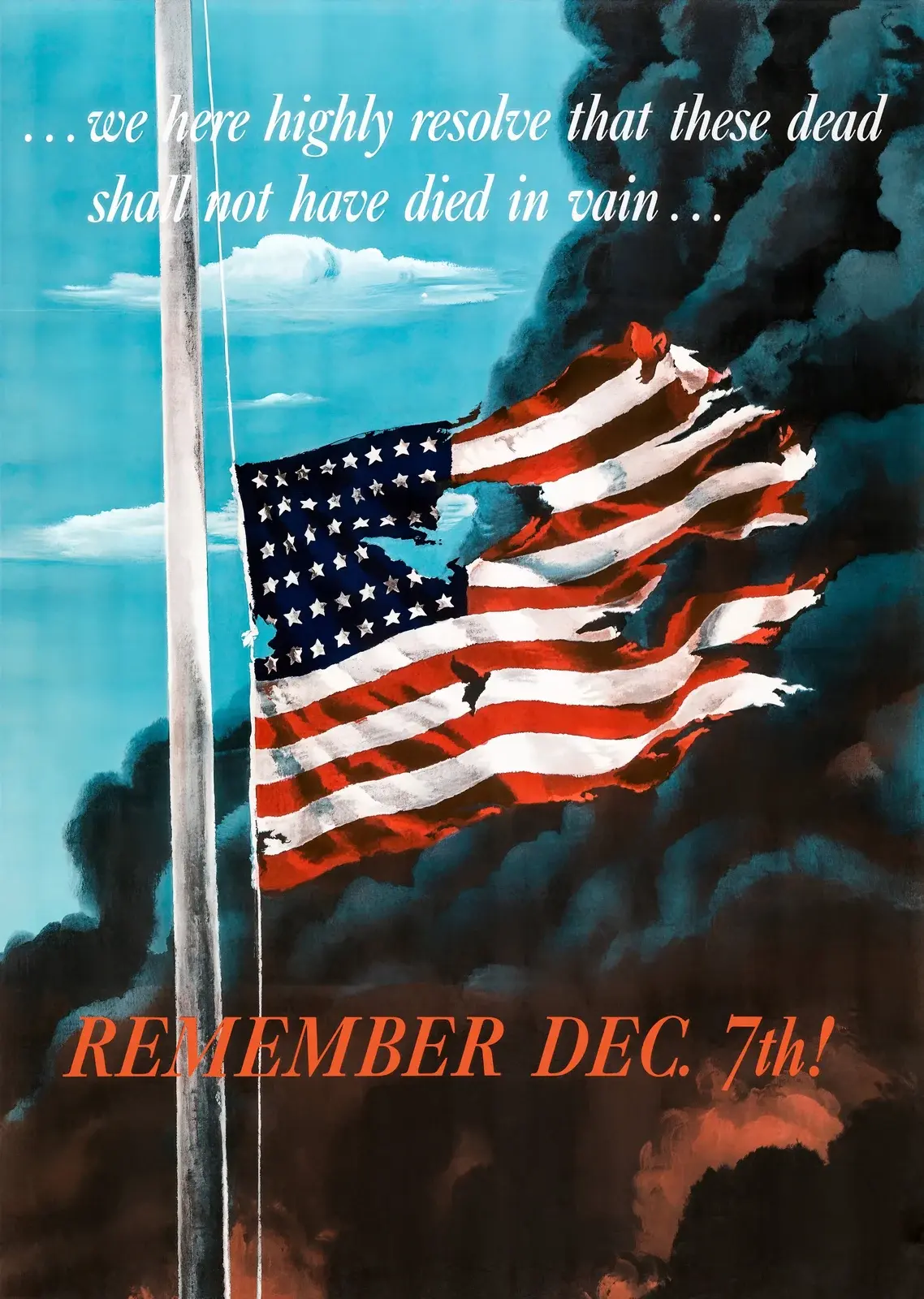
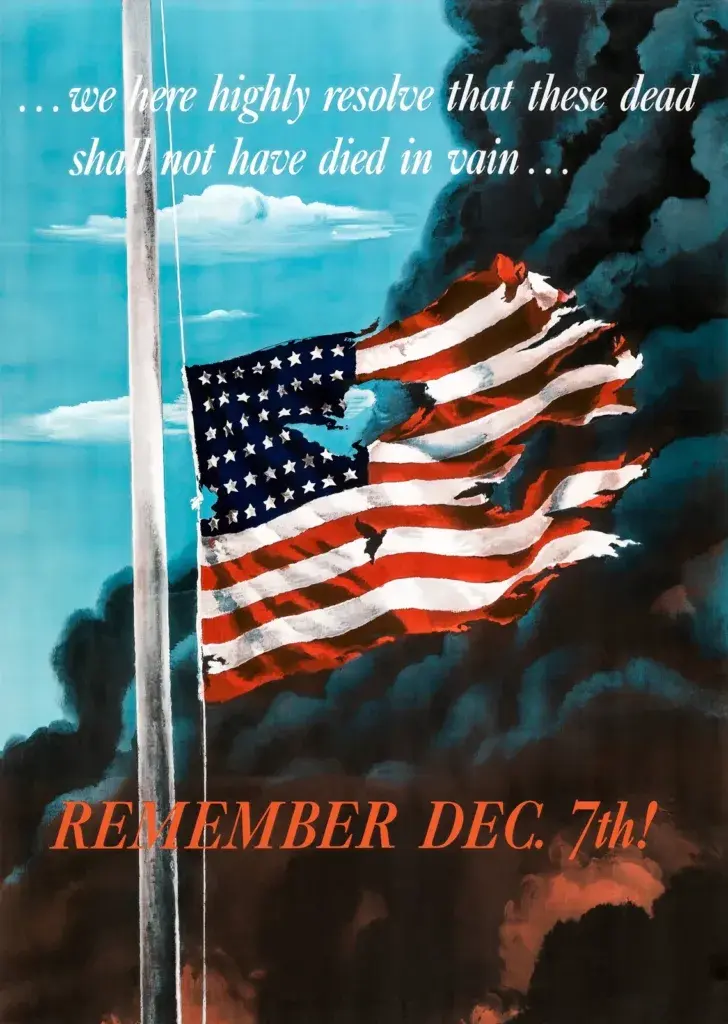
There is almost nothing in this picture. A tall white flagpole, a halyard, a patch of clean blue sky with two small clouds, and a wall of black smoke rolling in from the right. Halfway down the pole a 48-star flag streams out in the wind, scorched, holed and ripped into ribbons at the fly end. Across the sky, in white italic, runs a line every American schoolchild of 1942 would have known: …we here highly resolve that these dead shall not have died in vain… And at the foot, in red: Remember Dec. 7th!
The morning it remembers
Just before eight o’clock on Sunday 7 December 1941, the first wave of Japanese carrier aircraft reached Oahu. In under two hours they sank or damaged nearly twenty ships of the Pacific Fleet, destroyed 188 aircraft and killed 2,403 service members and civilians, with another 1,178 wounded. The battleship Arizona exploded and sank with more than eleven hundred of her crew. The next day President Roosevelt called it “a date which will live in infamy,” and Congress declared war on Japan.
“Remember Pearl Harbor” became the country’s first slogan of the war almost overnight. It was sung, printed on matchbooks and lapel pins, and painted on the sides of aircraft. This poster is the government’s own version of it, and the most restrained.
Lincoln’s words at Pearl Harbor
The quotation is from the Gettysburg Address, given on 19 November 1863 at the dedication of the soldiers’ cemetery on the battlefield. Lincoln’s full sentence asks the living to take up “the unfinished work” of the men buried there, “that we here highly resolve that these dead shall not have died in vain.” By setting those words over the Pearl Harbor smoke, the poster ties the dead of 1941 to the dead of the Civil War and turns remembrance into a promise: the war would be fought until it was won. It is mourning and recruiting in one sentence.
The flag at half-mast
The flag is the whole design. Lowered to half-mast, it is in mourning; torn and blackened, it has been through the attack itself; still flying, it has not been struck. Saalburg painted no ships, aircraft or sailors, and no enemy. The smoke stands for the burning fleet, and the empty blue sky on the left for the peace that was broken that morning. Since 1994 the law has marked 7 December as National Pearl Harbor Remembrance Day, and each year the President asks Americans to fly the flag at half-staff, much as it flies in this painting.
Allen Saalburg
Allen Russell Saalburg was born in 1899 and died in 1987. He was a New York painter, muralist and decorative artist who had painted murals for the Works Progress Administration in New York City during the Depression, and whose work is held by the Whitney Museum of American Art. His poster style here is a painter’s rather than an advertiser’s: loose, soft brushwork in the smoke and flag, and very little text.
The poster
Remember Dec. 7th! was issued in 1942 by the Office of War Information, the agency President Roosevelt created in June 1942 to run the government’s wartime publicity, and printed by the U.S. Government Printing Office. It carries the number OWI Poster No. 14, which places it among the very first posters the new agency produced. It was printed in more than one size, from small sheets of about 14 by 20 inches to large 28 by 40 inch posters. Copies are held by the Library of Congress, the United States Holocaust Memorial Museum, the Franklin D. Roosevelt Presidential Library, Queens College in New York and the University of North Texas.
The restored edition
Our edition was restored from a photograph of an original 1942 print. The horizontal fold lines, creases, stains and wear were removed and the colour of the sky, smoke and flag brought back, while the lettering is kept from the original. You can compare the archival source with the restored edition in the before and after slider on the product page. It is available as a paper print in three sizes or framed in black, white or natural wood, printed to order in the USA.
Also available as a metal poster
The design is also in our Displate metal poster collection: Remember December 7th on Displate ↗ and the Tattered Flag edition ↗.
Frequently asked questions
Who designed the Remember Dec. 7th poster?
Allen Russell Saalburg (1899–1987), a New York painter and muralist who had worked on WPA murals before the war. It was issued by the Office of War Information in 1942 as OWI Poster No. 14.
Where does the quotation come from?
From Abraham Lincoln’s Gettysburg Address of 19 November 1863: “that we here highly resolve that these dead shall not have died in vain.” The poster applies Lincoln’s promise to the Americans killed at Pearl Harbor.
Why is the flag at half-mast?
A flag at half-mast is the American sign of mourning. The torn, smoke-blackened flag stands for the 2,403 service members and civilians killed in the attack on 7 December 1941.
How big was the original?
The Government Printing Office printed it in more than one size. Surviving copies range from about 14 × 20 inches to large 28 × 40 inch sheets.
What sizes are the prints?
Paper prints are 11.7 × 16.5, 20 × 28 or 23.4 × 33.1 inches; framed prints are 12 × 17, 20 × 28 or 23 × 33 inches, in black, white or natural wood.
Historical sources
- Library of Congress: Remember Dec. 7th! (OWI Poster no. 14), Allen Saalburg, 1942
- United States Holocaust Memorial Museum collection: Remember Dec. 7th! poster (1988.42.19)
- Queens College Special Collections: Remember Dec. 7th! (OWI Poster No. 14)
- University of North Texas Libraries: Remember Dec. 7th
- National Park Service: National Pearl Harbor Remembrance Day