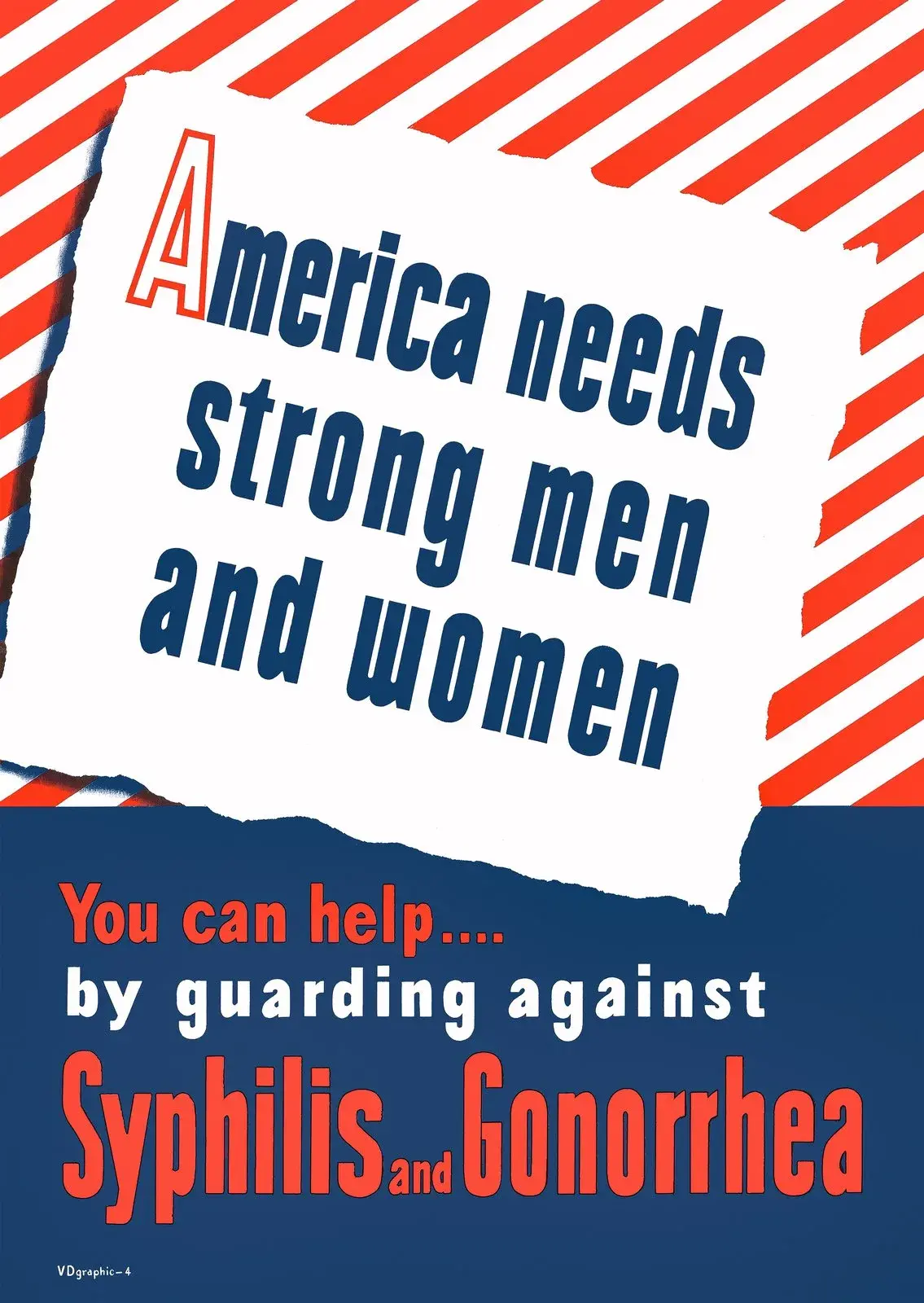
Red and white stripes run across the top of the sheet like a flag, and over them sits a torn white placard: America needs strong men and women. Below, on a band of navy blue, the poster makes its request. You can help…. by guarding against Syphilis and Gonorrhea. It is a home-front poster from the U.S. Public Health Service, and it treats a subject most Americans avoided in public as a plain matter of national strength.
What the poster shows
The design uses only three colours and no figures at all. The headline is hand-lettered in heavy navy capitals on the paper placard, with the first letter picked out in red and white. The placard’s ragged lower edge breaks into the blue band below, where the message changes from a statement to an instruction: first in red, then in white, and finally the two disease names in tall red letters. In the lower corner is the only credit, a small imprint reading VDgraphic-4.
What stands out is the audience. Many wartime venereal disease posters spoke only to servicemen, and many cast women as the danger. This one addresses men and women together, as citizens with a shared duty, and asks them to protect their own health for the country’s sake.
The Public Health Service and the fight against VD
Thomas Parran became Surgeon General in 1936 and made syphilis a national issue, insisting it be discussed openly as a disease rather than a moral failing. The National Venereal Disease Control Act of 1938 gave the states federal money for clinics, testing and education. The Public Health Service’s Division of Venereal Diseases produced leaflets, films and posters, and health departments across the country ordered them to display in clinics, factories and public places.
As the country rearmed, the campaign took on a military edge. In 1940 the Army, the Navy, the Public Health Service and state health departments agreed a joint plan to protect the armed forces and war industry from venereal disease, and the May Act of 1941 allowed federal authorities to act against prostitution near military bases. Venereal disease was now described as a threat to national defense: it kept draftees out of uniform, put servicemen in hospital and cost war plants working days.
Posters by number
The Public Health Service issued its VD posters as numbered series. The Monthly Catalog of U.S. Government Publications lists several of them, including a 1941 poster warning against quack cures, numbered VD 7, and a 1942 poster numbered VD 16. The VDgraphic-4 imprint on this poster marks it as an early entry in the Public Health Service’s VD graphic series. It is not dated, but its patriotic, defense-era message places it in the early war years, around 1941 to 1943.
From shame to treatment
The poster’s approach reflects the thinking of the time: tell people plainly, test widely and treat early. That became far more effective during the war itself. In 1943 Public Health Service doctors led by John Mahoney showed that penicillin could cure syphilis, and within a few years treatment that had taken months could be completed in days. Posters like this one helped bring people to the clinics that delivered it.
The restored edition
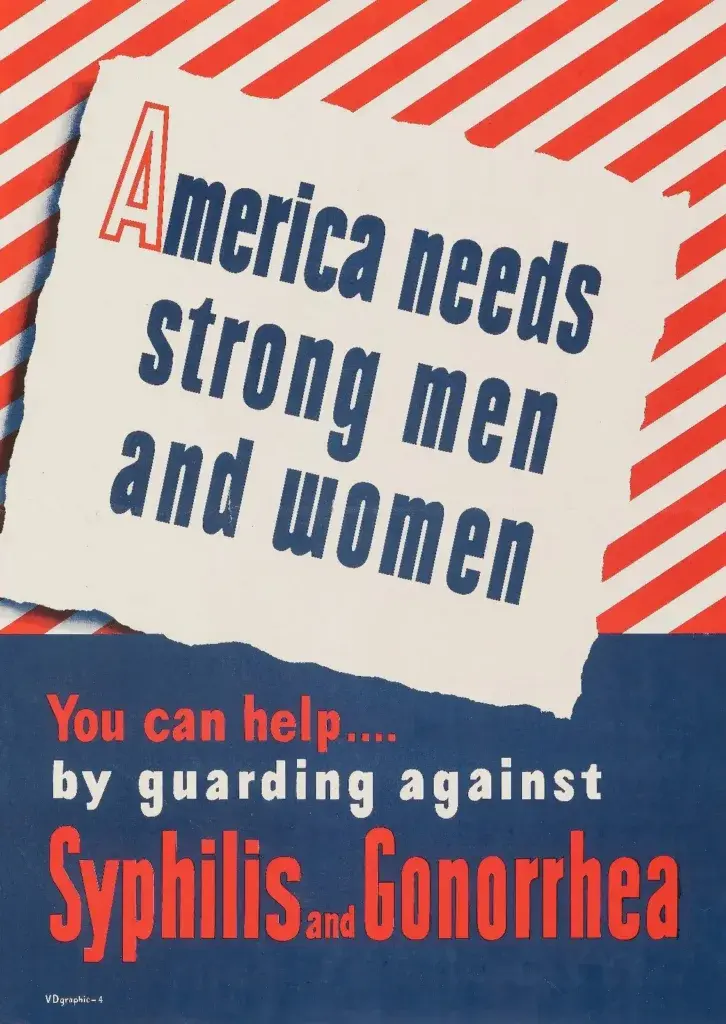
Our edition was restored from an archival scan of an original print. The yellowed paper was returned to clean white and the faded inks brought back to a strong stripe red and a deep navy, with stains and wear removed. The original lettering and the VDgraphic-4 imprint are kept. Drag the before and after slider on the product page to compare.
The restored poster is available as a paper print in three sizes or framed in black, white or natural wood, printed to order in the USA.
Frequently asked questions
Who made the America Needs Strong Men and Women poster?
It was issued by the U.S. Public Health Service as part of its wartime venereal disease control campaign. The artist is not named on the poster, which carries only the series imprint VDgraphic-4.
When was the poster made?
The poster is undated. Its style and message place it in the early years of the Second World War, around 1941 to 1943, when the Public Health Service was issuing numbered VD posters for war workers and the public.
What does VDgraphic-4 mean?
It is the series imprint printed in the lower corner. The Public Health Service issued its venereal disease posters as numbered series, and the imprint identifies this design as number 4 in its VD graphic series.
Why did America treat venereal disease as a wartime issue?
Syphilis and gonorrhea kept men out of the draft, put soldiers and sailors in hospital and cost war plants working days. Officials saw controlling them as part of national defense, and posters like this one carried that message to the home front.
How big is the restored print?
Our restored edition is available as a paper print up to 23.4 x 33.1 inches, or framed up to 23 x 33 inches, printed to order in the USA.
Historical sources
- National Library of Medicine: America needs strong men and women
- University of Minnesota Libraries: America needs strong men and women
- Monthly Catalog of U.S. Government Publications: Public Health Service VD poster, VD 7 (1941)
- Monthly Catalog of U.S. Government Publications: Public Health Service VD poster, VD 16 (1942)
- National Library of Medicine, Circulating Now: VD at the movies
- World War II U.S. military sex education