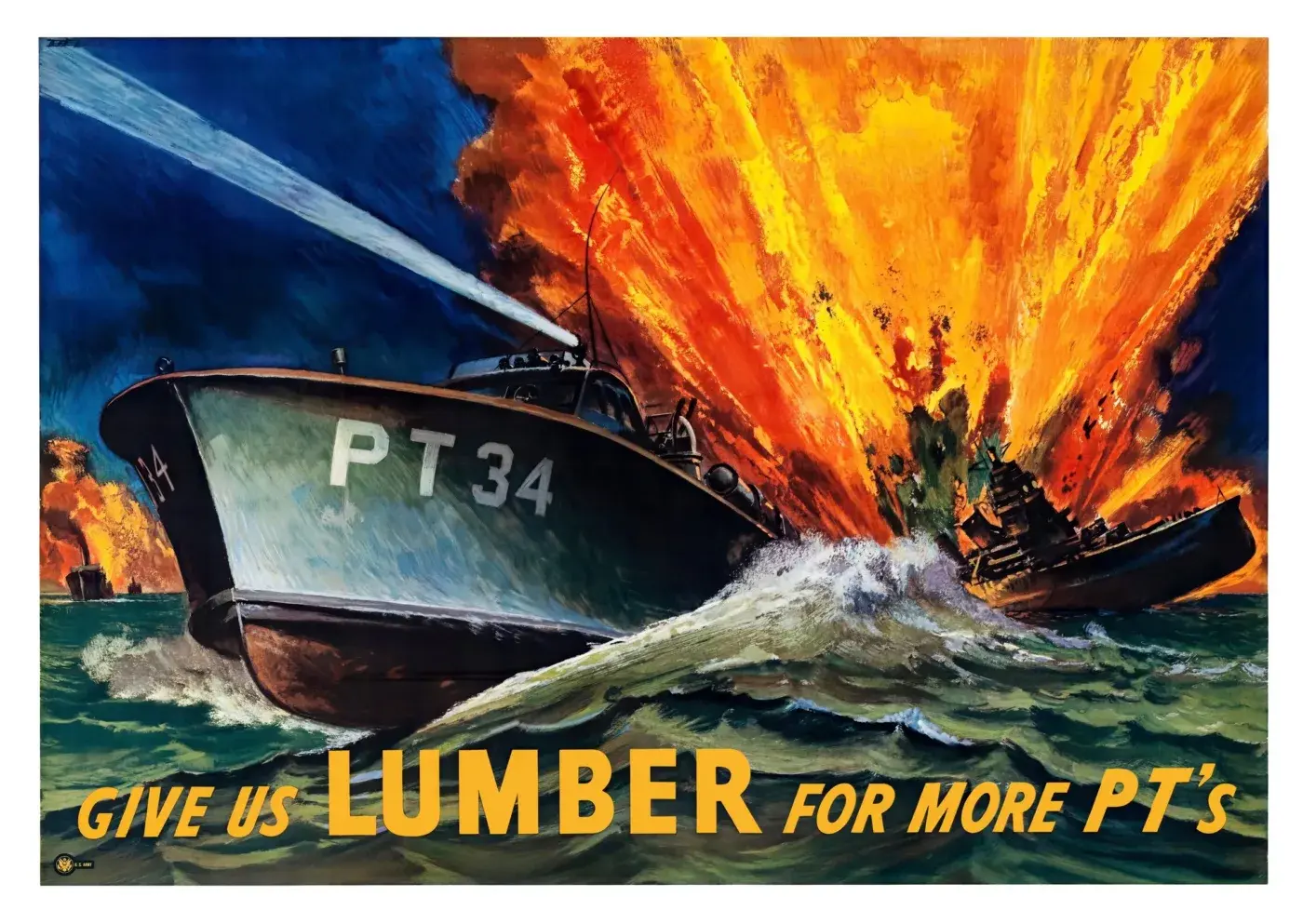
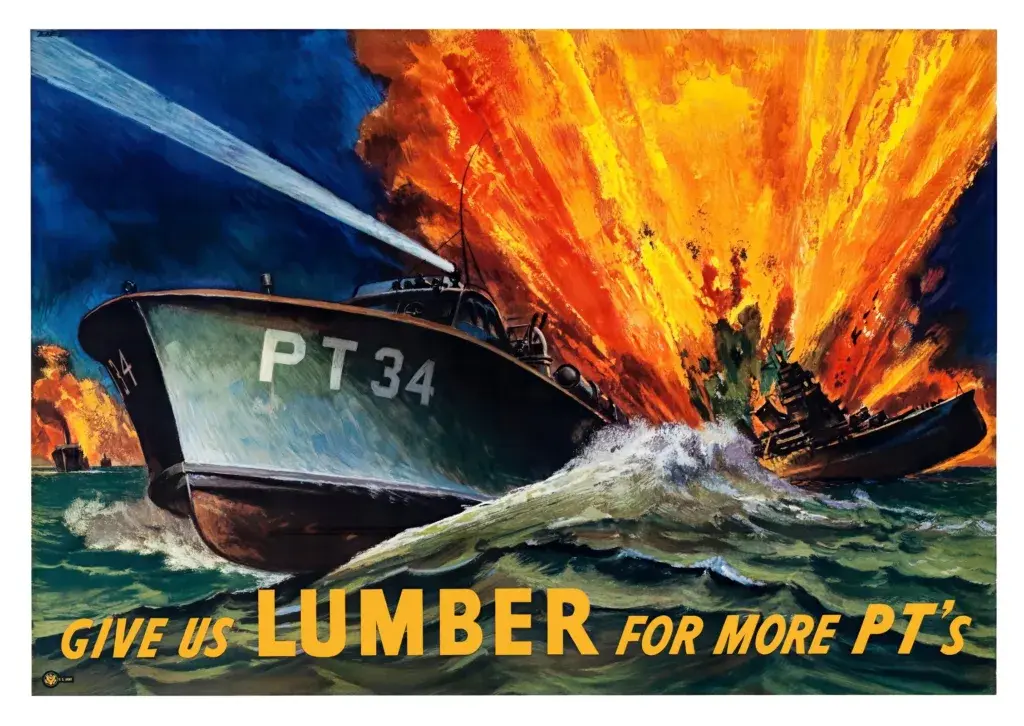
A PT boat comes straight at you out of the night, bow high, spray flying, the number 34 painted on its hull. Its searchlight slices across a dark blue sky. Behind it an enemy warship is breaking apart in a wall of orange and yellow flame, and on the horizon more ships are burning. Across the bottom, in yellow capitals: Give us LUMBER for more PT’s. In the lower left corner sits a small seal: U.S. Army.
An Army poster about a Navy boat
It looks like a Navy recruiting poster, but it was not aimed at sailors at all. It was issued by the U.S. Army in 1943, one of a run of Army posters about lumber. Wood was one of the most needed materials of the war: it went into crates and boxes for every shipment overseas, into barracks, docks and bridges, and into boats. By 1943 the mills were falling behind, and the War Department sent posters to logging camps, sawmills and lumber yards to push production up. Others in the same campaign carried lines such as A blow to the Axis, more lumber for the Army and The Army needs lumber for crates and boxes.
The PT boat was the perfect subject. Patrol torpedo boats were built almost entirely of wood, with hulls of laminated mahogany planking, so every boat really did depend on timber from the forests. The poster tells the lumberjack and the mill hand that the logs they cut become the boats that fight.
Wooden boats with teeth
PT boats were small, fast and lightly built. Elco, the Electric Launch Company of Bayonne, New Jersey, built 399 of its 80-foot boats, and Higgins Industries in New Orleans built about 200 of its 78-foot design. At its peak Elco worked three shifts a day, six days a week, turning out a boat about every 60 hours. Each carried torpedoes and machine guns, and later rockets and mortars too. PT-109, commanded by the future President John F. Kennedy, is the most famous of them.
The real PT-34
The number on the bow was not invented. PT-34 was an Elco boat launched in June 1941 and sent to the Philippines with Motor Torpedo Boat Squadron Three. When Japan attacked, the squadron fought on through the winter of 1941 and 1942. In March 1942, during the evacuation of General Douglas MacArthur, PT-34 carried Rear Admiral Francis Rockwell and other senior officers from Corregidor to Mindanao.
On the night of 8 April 1942, under Lieutenant Robert B. Kelly, PT-34 and PT-41 attacked the Japanese light cruiser Kuma off the east coast of Cebu. The crews believed they had scored several hits. Japanese records later showed that one torpedo did strike the cruiser’s bow but failed to explode. The next morning four Japanese floatplanes caught PT-34; Kelly’s crew beached the damaged boat at Cauit Island, where the planes returned and destroyed it. Two of the crew died. The poster gives the story the ending its crew believed: a cruiser blowing up under a PT boat’s torpedoes.
The artist
The painting is attributed to Peter Helck (1893 to 1988), a New York illustrator best remembered for his paintings of early motor racing. He painted for The Autocar and for advertisers, owned the 1908 Vanderbilt Cup winning Locomobile “Old 16”, and was elected to the National Academy of Design. Auction records credit the poster to Helck, while some dealers list it as anonymous, so we describe it as attributed to him.
The restored edition
Our edition was restored from a photograph of an original 1943 print. The paint was cleaned and the colour brought back, with folds, stains and wear removed. The lettering and the Army seal are kept from the original. The product page has a before and after slider so you can compare.
This is a landscape poster, wider than it is tall, and is available as a paper print in three sizes or framed in black, white or natural wood, printed to order in the USA.
Frequently asked questions
Who made the Give Us Lumber for More PT’s poster?
It was issued by the U.S. Army in 1943. The painting is attributed to the illustrator Peter Helck (1893 to 1988).
Why did the Army make a poster about Navy PT boats?
It was part of an Army campaign to raise lumber production. PT boats were built almost entirely of wood, so they were a clear way to show lumber workers what their timber was used for.
Was PT-34 a real boat?
Yes. PT-34 served with Motor Torpedo Boat Squadron Three in the Philippines, carried senior officers from Corregidor during the MacArthur evacuation in March 1942, and attacked the Japanese cruiser Kuma off Cebu on 8 April 1942. It was destroyed by Japanese floatplanes the next day.
What were PT boats made of?
Mostly wood. The hulls were built of mahogany planking, which is why the poster asks for lumber.
What sizes are the prints?
The poster is landscape. Paper prints are 16.5 × 11.7, 28 × 20 or 33.1 × 23.4 inches; framed prints are 17 × 12, 28 × 20 or 33 × 23 inches.
Historical sources
- artnet: U.S. Army, Give Us Lumber for More PT’s, Peter Helck (1943)
- Poster Group: Give Us Lumber for More PT’s, original c.1943 poster
- Monthly Catalog of U.S. Government Publications: A blow to the Axis, more lumber for Army (Army official poster, 1943)
- National Park Service: PT boats
- Wikipedia: Patrol torpedo boat PT-34
- Pacific Wrecks: PT-34
- Wikipedia: Peter Helck