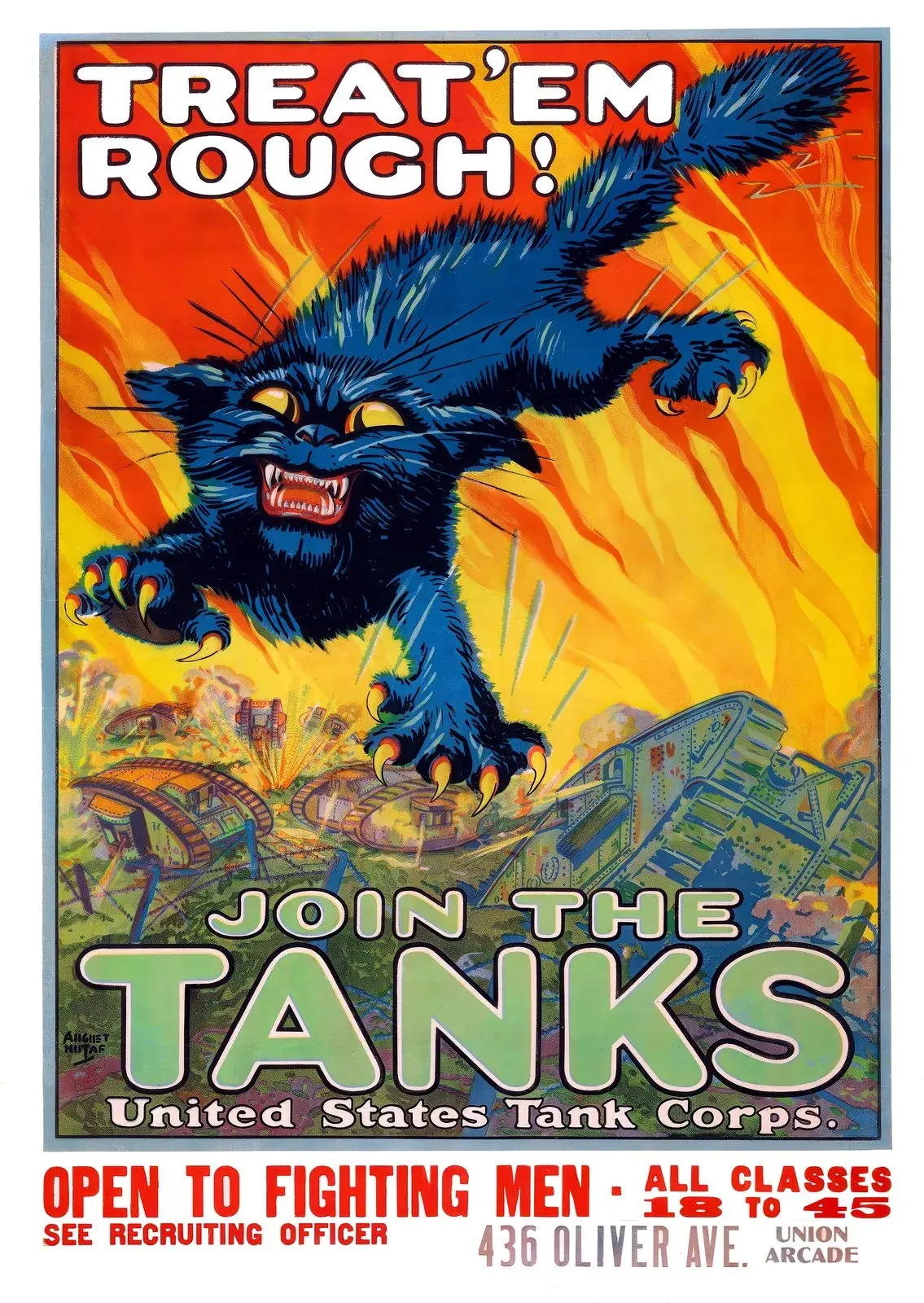
“Treat ’Em Rough! Join the Tanks.” Few recruiting posters of the First World War are as instantly recognisable as August William Hutaf’s snarling black cat. Printed in 1918 for the brand-new United States Tank Corps, it sold a weapon most Americans had never seen by giving it a fierce, simple personality.
What the poster shows
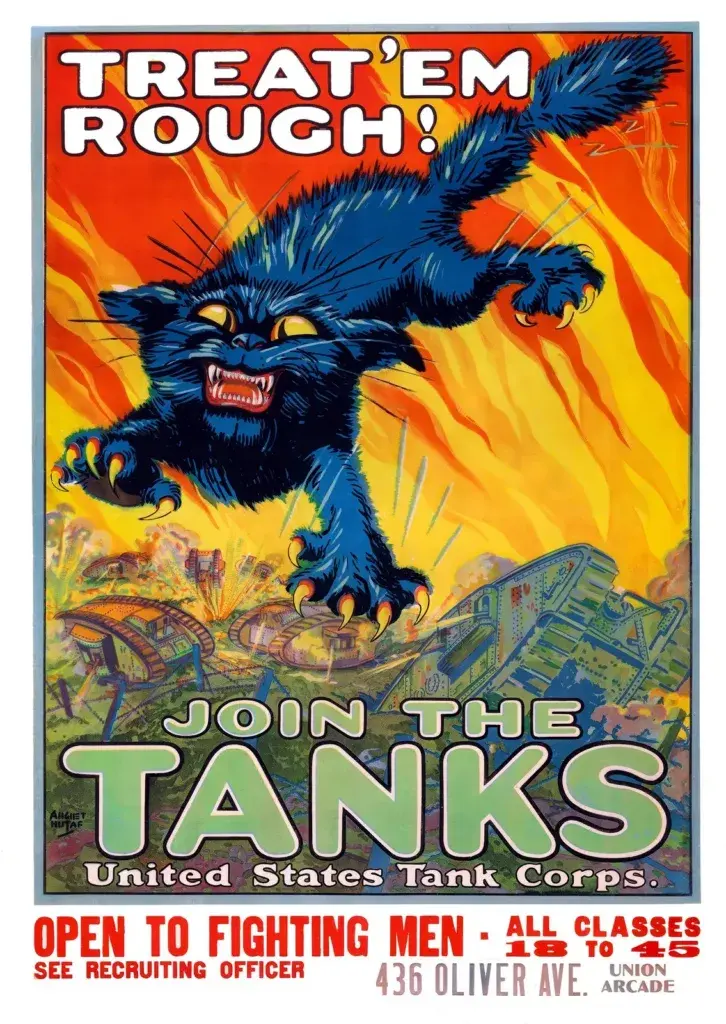
A blue-black cat, fur on end, claws spread and fangs bared, leaps across a sky of orange and yellow flame. Beneath it, rhomboid British-style heavy tanks grind over the battlefield through smoke and shellfire. TREAT ’EM ROUGH! is set in bold white letters at the top, and JOIN THE TANKS, United States Tank Corps, fills the lower half in pale green. The red panel at the bottom reads “Open to fighting men, all classes 18 to 45, see recruiting officer”, followed in this edition by the local address 436 Oliver Ave., Union Arcade.
Why a black cat?
The Tank Corps adopted a fighting black tomcat as its mascot in 1918, and its men became known as the Black Toms. The cat was a perfect emblem for a new and unfamiliar arm: fast, fearless and dangerous at close quarters. Historian Shirley Teresa Wajda traces the design to Philadelphia cartoonist Joseph Cunningham early in 1918, after which the cat was copied on other recruiting posters and on sheet music for the song “Treat ’Em Rough”. Hutaf’s version became the best known.
The first U.S. Tank Corps
The United States had no tanks when it entered the war in April 1917. The American tank service was organized late that year, with Captain George S. Patton as its first officer in France, and recruits in the United States trained at Camp Colt in Gettysburg, Pennsylvania, under a young Dwight D. Eisenhower. American tank crews went into action for the first time at St. Mihiel on September 12, 1918, mostly in French-built Renault light tanks. The heavy tanks on the poster are the British rhomboid type that had made tanks famous.
Many museum records date the poster simply to 1918. Wajda’s research suggests Hutaf’s design was published late that year, around the Corps’ autumn recruiting drive.
August William Hutaf
August William Hutaf (about 1874 to 1942) was a New Jersey illustrator and advertising art director who worked for lithographic and advertising firms and produced postcards, theatre programs, sheet music covers and national advertisements. The Tank Corps poster is his best-known work.
Our print edition
Our edition was prepared from a restored image of an original 1918 print and rebuilt as a high-resolution 300 dpi print file, keeping Hutaf’s outlines, the flame-orange sky and the lettering sharp at every size. It is available as a paper print in three sizes or framed in black, white or natural wood, printed to order in the USA.
Prefer metal? View Treat ’Em Rough on Displate ↗
Frequently asked questions
Who designed the Treat ’Em Rough! Join the Tanks poster?
The poster was drawn by American illustrator and advertising artist August William Hutaf, whose signature appears at the lower left. It was issued in 1918 to recruit men for the United States Tank Corps.
Why is there a black cat on the Tank Corps poster?
The U.S. Tank Corps adopted a fighting black tomcat as its mascot in 1918, and tank men were nicknamed the Black Toms. The cat, claws out and teeth bared, stood for the aggressive, clawing advance of the tanks.
When was the U.S. Tank Corps formed?
The American tank service was organized in late 1917, with George S. Patton as its first officer in France. American tank crews first went into combat at St. Mihiel on September 12, 1918, while new recruits trained in the United States at Camp Colt in Gettysburg, Pennsylvania.
Why do different copies show different recruiting addresses?
The bottom panel was used for local recruiting details, so surviving copies carry different addresses. This edition reads 436 Oliver Ave., Union Arcade, while the Library of Congress copy directs recruits to 1800 E Street.
What sizes is the restored print available in?
The restored edition is available as a paper print in 11.7 x 16.5, 20 x 28 or 23.4 x 33.1 inches, or framed at 12 x 17, 20 x 28 or 23 x 33 inches in black, white or natural wood.