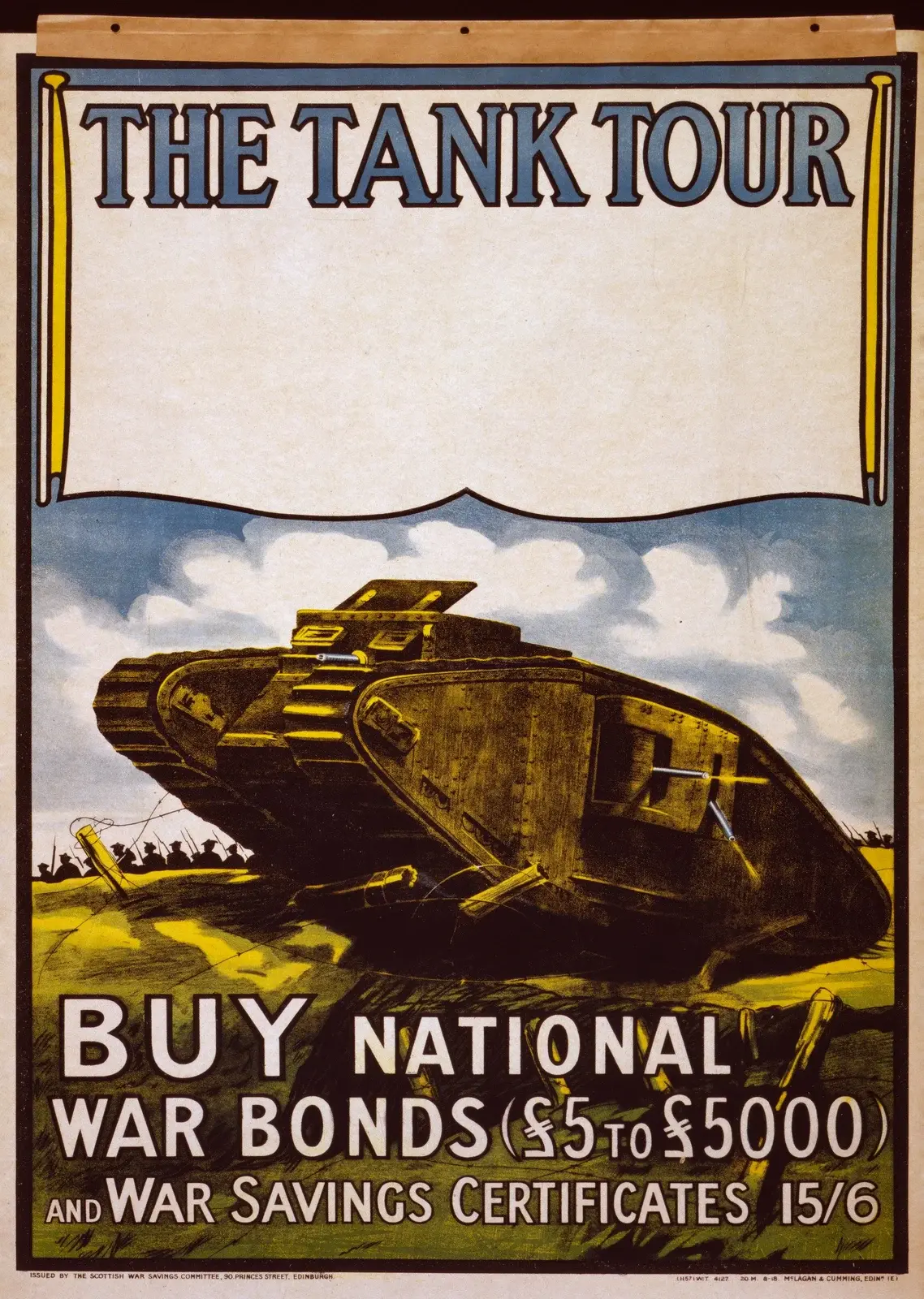
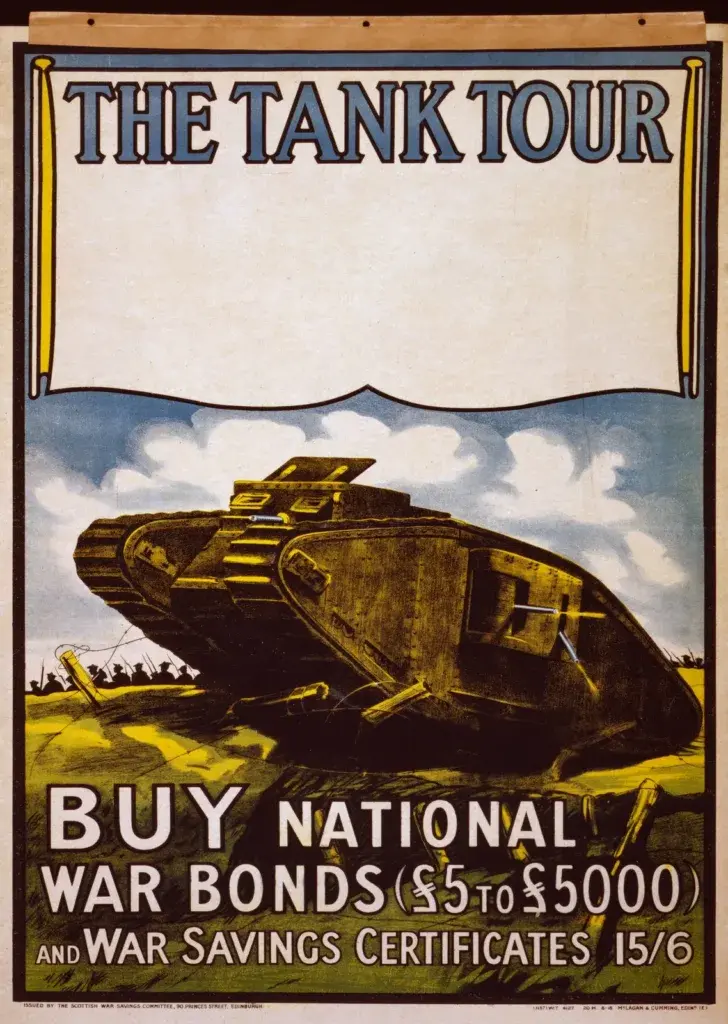
A rhomboid British tank lurches over a tangle of barbed wire, smoke trailing from its guns, while a line of soldiers in Scottish bonnets stands dark against a cloudy sky. Above them a blue scroll hangs empty, and the lettering below makes the pitch: Buy National War Bonds (£5 to £5000) and War Savings Certificates 15/6.
A tank in the town square
Tanks first went into battle in September 1916 and were still a marvel to the public. In late November 1917 the government parked tank 130, nicknamed Nelson, in Trafalgar Square and opened a cashier’s window in its side. Crowds bought war bonds and savings certificates straight from the machine, and the idea took off. Six Mark IV tanks, Julian, Ole Bill, Nelson, Drake, Iron Ration and Egbert, toured Britain through 1918. Only Egbert had actually fought in France.
Scotland’s tank weeks
Julian worked Scotland. It arrived in Edinburgh on 7 January 1918, where Lord Strathclyde, chairman of the Scottish War Savings Committee, spoke from the top of the tank and the city raised £4,764,639. Glasgow followed a week later, and in September 1918 Julian toured towns in Fife and Angus. Towns competed to post the biggest tank week total, and after the war the best fundraisers were given a presentation tank of their own.
Bonds and certificates
The poster offered two ways to lend money to the government. National War Bonds ran from £5 to £5,000 for larger savers, while a War Savings Certificate cost 15 shillings and 6 pence and could be cashed for £1 after five years, a safe return for ordinary families.
The poster
The Imperial War Museum dates this poster to June 1918. It was issued by the Scottish War Savings Committee from Princes Street, Edinburgh, and printed by McLagan & Cumming. The artist is not recorded. The empty scroll at the top was deliberate: each town could overprint the dates and place of its own tank visit.
The restored edition
Our edition was restored from a photograph of an original print. The colour was cleaned and brought back, with folds, stains and wear removed, and the lettering and printer’s line kept from the original. It is available as a paper print in three sizes or framed in black, white or natural wood, printed to order in the USA.
Frequently asked questions
Who issued The Tank Tour poster?
The Scottish War Savings Committee in Edinburgh, in June 1918. It was printed by McLagan & Cumming; the artist is not recorded.
What was a tank bank?
A real tank parked in a town square where people could buy war bonds and savings certificates from a cashier inside. Six Mark IV tanks toured Britain in 1917 and 1918.
Why is the banner at the top blank?
It was left empty so each town could print the dates and place of its own tank visit.
Is this an American poster?
No. It is a British (Scottish) poster from the First World War and is part of our Allied posters collection.
What sizes are the prints?
Paper prints are 11.7 × 16.5, 20 × 28 or 23.4 × 33.1 inches; framed prints are 12 × 17, 20 × 28 or 23 × 33 inches, in black, white or natural wood.
Historical sources
- Imperial War Museum: The Tank Tour (Art.IWM PST 10247)
- Library of Congress: The tank tour (cph.3g11079)
- Tank Encyclopedia: Tank Week
- Tank Encyclopedia: Tank Week in Edinburgh