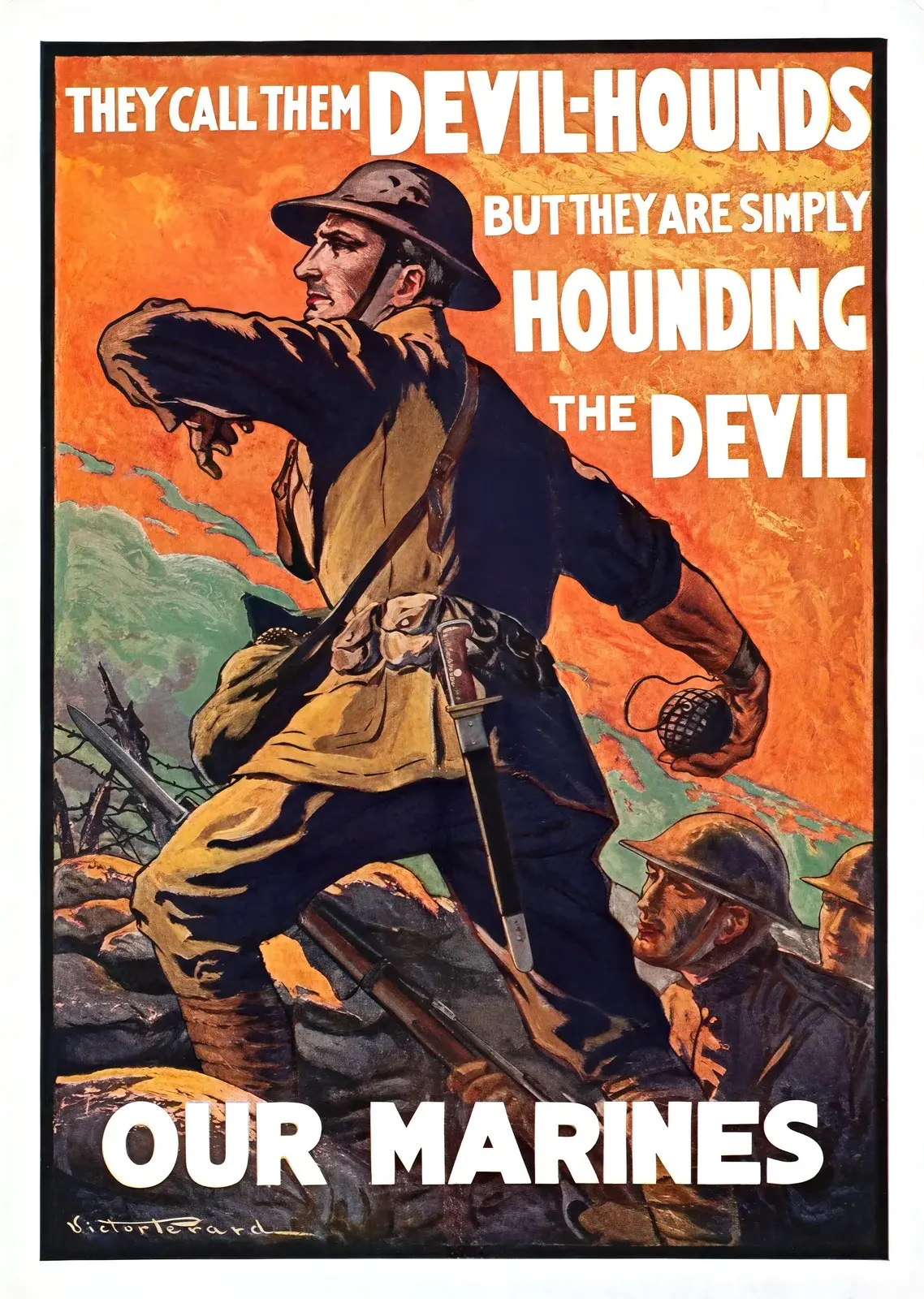
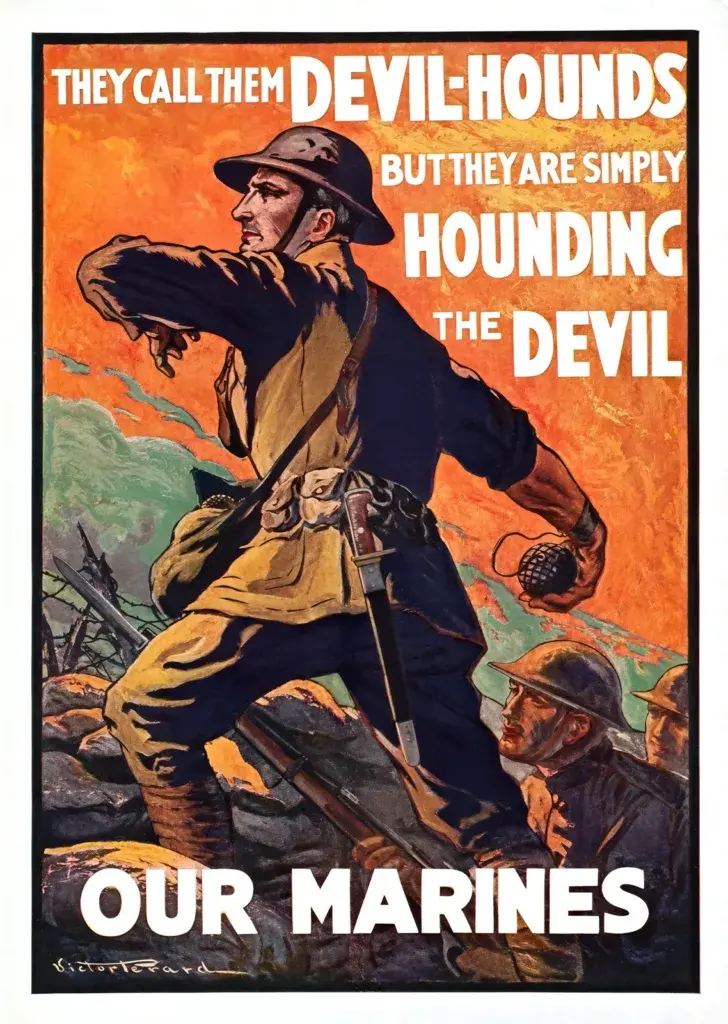
A Marine in a steel helmet and khaki stands braced on a broken field, his left arm thrown back to hurl a grenade, a rifle with fixed bayonet in his right hand. Behind him two more Marines advance over the shell holes and splintered trees, and the whole sky burns orange. The lettering above makes the argument in three steps: They call them Devil-Hounds, but they are simply hounding the devil. Across the bottom, in heavy white capitals: Our Marines. The artist’s signature, Victor Pérard, sits at lower left, and a line of small type beneath the image reads Supplement to Engineering News-Record, June 20, 1918.
A nickname from the newspapers
The Devil Dog legend holds that German soldiers, facing the Marines at Belleau Wood, called them Teufel Hunden, hounds of hell. The name was in print before the battle. On 14 April 1918 the Boston Globe reported that Marine recruiters had a new nickname to work with, “Germans call ’em Teufel Hunden,” and other papers picked up the story through April and May. The Marines went into Belleau Wood on 6 June 1918 and cleared it, at great cost, by 26 June. No German source using the name has ever been found, and the journalist H. L. Mencken wrote in 1919 that it had been invented by an American correspondent. It did not matter. The nickname fitted the Marines’ idea of themselves, and it has stayed with the Corps ever since.
Hounding the devil
Pérard’s poster was dated 20 June 1918, while the fighting at Belleau Wood was still going on, which makes it one of the earliest printed uses of the nickname. Where C. B. Falls’s better-known Teufel Hunden recruiting poster drew the Marines as a bulldog chasing a German dachshund, Pérard took the phrase seriously and answered it. The Germans might call them devil-hounds; the Marines were hounding the devil, and the Kaiser’s Germany was the devil in question.
A poster for engineers
The poster was not issued by the Marine Corps. It came folded into Engineering News-Record, the New York weekly read by the civil engineers and contractors who built America’s roads, bridges and factories. During 1918 the magazine published a series of patriotic posters as supplements, which subscribers could pull out and hang in offices, drafting rooms and construction camps. The construction trades were central to the war effort, building cantonments, shipyards and munitions plants at home and serving in the Army’s engineer regiments in France, and the magazine’s posters kept the fighting man in front of them.
Victor Pérard
Victor Semon Pérard was born in 1870 and trained at the Art Students League and the National Academy of Design in New York and at the École des Beaux-Arts in Paris, with anatomy studies at the New York University medical college. He became a prolific book and magazine illustrator and a teacher, giving life-drawing classes at Cooper Union for twenty years and later at the Traphagen School of Fashion. His instruction books, above all Anatomy in Drawing, stayed in print for decades, and his etchings and lithographs are held by the Metropolitan Museum of Art. His portraits of General John J. Pershing and Marshal Ferdinand Foch, the American and Allied commanders of 1918, are in the Smithsonian. He died in New York in 1957.
The restored edition
Our edition was restored from a photograph of an original print. The colour was cleaned and brought back, with folds, stains and wear removed, while the lettering, the artist’s signature and the printed supplement line are kept from the original. You can compare the archival source with the restored edition in the before and after slider on the product page. It is available as a paper print in three sizes or framed in black, white or natural wood, printed to order in the USA.
Frequently asked questions
Who painted the They Call Them Devil-Hounds poster?
Victor Pérard (1870–1957), a New York illustrator and Cooper Union drawing teacher. It was issued as a supplement to Engineering News-Record on 20 June 1918.
Did the Germans really call the Marines Devil Dogs?
No German source has been found. American newspapers reported the nickname in April 1918, before Belleau Wood, and H. L. Mencken wrote in 1919 that an American correspondent had invented it.
Is this a recruiting poster?
Not officially. It was printed by Engineering News-Record for its readers in the construction and engineering trades, during the Battle of Belleau Wood.
What sizes are the prints?
Paper prints are 11.7 × 16.5, 20 × 28 or 23.4 × 33.1 inches; framed prints are 12 × 17, 20 × 28 or 23 × 33 inches, in black, white or natural wood.