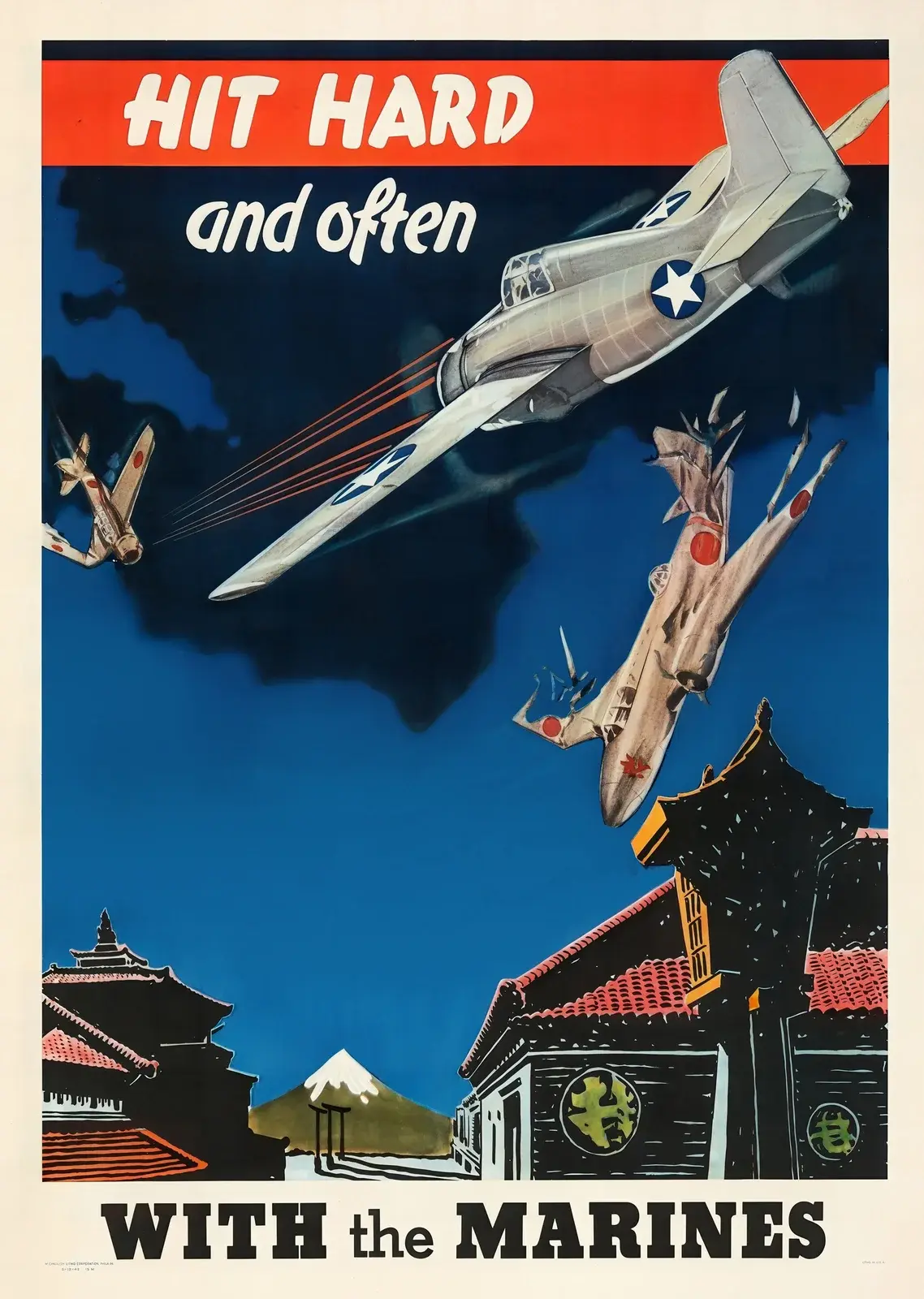
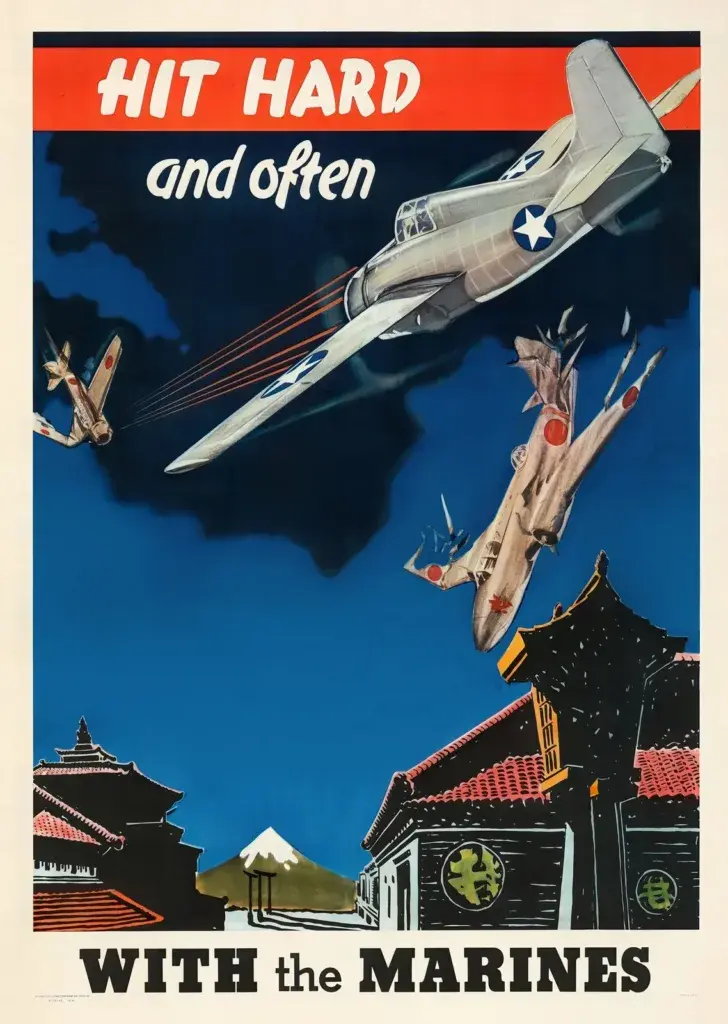
A silver fighter with the white star of the United States on its wings and fuselage dives across the poster from top right, red tracer streaming from its guns. One Japanese aircraft, marked with the red sun, is already breaking apart; a second falls away at the left edge. Beneath them are the tiled roofs and painted signs of a Japanese town, and far off, white against the dark sky, the cone of Mount Fuji. A red band at the top carries the words Hit Hard, with and often in script below, and the bottom line delivers the pitch in heavy black capitals: With the Marines.
The Marine Corps Publicity Bureau
The poster was issued by the Marine Corps Publicity Bureau, the Corps’ own recruiting and public relations office, founded in New York in 1907. The bureau produced most of the Marine recruiting posters of both world wars, sometimes commissioning well-known illustrators and sometimes, as here, leaving the work unsigned. The printed code along the bottom edge, MCPB 105578 9-15-42 15M, records the order number, the date of 15 September 1942 and a print run of 15,000 copies. Full-size copies measure 28 × 40 inches and were lithographed in Philadelphia; a 14 × 11 inch window card version was also made for shop windows and recruiting stations, and one of these is held by the Franklin D. Roosevelt Presidential Library and Museum.
September 1942: Wildcats over Guadalcanal
The fighter in the poster is a Grumman F4F Wildcat, the stubby carrier fighter that Marine and Navy squadrons flew through the first year of the Pacific war. Marine Wildcats of VMF-211 had fought the defence of Wake Island in December 1941, and on 20 August 1942 the Wildcats of VMF-223 landed on the captured airstrip at Guadalcanal, Henderson Field, to begin the air battle that decided the campaign. Through September 1942, the month this poster was printed, Marine pilots such as Major John L. Smith and Captain Marion Carl were scrambling almost daily to meet Japanese bombers and Zero fighters flying down from Rabaul. Smith was awarded the Medal of Honor for that fighting. Newspapers at home followed the “Cactus Air Force” closely, and the poster’s image of a Wildcat shooting down two Japanese aircraft spoke directly to those headlines.
Taking the war to Japan
The scene itself was a promise rather than a report. No Marine fighter flew over Mount Fuji in 1942; the Doolittle Raid of April that year, flown by Army bombers from a Navy carrier, was the only American attack on the home islands until 1944. By placing the Wildcat over a Japanese town, the artist told recruits where the Corps intended to go. Marine Corps historian Zayna Bizri describes it as the most direct reference to the Japanese aerial attacks of all the Marine posters of the period, and notes how it draws on the Corps’ “first to fight” reputation by inviting the viewer to imagine himself as the attacking aviator.
Recruiting flyers and ground crews
Aviation was the glamour arm of every service after Pearl Harbor and the Doolittle Raid. Marine pilots were trained through the Navy’s flight programme, and for every pilot the Corps needed mechanics, armourers, radiomen and ground crew, so posters like this one worked for the whole of Marine aviation rather than only the cockpit. The appeal was urgent. In December 1942 President Roosevelt ended voluntary enlistment for men of draft age, placing all the services under Selective Service from early 1943. The Marines, who prized their all-volunteer image, answered by recruiting seventeen-year-olds with their parents’ permission and by stationing Marine liaison officers at induction centres to pick out draftees who wanted the Corps.
The artist
The poster is unsigned and no artist is named in the museum or auction records we have found. Original copies now sell for several hundred to more than a thousand dollars at auction.
The restored edition
Our edition was restored from a photograph of an original print. The colour was cleaned and brought back, with folds, stains and wear removed, while the lettering and the bureau’s printed code are kept from the original. It is available as a paper print in three sizes or framed in black, white or natural wood, printed to order in the USA.
Frequently asked questions
Who made the Hit Hard and Often poster?
The Marine Corps Publicity Bureau issued it on 15 September 1942 (code MCPB 105578, print run 15,000). The artist is not credited.
What aircraft is shown?
A Grumman F4F Wildcat, the fighter Marine squadrons flew at Wake Island and Guadalcanal in 1941 and 1942, shooting down two Japanese aircraft over Mount Fuji.
Did Marines really fly over Japan in 1942?
No. The image was a promise of where the Corps intended to take the war. Apart from the Doolittle Raid in April 1942, Japan was not attacked from the air until 1944.
What sizes was the original?
It was printed as a 28 × 40 inch poster and as a 14 × 11 inch window card for shop windows and recruiting offices.
What sizes are the prints?
Paper prints are 11.7 × 16.5, 20 × 28 or 23.4 × 33.1 inches; framed prints are 12 × 17, 20 × 28 or 23 × 33 inches, in black, white or natural wood.
Historical sources
- Franklin D. Roosevelt Presidential Library: Hit Hard and Often (MO 2005.13.23.9)
- Zayna N. Bizri, From Making Men to Making Marines, Marine Corps History (Summer 2015)
- Swann Galleries: Hit Hard and Often With the Marines, 1942 (lot 84)
- Marines in World War II: the Guadalcanal campaign (National Park Service)