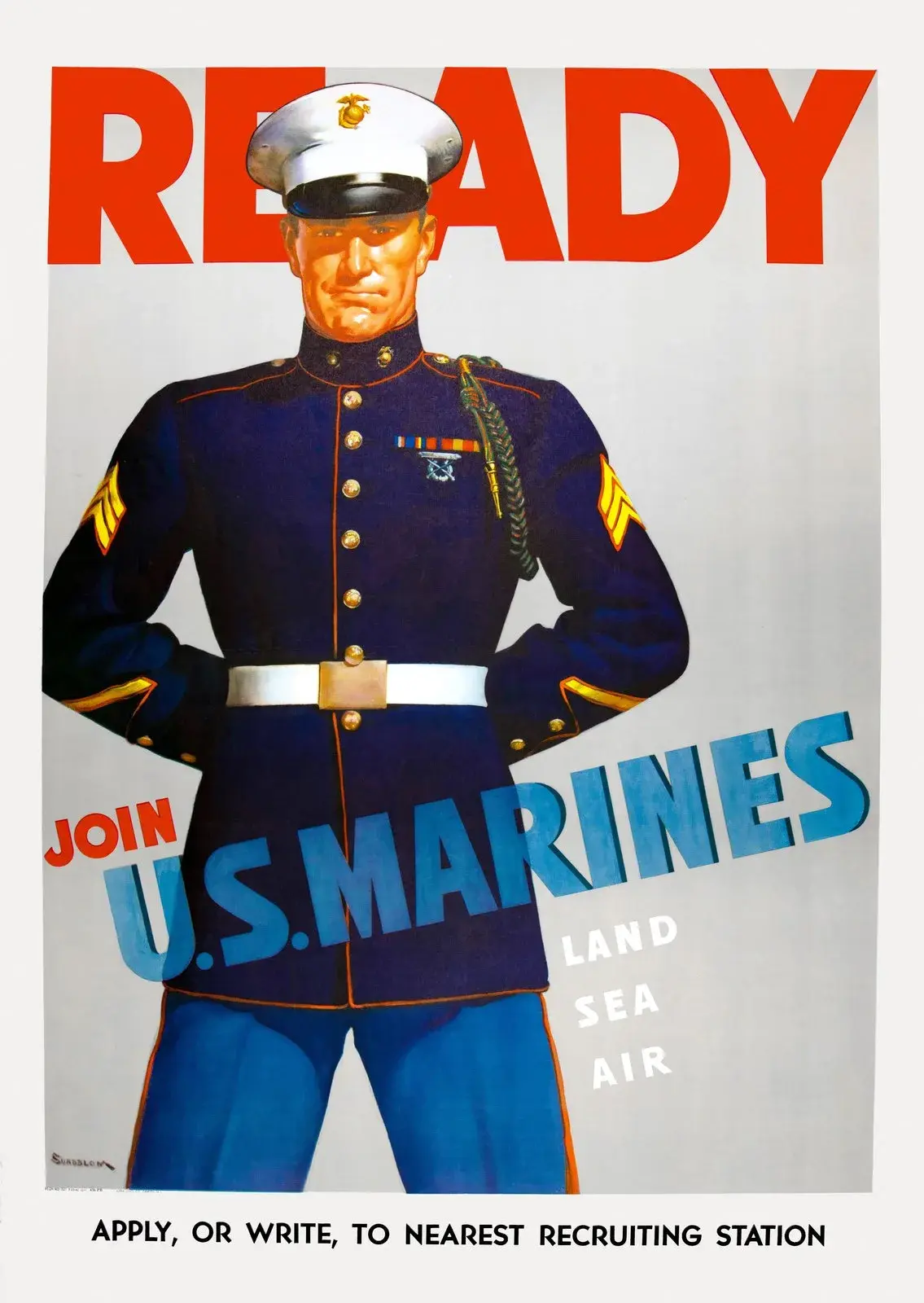
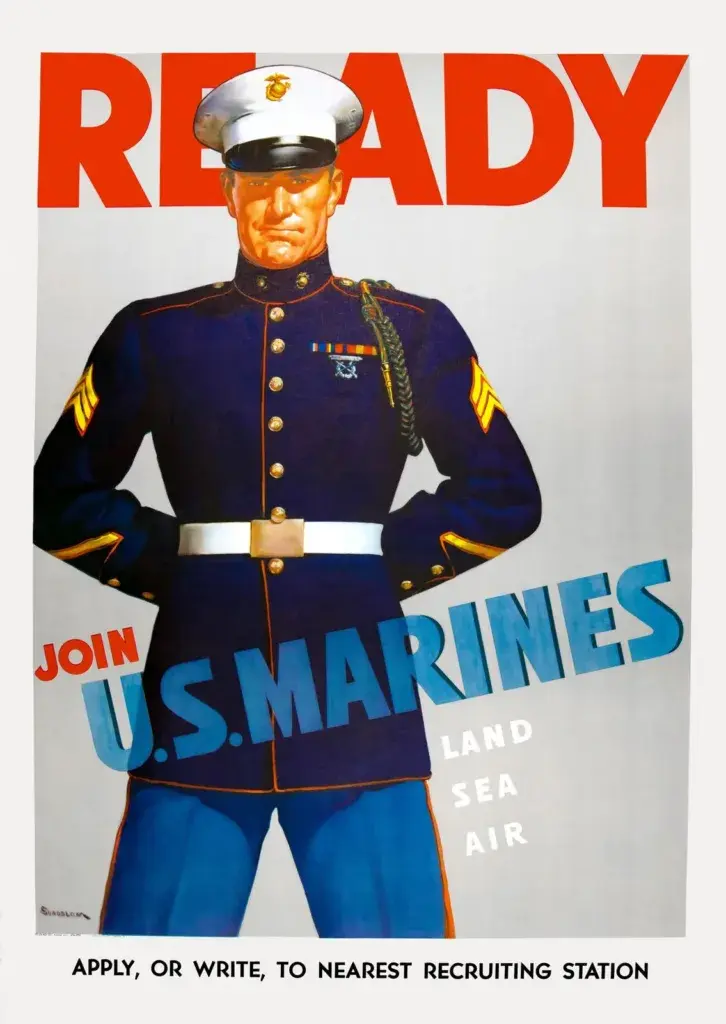
A Marine sergeant stands with his feet apart and his hands on his hips, looking straight out of the poster. His dress blue tunic is buttoned to the collar, his white cover gleams, and his chevrons, ribbons and marksmanship badge catch the light. Behind his head, in red capitals so big they run off the sheet, is one word: Ready. Below, Join U.S. Marines slants across his tunic, with Land, Sea, Air beside it.
What the poster shows
Sundblom painted the sergeant the way he painted advertising: smooth, warm and confident, with strong light on the face and the brass. It is a portrait of steadiness more than action, and that was the point in 1942, months after Pearl Harbor. The line Land, Sea, Air reminded recruits that the Marines fought on all three.
The poster was issued in 1942. The Smithsonian’s National Museum of American History holds a copy measuring 40 by 28 inches, and the Hennepin County Library has another.
Haddon Sundblom
Haddon Sundblom was born in Muskegon, Michigan, in 1899 and trained at the American Academy of Art in Chicago, where he spent his career. From 1931 he painted the Coca-Cola Santa Claus for more than thirty years, and his warm, round-faced Santa became the image most people still picture. He also created Coca-Cola’s Sprite Boy in 1942 and updated the Quaker Oats man in 1957. He died in Chicago in 1976.
The restored edition
Our edition was restored from an original 1942 print: the paper and colours cleaned, and creases, stains and wear removed, with the lettering and Sundblom’s signature kept. We don’t have a usable scan of this print before restoration, so there is no before and after comparison.
The restored poster is available as a paper print in three sizes or framed in black, white or natural wood, printed to order in the USA.
Frequently asked questions
Who painted the Ready poster?
Haddon Sundblom (1899 to 1976), the Chicago illustrator famous for painting Coca-Cola’s Santa Claus. His signature is at the lower left.
When was it made?
In 1942, during the first year of America’s war.
What does Land, Sea, Air mean?
It reminded recruits that the Marine Corps fought on land, at sea and in the air, with its own aviation.
What uniform is the sergeant wearing?
Marine Corps dress blues with a white cover, sergeant’s chevrons, ribbons and a marksmanship badge.
How big is the restored print?
Our restored edition is available as a paper print up to 23.4 x 33.1 inches, or framed up to 23 x 33 inches, printed to order in the USA.