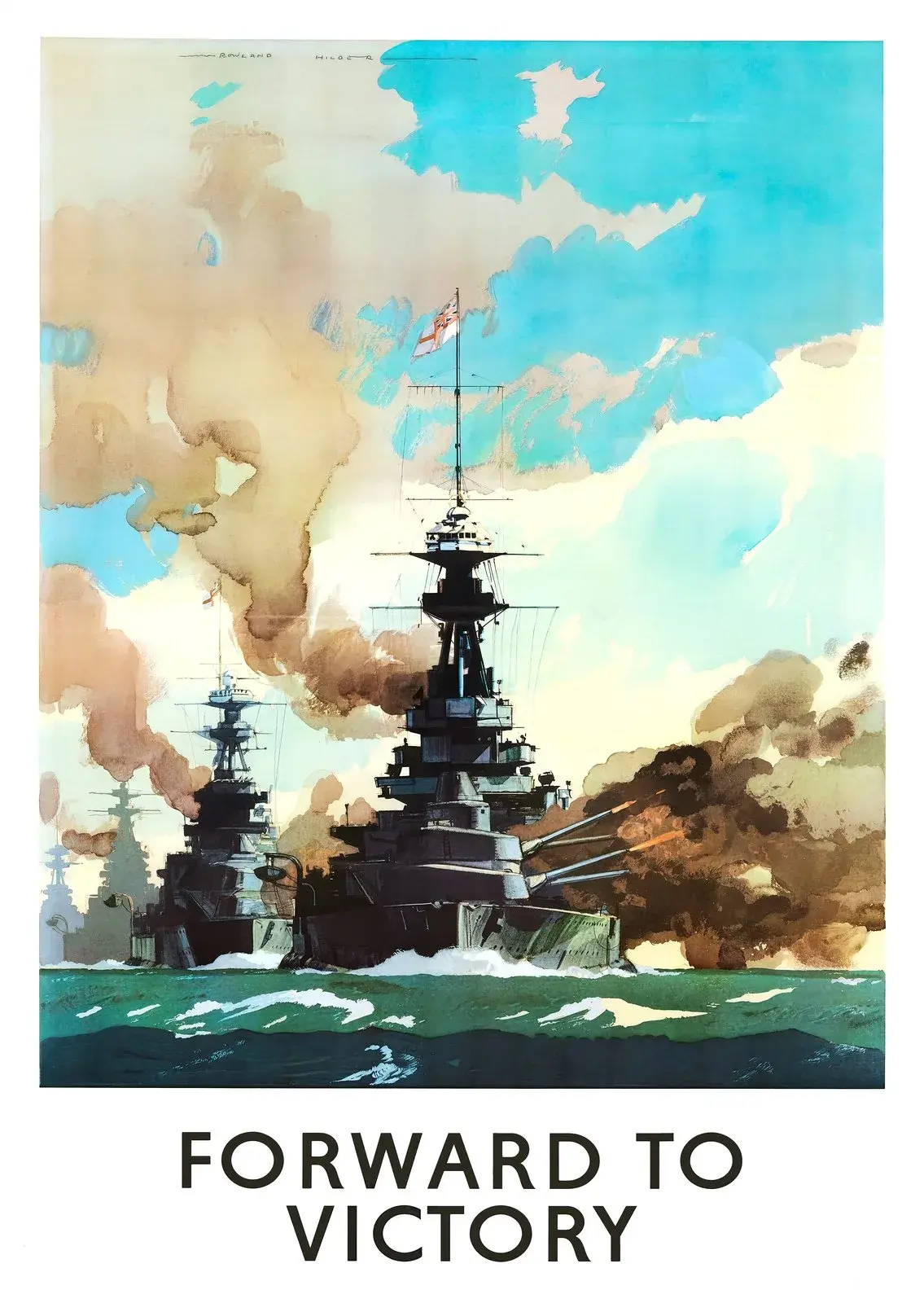
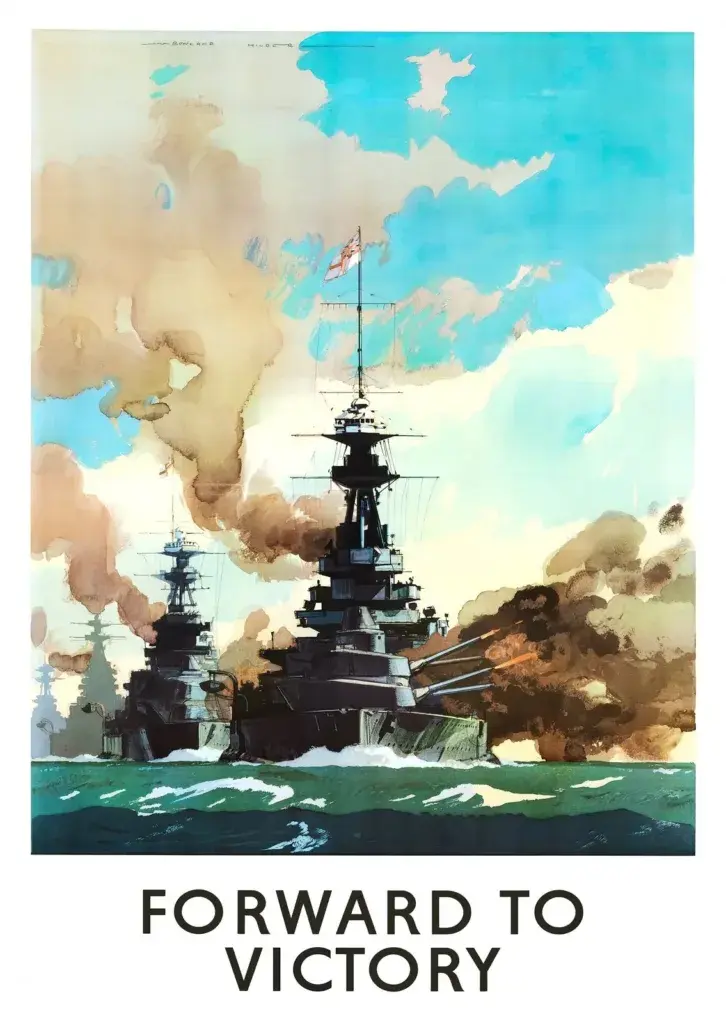
A line of battleships drives out of the haze, the nearest firing her main guns in a rolling cloud of brown smoke. The White Ensign streams from her mast. Above them a watercolour sky opens into blue. Under the picture are three words in plain black capitals: Forward to Victory. This is a British poster, painted by Rowland Hilder for the Ministry of Information in the early years of the Second World War, when the Royal Navy stood between Britain and defeat.
What the poster shows
Hilder paints the fleet the way he painted the Thames: with fast, wet washes and a few hard, dark shapes. The battleships are almost silhouettes, their towering superstructures, gun turrets and masts picked out in slate and black. The sea is a band of cold green broken by white wash. Everything else is weather. Clouds of gun smoke and sky run into each other in soft blooms of blue, cream and brown, as though the paper were still damp.
There is no enemy in the picture and no slogan beyond the title. The poster asks for nothing. It simply shows British naval power moving forward, and trusts the viewer to feel it.
The Forward to Victory series
The Ministry of Information was set up at the start of the war to run Britain’s publicity at home and abroad. Forward to Victory was one of its early poster series, built on a simple formula: a painted scene of the armed forces above the same three words in large, calm lettering. The Imperial War Museum holds a companion design by Harold Forster, dated 1940, showing RAF pilots running to their Spitfires. Hilder’s design gave the series its naval subject.
The tone is telling. In 1940 Britain had watched France fall and was fighting on with its Empire and Commonwealth. The Forward to Victory posters do not warn, scold or ask for money. They are statements of confidence, meant to steady morale at a dangerous time.
Rowland Hilder, born in New York
Rowland Hilder was born in New York in 1905. His English father brought the family back to England in 1915 so that he could enlist, and the boy grew up to study at Goldsmiths’ College in London. He became known for drawings and watercolours of the Thames, its sailing barges and the Kent countryside, and won a Times prize in 1929 for his illustrations to Treasure Island. From 1929 he also worked for Shell on its much-loved guides and advertising.
In the war Hilder served as an army camouflage officer and worked with the Ministry of Information. He also painted posters for the National Savings campaign, among them Convoy Your Country to Victory in 1942. After the war he became president of the Royal Institute of Painters in Water Colours, from 1964 to 1974, and was appointed OBE in 1986. He died in 1993.
The restored edition
Our edition was restored from a scan of an original print. The yellowed paper was cleaned back to white and the faded blues of the sky and sea were brought back, with stains and wear removed. Hilder’s loose watercolour washes are kept as he painted them, and his signature along the top edge is preserved. Drag the before and after slider on the product page to compare.
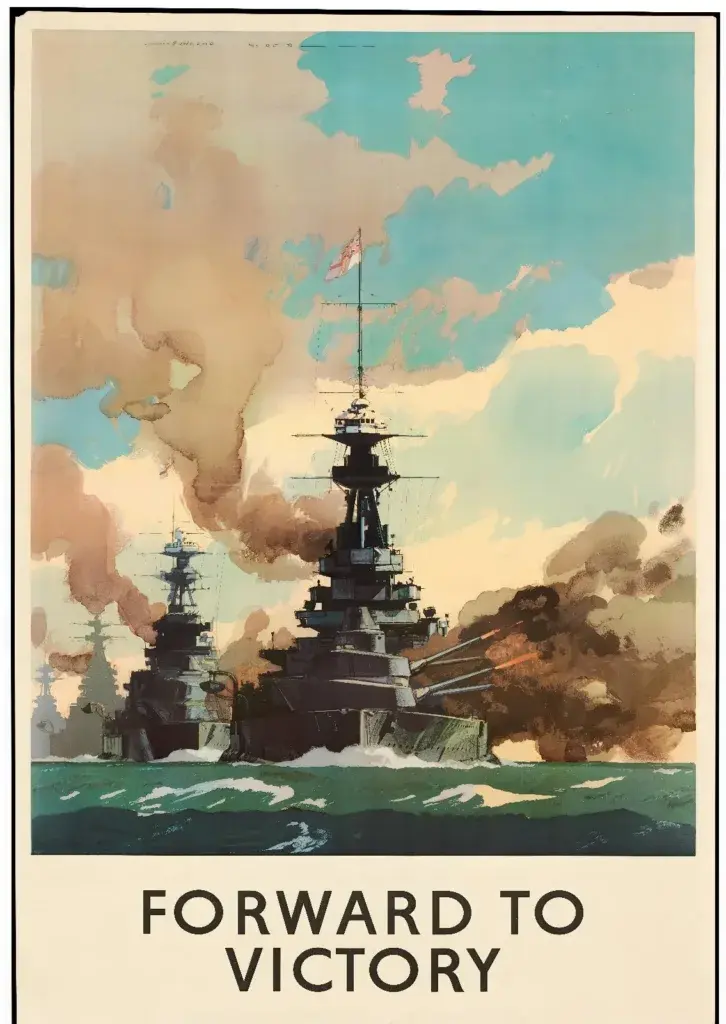
The restored poster is available as a paper print in three sizes or framed in black, white or natural wood, printed to order in the USA.
Frequently asked questions
Who painted the Forward to Victory battleship poster?
Rowland Hilder (1905 to 1993), whose signature runs along the top edge of the picture. He was born in New York, moved to England as a boy, and became one of Britain’s best-known painters of ships, rivers and landscape.
Is this an American poster?
No. It is British, issued by the Ministry of Information in London. The warships fly the White Ensign of the Royal Navy. We include it in our small Allied collection, clearly labelled as British.
When was it made?
The poster itself is undated. It belongs to the Ministry of Information’s Forward to Victory series; the Imperial War Museum dates a companion design in the series to 1940.
What were the other Forward to Victory posters?
The series used the same simple layout, a painted scene above the words Forward to Victory in black capitals. The Imperial War Museum holds a version by Harold Forster showing RAF pilots running to their Spitfires.
How big is the restored print?
Our restored edition is available as a paper print up to 23.4 x 33.1 inches, or framed up to 23 x 33 inches, printed to order in the USA.