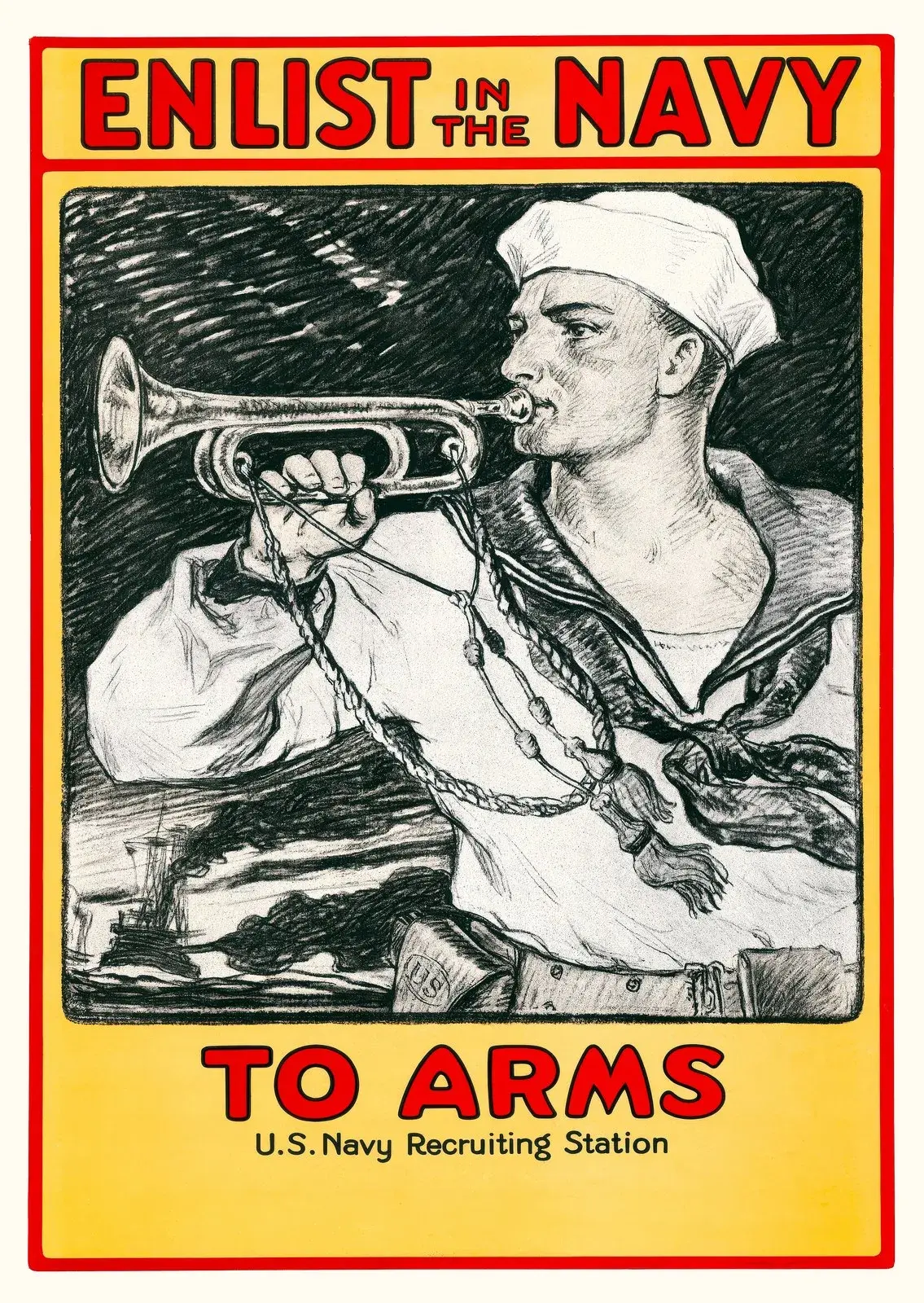
A sailor in a white cap lifts a bugle to his lips and sounds the call. The long tasselled cord swings from his fist, his neckerchief flies, and behind him a battleship pushes through dark, choppy water under a trail of smoke. Above, in red capitals on gold: Enlist in the Navy. Below: To Arms. Milton Bancroft drew it in 1917, the year America went to war.
What the poster shows
Most First World War recruiting posters were printed in full colour. Bancroft’s is striking because the picture is a black and white drawing, built from heavy, energetic charcoal strokes, set inside a bright red and gold frame. The contrast makes the sailor leap off the wall. The bugle is the message: in the Navy, as in the Army, the bugle call was the signal to action, and here it is turned on the viewer.
The poster was printed with the words U.S. Navy Recruiting Station at the foot, so it could hang at any station in the country.
Where copies survive
The design was widely printed. The Library of Congress and the New York Public Library both hold copies, and the Victoria and Albert Museum in London has one measuring 39 by 25 inches, given to the museum in 1918 by the Underground Electric Railways Company of London.
Milton Bancroft
Milton Herbert Bancroft was born in Newton, Massachusetts, in 1867. He studied at the Pennsylvania Academy of the Fine Arts in the 1880s and then spent five years training in Paris, where he absorbed the light and colour of the Impressionists. Back in America he became known for portraits, figure paintings and murals.
During the First World War he turned his skills to the home front, making posters for the U.S. Navy, the Red Cross and the Council of National Defense. To Arms became the best known of them. He died in 1947.
The restored edition
Our edition was restored from an original 1917 print: the paper and colours cleaned, and creases, stains and wear removed, with the lettering and Bancroft’s drawing kept. We don’t have a usable scan of this print before restoration, so there is no before and after comparison.
The restored poster is available as a paper print in three sizes or framed in black, white or natural wood, printed to order in the USA.
Frequently asked questions
Who drew Enlist in the Navy, To Arms?
Milton Bancroft (1867 to 1947), an American Impressionist painter and muralist who made posters for the Navy, the Red Cross and the Council of National Defense during the First World War.
When was the poster made?
In 1917, the year the United States entered the First World War.
Why is the picture in black and white?
Bancroft drew the sailor in charcoal-style black line and set it inside a bright red and gold frame. The contrast makes the figure stand out from across a room.
Where can I see an original?
Copies are held by the Library of Congress, the New York Public Library and the Victoria and Albert Museum in London.
How big is the restored print?
Our restored edition is available as a paper print up to 23.4 x 33.1 inches, or framed up to 23 x 33 inches, printed to order in the USA.
Historical sources
- Library of Congress: Enlist in the Navy, To arms / Milton Bancroft
- Victoria and Albert Museum: Enlist in the Navy. To Arms. (E.119-1918)
- New York Public Library: To arms. Enlist in the Navy.
- IUP: Gilded Age to Great War, Milton Bancroft and His Art
- Australian War Memorial: ARTV00753
- Metal poster edition of this design on Displate ↗