A new kind of Marine
The U.S. Marine Corps Women’s Reserve was created by law on July 30, 1942, and publicly announced on February 13, 1943. Its purpose was spelled out in the recruiting slogan itself: women would take over jobs at shore stations and air bases so that male Marines could be released for combat. Major Ruth Cheney Streeter was appointed the first Director, and by June 1944 the Reserve had reached its goal of 18,000 enlisted women and 1,000 officers. About 23,000 women served during the war.
The Corps was unusually firm that these recruits were Marines in every sense. Commandant Thomas Holcomb said: “They are Marines. They don’t have a nickname and they don’t need one.”
The woman on the poster
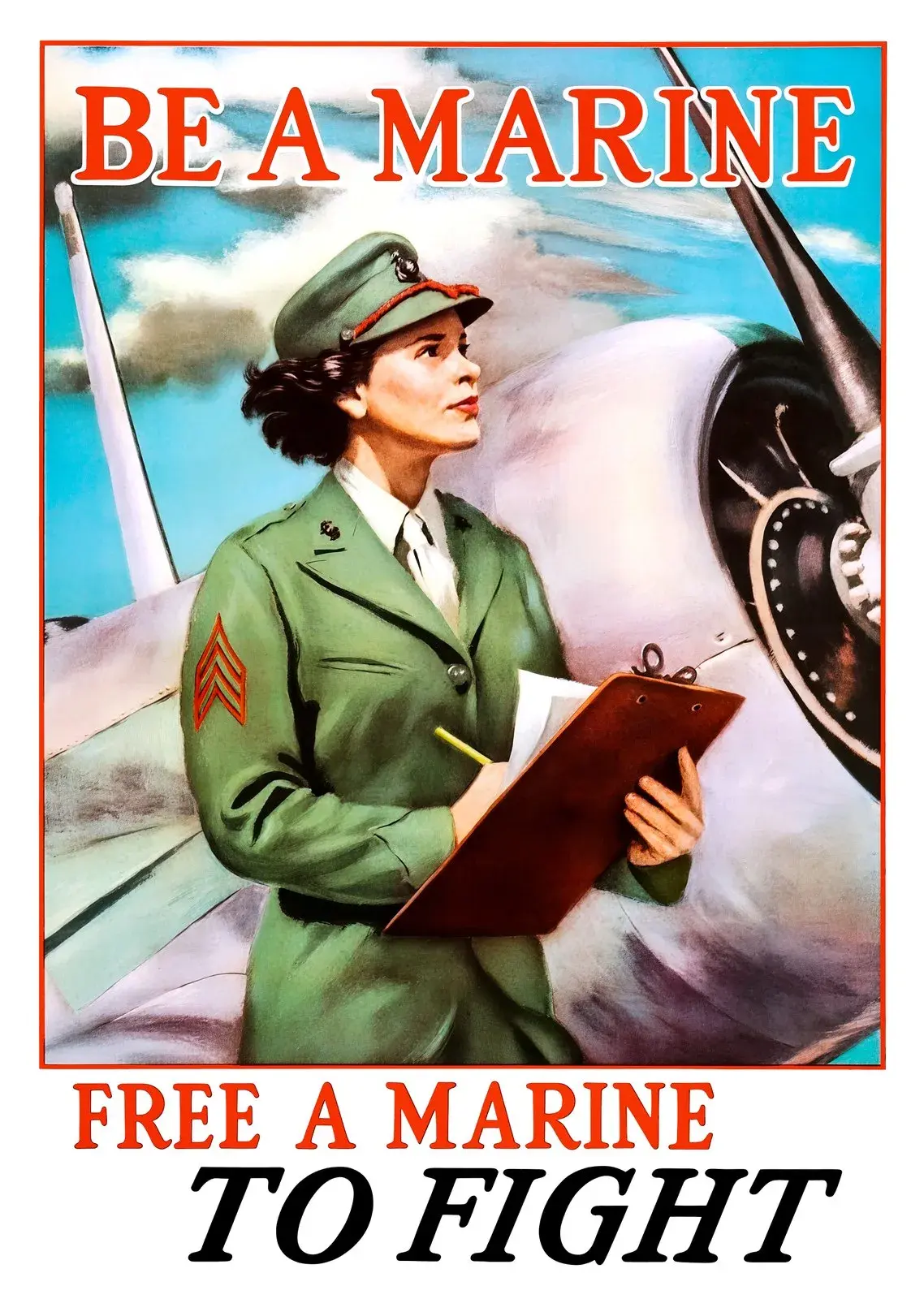
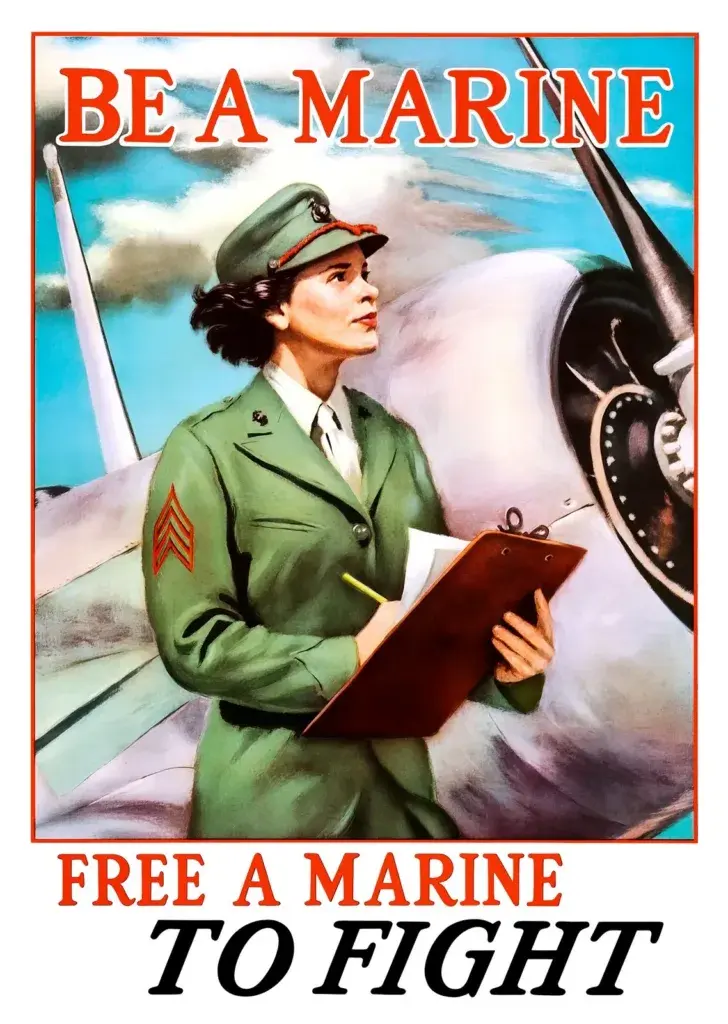
The poster shows a woman Marine in the forest-green service uniform, sergeant’s chevrons on her sleeve and a clipboard in hand, checking an aircraft with its propeller and radial engine behind her. The model is identified as Veronica Byrnes Bradley (1923 to 2018), who served in the Women’s Reserve and had worked on aircraft before she recognised her own image on the poster. Aviation was one of the fields where women Marines served in the largest numbers, from mechanics and parachute riggers to control tower operators.
Copies in public collections date the poster to 1943 and credit the U.S. Marine Corps as publisher. Surviving copies carry the imprint of McCandlish Lithograph Corporation of Philadelphia. The artist is not recorded on most collection records.
Why it worked
“Free a Marine to Fight” turned enlistment into a direct contribution to the front line, and it became one of the most successful recruiting slogans of the war. Positions open to women grew from about 34 job types in 1943 to more than 200 by 1945, including radio operators, drivers, cooks, aviation machinists and clerks.
The restored edition
Our edition was restored from an archival scan: fading, staining and paper wear were repaired and the colours brought back, keeping the original artwork and lettering true to the 1943 poster. It is available as a paper print or framed in black, white or natural wood.