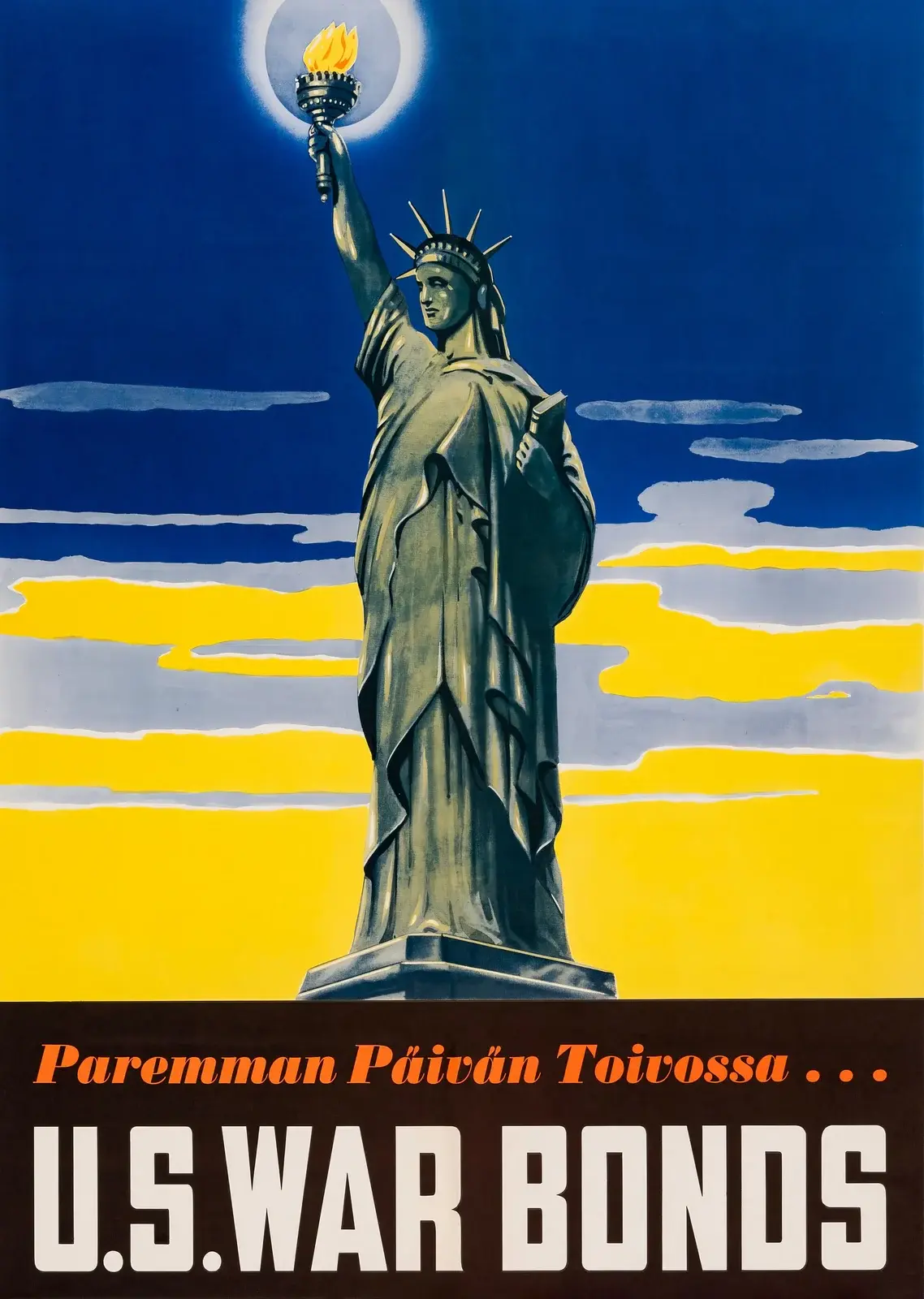
The Statue of Liberty rises in olive green against bands of deep blue sky and bright yellow cloud, her torch blazing in a white halo. Beneath her, in orange script, runs a line in Finnish, Paremman Päivän Toivossa…, “in hope of a better day”, and then the message in heavy capitals that needed no translation: U.S. War Bonds.
War bonds in many languages
America in 1943 was a nation of immigrants, and millions of its citizens read newspapers in Polish, Italian, German, Finnish or Slovak. To reach them, the Treasury printed the same war bond designs with slogans in their languages. This Statue of Liberty design is known in Finnish, Ukrainian, Romanian and Slovene versions, printed by the Government Printing Office in 1943. The Ukrainian edition reads “for a better tomorrow”.
Saving for victory
Eight war loan drives ran from 1942 to 1945. A $25 Series E bond cost $18.75 and paid back its full value after ten years. Around 85 million Americans bought bonds, lending the government about $185 billion. Foreign-language posters, newspapers and radio carried the campaign into neighbourhoods where English was a second language.
An awkward homeland
For Finnish-Americans the poster carried a complication. After the Soviet invasion of Finland in the Winter War of 1939 to 1940, Finland fought the Soviet Union again from 1941 alongside Germany, calling itself a co-belligerent rather than an ally. Britain declared war on Finland in December 1941, but the United States never did. The Treasury was asking Finnish-Americans to fund a war in which their old country fought with the other side, and promising them, in their own language, a better day.
The poster
No artist is credited on the poster or in the records we found, and we have not found an English-language master of the design. It is a federal government poster printed by the GPO.
The restored edition
Our edition was restored from a photograph of an original print. The colour was cleaned and brought back, with folds, stains and wear removed, and the lettering kept from the original. It is available as a paper print in three sizes or framed in black, white or natural wood, printed to order in the USA.
Frequently asked questions
What does Paremman Päivän Toivossa mean?
It is Finnish for “in hope of a better day”.
Why is a U.S. war bonds poster in Finnish?
The Treasury printed war bond posters in the languages of immigrant communities. This Statue of Liberty design is also known in Ukrainian, Romanian and Slovene.
Who made the poster?
It was printed by the U.S. Government Printing Office for the Treasury in 1943. The artist is not recorded.
What sizes are the prints?
Paper prints are 11.7 × 16.5, 20 × 28 or 23.4 × 33.1 inches; framed prints are 12 × 17, 20 × 28 or 23 × 33 inches, in black, white or natural wood.