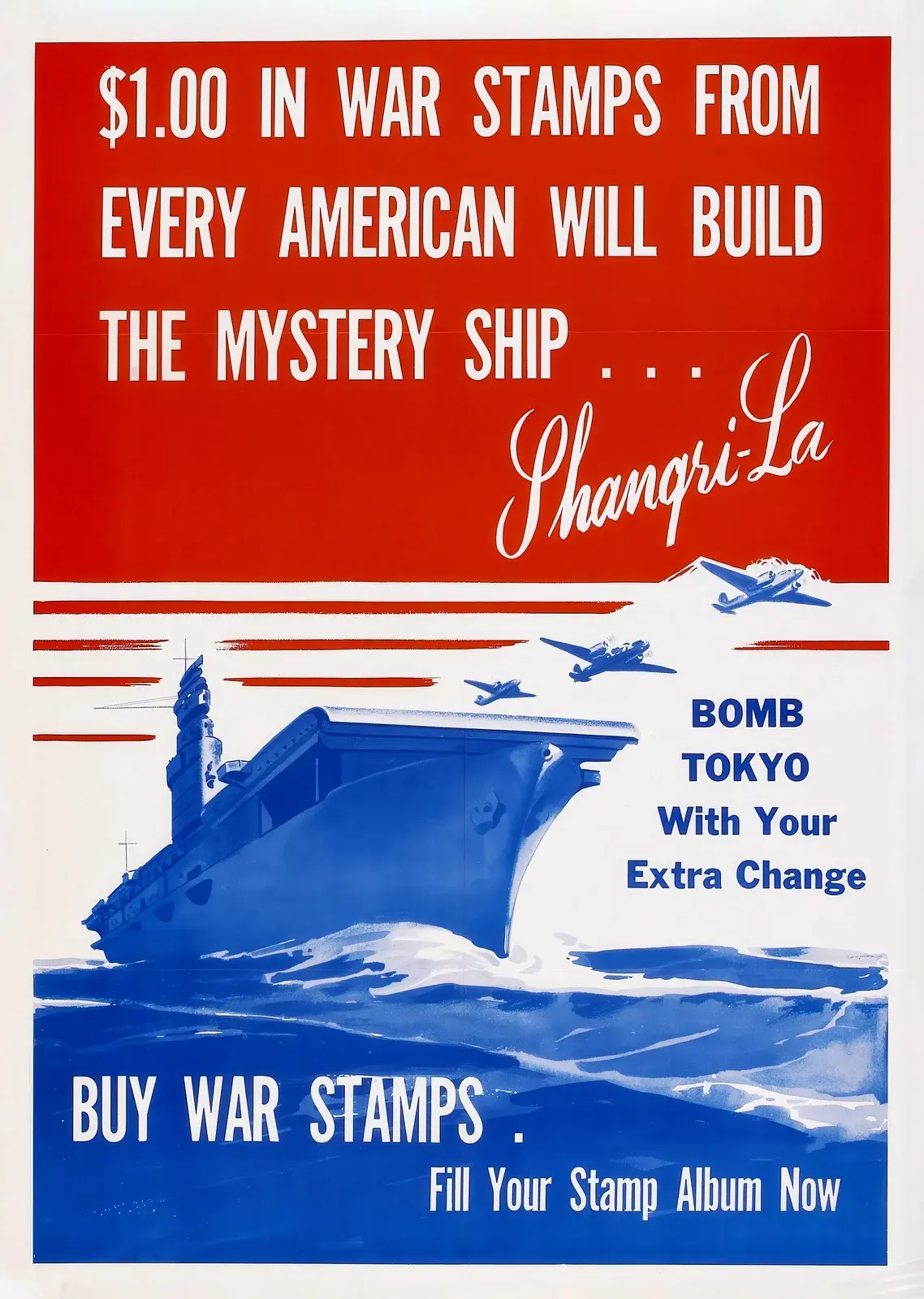
A red panel fills the top of the poster: $1.00 in war stamps from every American will build the mystery ship… Shangri-La. Below it, a blue aircraft carrier cuts through white-capped seas while its aircraft lift off the deck, and four words in blue capitals give the reason: Bomb Tokyo with your extra change. Across the bottom: Buy war stamps. Fill your stamp album now.
A ship named after a joke
On 18 April 1942 sixteen Army B-25 bombers led by Lieutenant Colonel James Doolittle bombed Tokyo and other Japanese cities. The raid did little damage, but it shocked Japan and lifted spirits at home. When reporters asked President Roosevelt where the bombers had come from, he answered “Shangri-La”, the hidden Himalayan kingdom in James Hilton’s best-selling novel Lost Horizon. The real answer, the carrier USS Hornet, stayed secret for a year.
The Navy kept the joke. A new Essex-class carrier laid down at Norfolk Navy Yard in January 1943 was named Shangri-La, honouring the Hornet’s part in the raid. She was launched on 24 February 1944, sponsored by Josephine Doolittle, and commissioned that September.
Stamps for children and savers
War stamps were the small change of the war finance effort. They cost as little as ten cents, were stuck into albums, and once an album was full it could be traded for a war bond. Schools ran stamp days and children were the programme’s best salesmen. This poster, coded WSS 817-A and printed by the Government Printing Office in 1943, pitched the carrier as something everyone could help build with a single dollar. That was a campaign line rather than an accounting fact, but it gave a child’s ten-cent stamp a target: the mystery ship.
Shangri-La at war
The real ship reached the Pacific in 1945. She flew her first strikes on 25 April 1945 against Okino Daito Jima, raided the Japanese home islands that summer, and steamed into Tokyo Bay on 16 September 1945, after the surrender. She earned two battle stars in the Second World War and served on into the Vietnam era.
The artist
No artist is credited on the poster or in the museum records we found. Copies are held by the Huntington Library, the Detroit Historical Society and the Museum of Fine Arts, Boston, which also holds a small handbill version.
The restored edition
Our edition was restored from a photograph of an original print. The colour was cleaned and brought back, and folds, stains and wear were removed, while the lettering and printed codes are kept from the original. It is available as a paper print in three sizes or framed in black, white or natural wood, printed to order in the USA.
Frequently asked questions
Who made the Shangri-La war stamps poster?
It was issued for the U.S. Treasury’s war stamp programme and printed by the Government Printing Office in 1943. The artist is not recorded.
Why was the ship called Shangri-La?
After the Doolittle Raid in April 1942, President Roosevelt joked that the bombers had flown from Shangri-La, the imaginary kingdom in Lost Horizon. The Navy later gave the name to a new carrier, USS Shangri-La (CV-38).
Did war stamps really pay for the carrier?
The poster’s “one dollar from every American” was a campaign pitch. War stamps and bonds helped fund the war effort as a whole rather than one particular ship.
What happened to USS Shangri-La?
She was launched in February 1944, fought off Japan in 1945, entered Tokyo Bay after the surrender and earned two battle stars.
What sizes are the prints?
Paper prints are 11.7 × 16.5, 20 × 28 or 23.4 × 33.1 inches; framed prints are 12 × 17, 20 × 28 or 23 × 33 inches, in black, white or natural wood.
Historical sources
- Huntington Library: Bomb Tokyo with your extra change (1943)
- Detroit Historical Society: Bomb Tokyo with your extra change
- Museum of Fine Arts, Boston: handbill version
- Naval History and Heritage Command: Shangri-La (CV-38)
- Wikipedia: USS Shangri-La