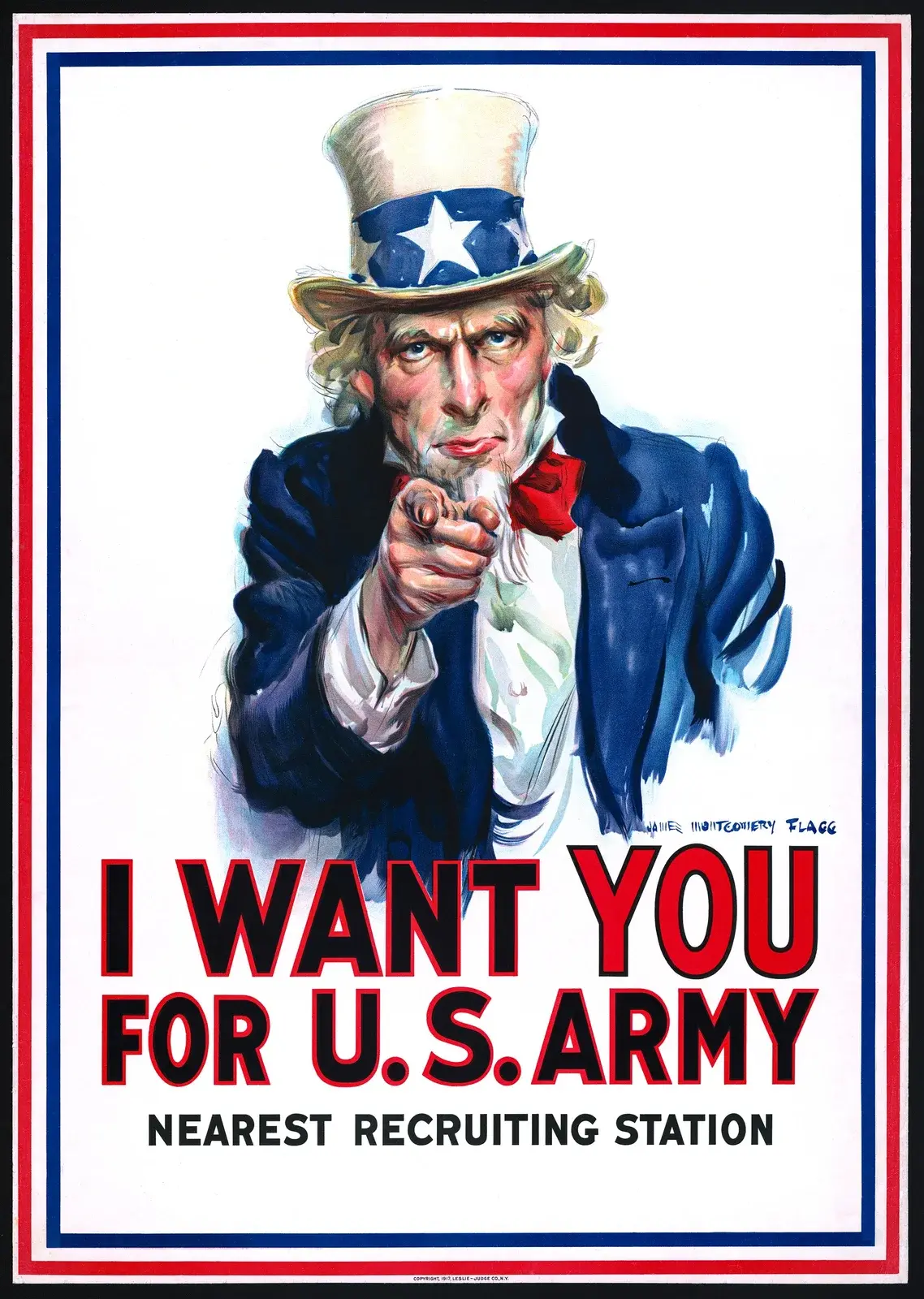
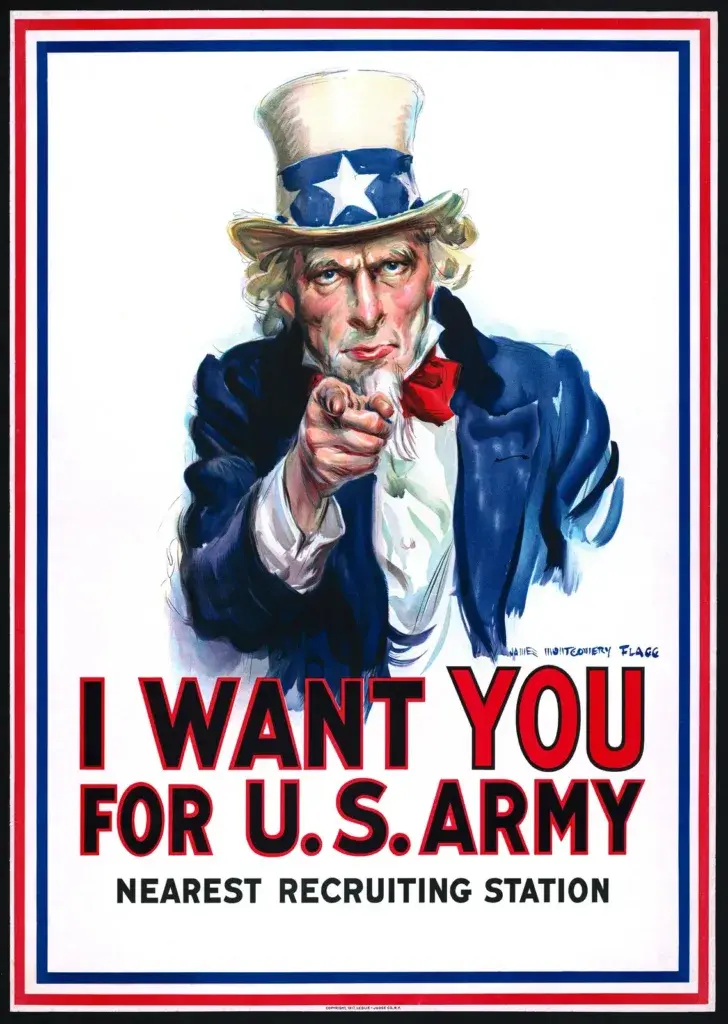
An old man in a white top hat with a band of stars leans out of the poster and points. His white hair and goatee frame a face set hard, blue eyes fixed on whoever is looking, under a blue coat, white shirt and red bow tie. Beneath him, in red and blue capitals: I Want You for U.S. Army. A smaller line adds the instruction: Nearest Recruiting Station. A red, white and blue border runs around the edge, and the artist’s signature sits beside Uncle Sam’s shoulder.
A magazine cover first
The picture was not made as a poster. James Montgomery Flagg drew it for the cover of Leslie’s Weekly, the New York illustrated magazine, dated 6 July 1916. The United States was still neutral, and the cover line asked readers What are you doing for preparedness?, the slogan of the movement to build up the Army and Navy before the country was drawn into the European war. When Congress declared war on Germany on 6 April 1917, the image was already in circulation, and it was quickly reworked with the new caption and issued as an Army recruiting poster. Leslie’s publisher, the Leslie-Judge Company, held the copyright, and its name appears in small type along the bottom edge.
Four million copies
Flagg was one of the busiest illustrators in America and a leading member of the Division of Pictorial Publicity, the volunteer committee of artists organised by Charles Dana Gibson to make posters for the government. He produced forty-six designs for the war effort, but none came close to this one. About four million copies of I Want You were printed between 1917 and 1918, more than any other American poster of the First World War. The full-size print measured about 40 × 30 inches and went up on walls, in shop windows and outside every recruiting office in the country.
Kitchener’s finger
The pointing figure had a precedent. In September 1914 the British magazine London Opinion published Alfred Leete’s drawing of Lord Kitchener, the Secretary of State for War, staring out and pointing above the words Your Country Needs You. It was adopted for recruiting posters and became the most famous British image of the war. Flagg borrowed the device of the direct stare and the pointing hand, and replaced the field marshal with Uncle Sam, the national figure who had been drawn in striped trousers and a star-spangled hat since the cartoons of Thomas Nast in the 1870s. Flagg’s Uncle Sam, older, leaner and angrier than Nast’s, became the standard version, and almost every Uncle Sam drawn since has been a copy of it.
The man in the mirror
Flagg used himself as the model. He was thirty-nine in 1916, a tall, good-looking man proud of his eyebrows, and he worked in front of a mirror, adding the white hair, the goatee and the lines of age to his own features. He later said he did it to avoid the bother and cost of hiring a model. In 1942, when the poster was being reprinted for the Second World War, Flagg presented a copy to President Franklin D. Roosevelt and told him the story. Roosevelt wrote back congratulating him on his resourcefulness in saving model hire, and said that his method suggested Yankee forebears. Flagg kept the joke going for the rest of the war, posing for photographers in full Uncle Sam costume.
Two wars and after
When the United States entered the Second World War in December 1941 the poster was brought back unchanged, apart from the printing details, and millions more copies were made. Afterwards it passed into the common language. It has been parodied, copied and quoted on everything from protest placards to advertisements, and the Library of Congress holds several original printings of the 1917 edition. Flagg himself, born in Pelham Manor, New York, in 1877, went on illustrating for magazines and Hollywood until his eyesight failed; he died in New York on 27 May 1960.
The restored edition
Our edition was restored from a photograph of an original 1917 printing. The colour was cleaned and brought back, with folds, stains and wear removed, while the lettering, Flagg’s signature and the Leslie-Judge copyright line are kept from the original. You can compare the archival source with the restored edition in the before and after slider on the product page. It is available as a paper print in three sizes or framed in black, white or natural wood, printed to order in the USA.
Frequently asked questions
Who painted the I Want You poster?
James Montgomery Flagg (1877–1960), a New York magazine illustrator. He drew it for the cover of Leslie’s Weekly dated 6 July 1916 and it became an Army recruiting poster in 1917.
Who was the model for Uncle Sam?
Flagg himself. He painted his own face in a mirror, adding white hair, a goatee and the top hat, and later said he did it to save hiring a model.
How many copies were printed?
About four million between 1917 and 1918, more than any other American poster of the First World War. Millions more were printed in the Second World War.
Was it copied from the Kitchener poster?
The pointing-finger idea came from Alfred Leete’s 1914 British poster of Lord Kitchener, Your Country Needs You. Flagg put Uncle Sam in Kitchener’s place.
How big was the original?
About 40 × 30 inches, lithographed in colour, copyright Leslie-Judge Co., New York.
What sizes are the prints?
Paper prints are 11.7 × 16.5, 20 × 28 or 23.4 × 33.1 inches; framed prints are 12 × 17, 20 × 28 or 23 × 33 inches, in black, white or natural wood.
Historical sources
- Library of Congress: I want you for U.S. Army, James Montgomery Flagg, c1917
- Illustration Chronicles: I Want YOU, the story of Flagg’s poster
- Fine Arts Museums of San Francisco: I Want You for U.S. Army
- Wikipedia: James Montgomery Flagg
- Teaching American History: Recruitment Poster, I Want YOU for U.S. Army