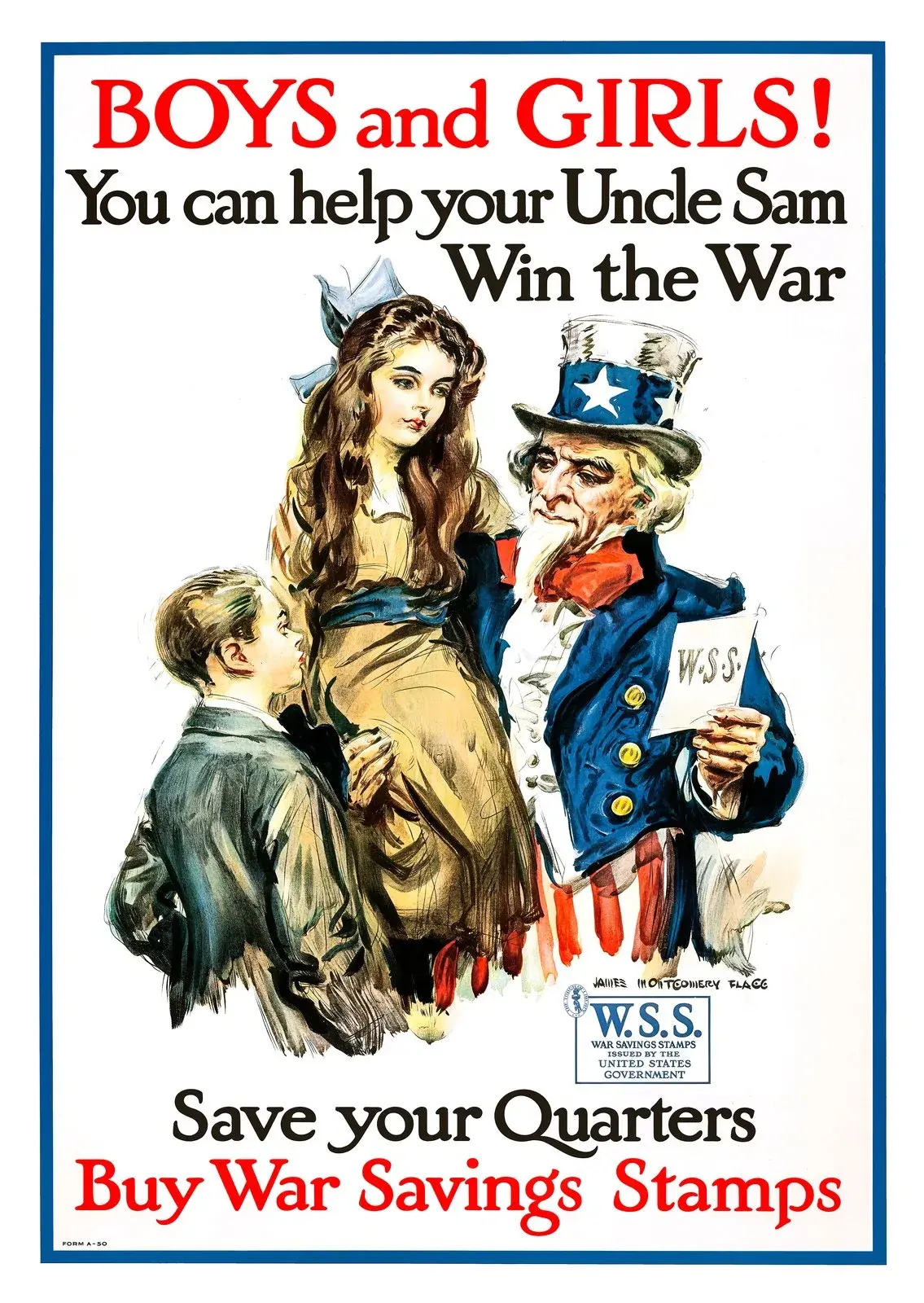
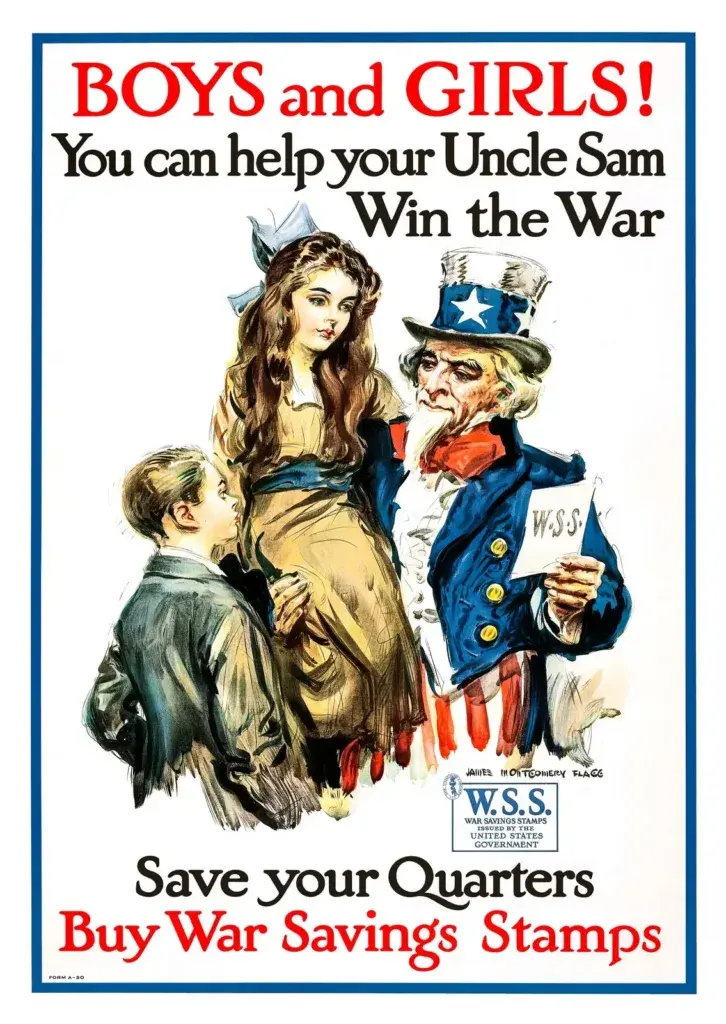
“Boys and Girls! You can help your Uncle Sam win the war. Save your quarters, buy War Savings Stamps.” Few World War I posters speak so directly to children. Drawn by James Montgomery Flagg, the illustrator who gave America its pointing “I Want You” Uncle Sam, this Treasury poster turned the cost of the war into something a schoolchild could hold: a 25-cent stamp.
What the poster shows
Uncle Sam stands at the right in his star-spangled top hat and blue tailcoat, holding a small card marked W.S.S., for War Savings Stamps. A girl with long brown hair and a blue bow leans against him, and a boy in a grey jacket looks up at him from below. The drawing is loose and quick, in Flagg’s typical style, with only the flag colours of Uncle Sam’s costume picked out in strong red, white and blue.
The lettering does the rest. BOYS and GIRLS! in red at the top, the promise that they can help Uncle Sam win the war, and at the bottom the two instructions: Save your Quarters, Buy War Savings Stamps. The official W.S.S. emblem, “War Savings Stamps issued by the United States Government”, sits beside Flagg’s signature.
James Montgomery Flagg
James Montgomery Flagg (1877 to 1960) was one of the best-paid illustrators in America when the United States entered the war in April 1917. He volunteered his talent to the government’s poster effort and produced some of its most famous images, above all the 1917 “I Want You for U.S. Army”, in which he used his own face as the model for Uncle Sam. Here the same Uncle Sam appears in a gentler role, as a kindly uncle asking the children of the country for help rather than giving orders.
How War Savings Stamps worked
The Treasury launched War Savings Stamps in late 1917 so that ordinary Americans, not only people who could afford a $50 Liberty Bond, could lend money to the government. A $5 War Savings Stamp went on sale on December 3, 1917 for $4.12. Its price rose a little each month through 1918, it earned 4 percent interest compounded quarterly, and it could be cashed for the full $5 on January 1, 1923.
For children the entry point was the 25-cent Thrift Stamp. Sixteen of them filled a Thrift Card worth $4, and with a few extra cents the full card could be exchanged for a $5 War Savings Stamp. Schools handed out savings booklets, the stamps were sold at post offices, banks and shops, and Boy Scouts and Girl Scouts sold millions of dollars’ worth door to door. By the end of the program War Savings Stamps had raised close to a billion dollars.
Why the image still works
Most war finance posters of 1917 and 1918 used soldiers, battle scenes or dramatic allegory. Flagg chose a family moment instead: two children and a trusted grown-up. It made saving feel like a way for young people to belong to the war effort, and it remains one of the most appealing American home-front posters of the First World War. Copies survive in the Library of Congress, the Hoover Institution and the Maine Historical Society, among other collections.
The restored edition
Our edition was restored from an archival scan of an original print. The comparison below shows the difference: the yellowed paper, fading, stains and edge wear were cleaned up and the colours brought back, while Flagg’s brushwork, his signature and the original lettering were kept intact.
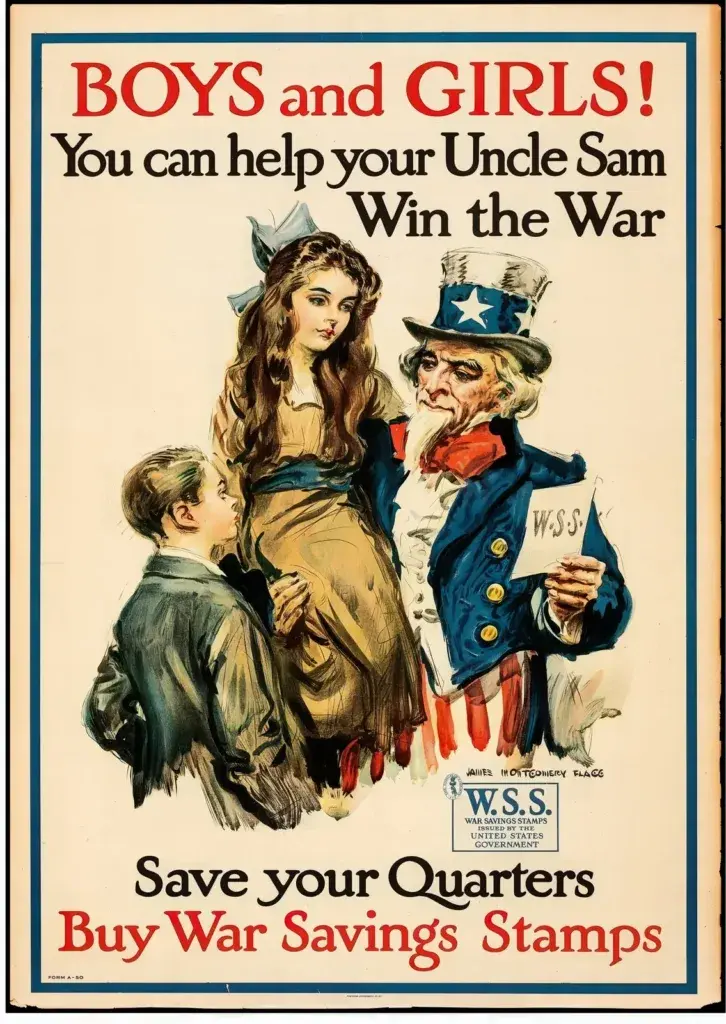
The restored poster is available as a paper print in three sizes or framed in black, white or natural wood, printed to order in the USA.
Frequently asked questions
Who designed the Boys and Girls War Savings Stamps poster?
The poster was drawn by James Montgomery Flagg, the illustrator best known for the "I Want You" Uncle Sam recruiting poster. It was issued around 1917 to 1918 by the U.S. Treasury Department's War Savings campaign and printed by the American Lithographic Co. of New York.
What were War Savings Stamps?
War Savings Stamps were small government savings certificates sold by the U.S. Treasury to help pay for World War I. A $5 War Savings Stamp earned 4 percent interest, compounded quarterly, and could be redeemed for its full $5 face value on January 1, 1923.
How much did a War Savings Stamp cost?
When sales began in December 1917 a $5 War Savings Stamp cost $4.12. The price rose slightly each month through 1918, so buying early gave the best return.
How could children afford War Savings Stamps?
Children saved with 25-cent Thrift Stamps. Sixteen Thrift Stamps filled a Thrift Card worth $4, which could be traded, with a few extra cents, for a $5 War Savings Stamp. That is why the poster tells boys and girls to save their quarters.
How big was the original poster?
Original copies are colour lithographs measuring about 40 x 30 inches. Our restored edition is available as a paper print up to 23.4 x 33.1 inches and as a framed print up to 23 x 33 inches.
Historical sources
- Library of Congress: Boys and girls! You can help your Uncle Sam win the war
- Hoover Institution Library & Archives: poster record
- Maine Memory Network: Children and war stamps World War I poster, 1917
- War savings stamps of the United States
- Mystic Stamp Company: War Savings Stamps issued to fund WWI