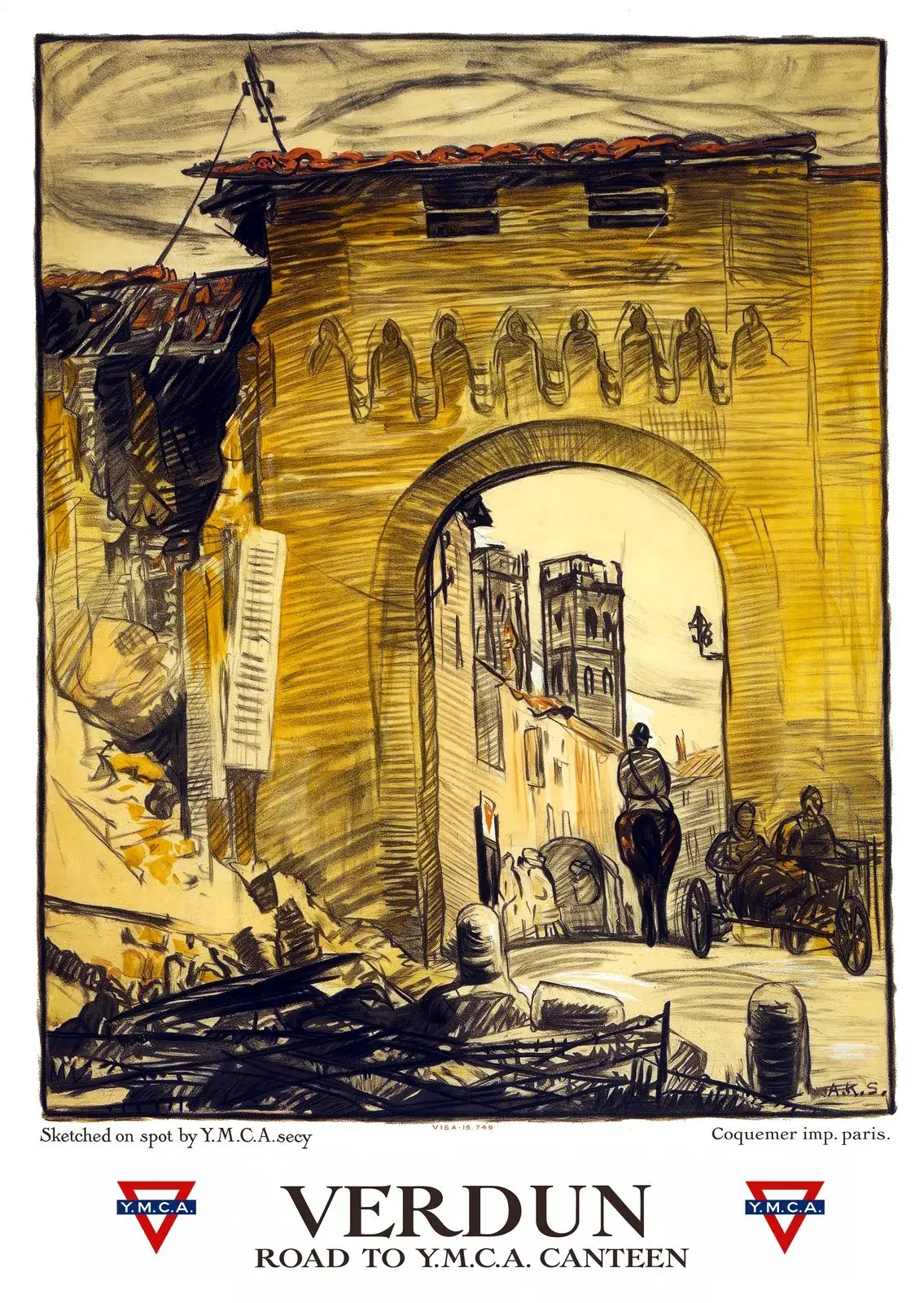
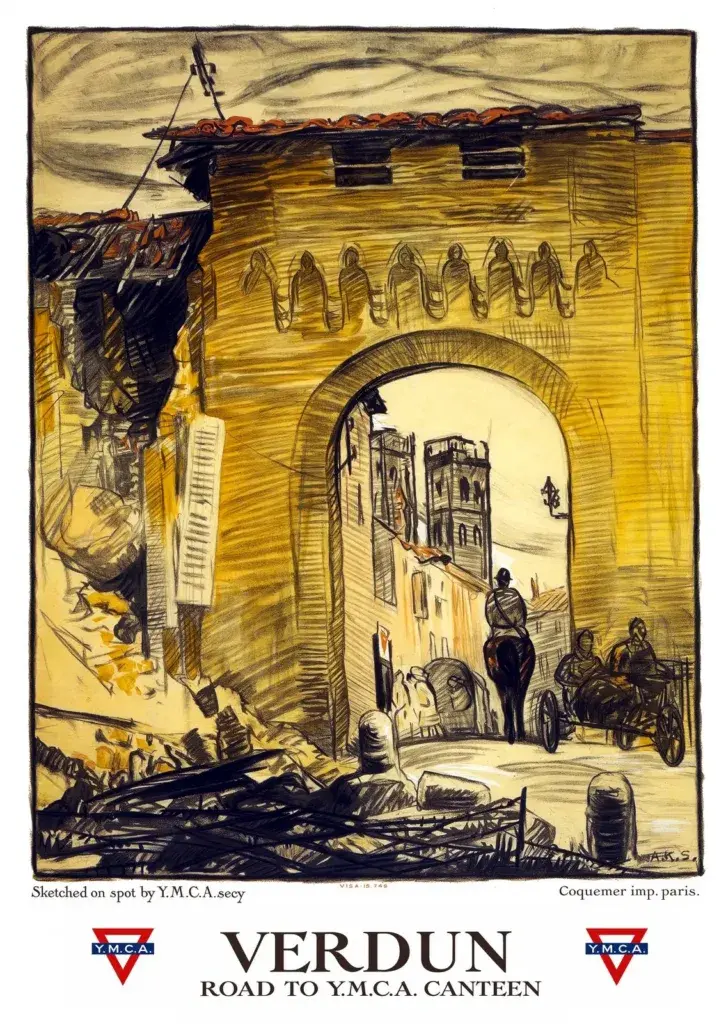
Most First World War posters sold bonds or asked for recruits. “Verdun, Road to Y.M.C.A. Canteen” does something quieter. It shows a real street in a shattered town and points the viewer toward a place of rest. The drawing is signed only with the initials A.K.S. and carries the line “sketched on spot by Y.M.C.A. secy”, and the poster was printed in Paris by Coquemer.
What the poster shows
A massive stone gateway, its upper walls broken by shellfire and a torn sign hanging from its face, frames the road ahead. Through the arch, a street of ruined houses leads toward a church tower. Mounted soldiers, a motorcycle and men on foot move among heaps of rubble. The yellow sky and heavy black drawing make the scene both documentary and theatrical, and the red YMCA triangles in the lower corners and on the street show where the road leads.
Why Verdun
By 1917 the name Verdun was known around the world. From February to December 1916 the French army held the city against a massive German offensive in one of the longest and costliest battles of the war. The poster avoids the battlefield panorama and instead shows what came after at street level: traffic, soldiers, wreckage, and the effort to provide ordinary comfort amid extraordinary destruction.
The YMCA canteens
The Smithsonian records the National Council of Young Men’s Christian Associations of the United States as the issuing body. During the war the YMCA ran canteens and huts close to the lines, offering soldiers hot drinks, food, writing paper, entertainment and a place to rest. Posters like this one showed supporters at home where their donations went.
The archival record
The Library of Congress dates the poster to 1917 and describes it as a colour lithograph of about, with the advisory “No known restrictions on publication”. The Smithsonian and the Detroit Institute of Arts hold matching records naming A.K.S. as artist and Coquemer as printer.
The restored edition
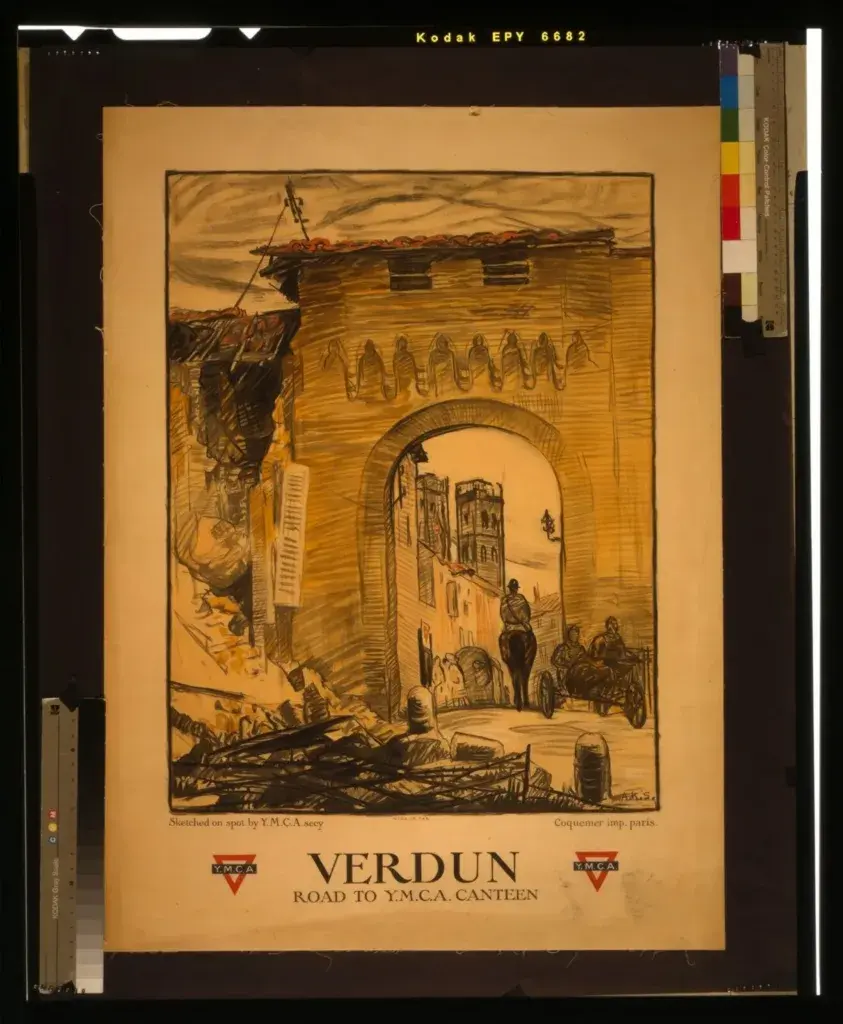
Our edition was restored from the Library of Congress scan of an original print. The transparency border and colour targets were removed, the colour cast corrected, the damaged edges rebuilt, and the lettering and line work made clear again. The restoration adjusted the layout, so the before and after are shown separately rather than as a slider.
The restored poster is available as a paper print in three sizes or framed in black, white or natural wood, printed to order in the USA.
Frequently asked questions
Who made the Verdun, Road to Y.M.C.A. Canteen poster?
It is signed with the initials A.K.S. and says it was sketched on the spot by a YMCA secretary. It was printed by Coquemer of Paris for the YMCA.
When was the Verdun YMCA poster made?
The Library of Congress dates it to 1917, the year after the Battle of Verdun.
What was a YMCA canteen in World War I?
A canteen or hut run by the YMCA near the front where soldiers could get hot drinks, food, writing paper, entertainment and a place to rest.
How big was the original poster?
About. Our restored edition is available up to 23.4 x 33.1 inches as a paper print and 23 x 33 inches framed.