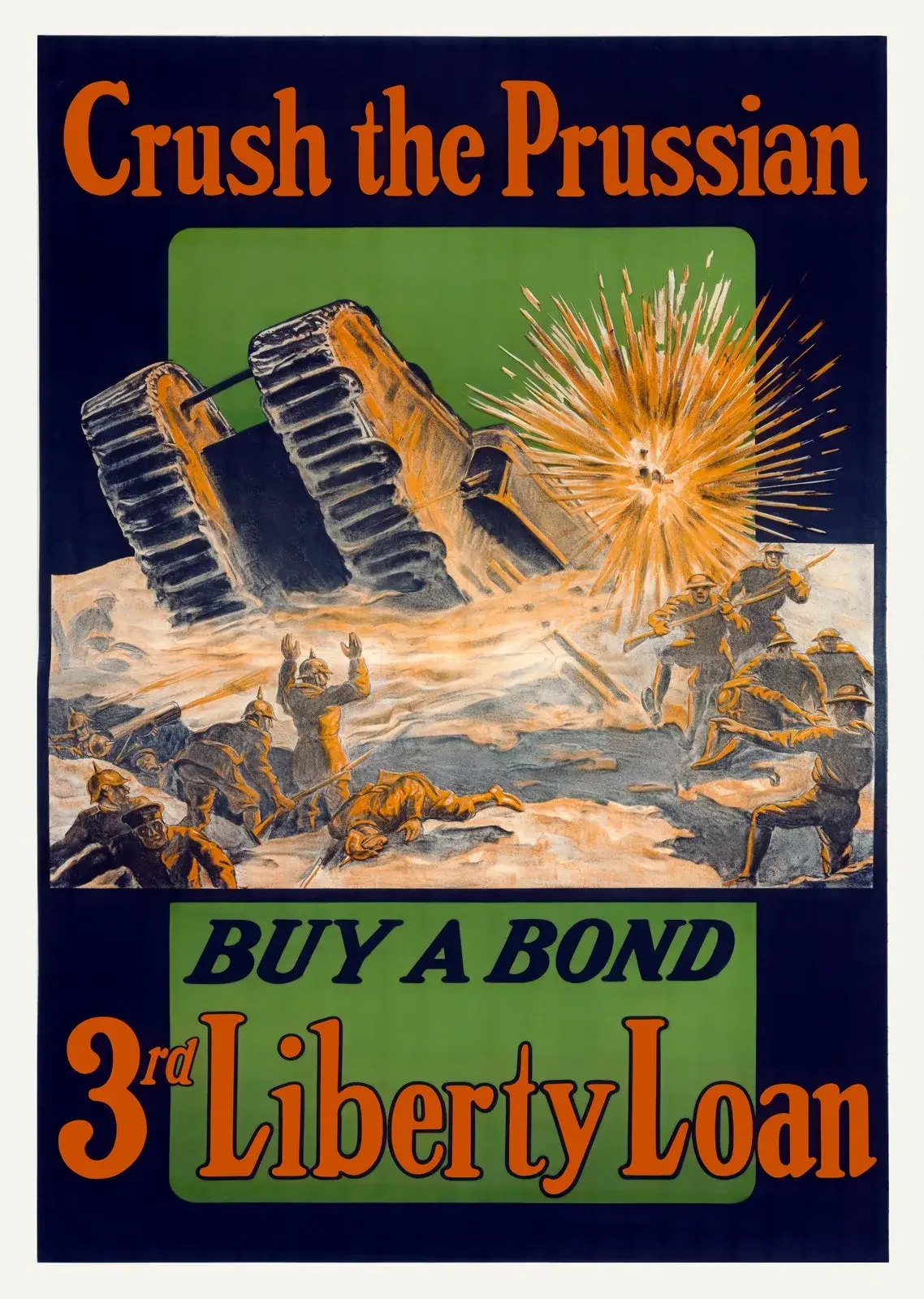
Crush the Prussian: Buy a Bond, 3rd Liberty Loan. Artist not recorded, 1918 (restored print edition). Original: Library of Congress, LC-USZC4-8892.
A tank rears up over a trench, its tracks in the air, as a shell bursts beside it in a star of orange flame. Under it, men in spiked helmets throw up their hands. On the right, American infantry come forward with rifles levelled. The words above and below tell you what to do about it: crush the Prussian, buy a bond.
This is a poster for the Third Liberty Loan of April 1918, the war-bond drive that paid for the American army then arriving in France. It is one of the few American bond posters with a tank as its subject, and nobody knows who painted it.
The poster
The sheet is a large colour lithograph, about 42 by 28 inches, printed in four colours: orange, green, black and the cream of the paper. The lettering is confident and simple. CRUSH THE PRUSSIAN runs across the top in orange capitals, BUY A BOND sits in black on a green panel, and 3rd LIBERTY LOAN fills the bottom in orange.
The picture between them is a battle. A rhomboid heavy tank climbs out of a trench at a steep angle, so steep that its whole underside shows. A shell bursts behind it. German soldiers in the foreground surrender, fall or lie still, and a line of American troops in steel helmets advances from the right with bayonets fixed. The Library of Congress catalogue sums it up in a sentence:
“Poster showing a battle scene with trenches, a tank, and explosion.”
The Third Liberty Loan
The United States paid for the First World War largely by borrowing from its own citizens. Four Liberty Loans and a final Victory Loan raised more than seventeen billion dollars between 1917 and 1919, and about twenty million people bought bonds.
The third drive opened on 6 April 1918, the first anniversary of America’s entry into the war. President Wilson launched it himself in Baltimore with a speech that ended, “Force, force to the utmost, force without stint or limit.” The Treasury asked for three billion dollars. By the time the drive closed on 4 May it had taken subscriptions of $4,176,516,850 from more than eighteen million Americans. The bonds paid 4.25 per cent and ran to 1928.
Posters were the drive’s main advertising. The Treasury and the Federal Reserve banks printed millions of them, and local loan committees added their own. This one carries no committee name, which suggests a national or commercial printing rather than a local one.
Why “Prussian”?
The enemy on this poster is not called German. That was deliberate. From the start of the war Wilson separated the German people from the government that led them. In his message to Congress in December 1917 he described the enemy as “the Prussian military and commercial autocracy”, and said that power “must be crushed”. The poster’s headline repeats his verb.
By 1918 the word was everywhere. Posters urged Americans to be “Pro-Pershing, not Pro-Prussian”, the railroads said a broken-down locomotive was “a Prussian soldier”, and Fox released a film called The Prussian Cur. Calling the enemy Prussian let the poster attack the Kaiser’s regime without attacking the millions of Americans with German names.
The tank
The tank is British. Its shape, a rhomboid with the tracks running all the way round the hull, is the Mark IV type that the British Army had used at Cambrai in November 1917, the first great tank battle. American poster artists drew it again and again, because it was the tank the public had seen in newsreels and on the Fifth Avenue parade of 1917.
The United States had no tanks of its own in action in 1918. The new American Tank Corps, with George S. Patton among its first officers, went into battle at St. Mihiel in September 1918 in French Renault light tanks, and one American battalion fought with the British in Mark V heavies. The tank on the poster is a promise of what the bonds would buy, not a record of what the Army had.
Selling bonds with aggression
Liberty Loan posters worked on every emotion the artists could reach. Some showed dying soldiers and asked whether the viewer was doing enough. Some showed children with bonds. Some showed happy crowds queuing to subscribe.
This one offers something different: the pleasure of winning. The Library of Congress’s own teaching staff use it in a classroom lesson on persuasion, alongside a dying soldier and a child clutching a bond, as the example of a poster that sells through aggression. There is no guilt here, no grief. Buy a bond and the enemy goes under the tracks.
What to look for
The surrendering soldier
In the centre foreground a German soldier faces the tank with both arms raised. His spiked helmet, the Pickelhaube, was already being replaced by the steel helmet in 1916, but it remained the symbol of Prussia for poster artists on both sides.
The underside of the tank
The artist has tipped the tank so far back that we see the belly of the hull and both tracks from below. It is not how a tank climbs a trench, but it makes the machine look as if it is rearing over the men in front of it, which is the point.
The four-colour print
Look at the explosion. The star of light is built from the orange ink, the green of the panels and the untouched cream of the paper, with black lines for the splinters. It is a cheap print made to look expensive.
Our print edition
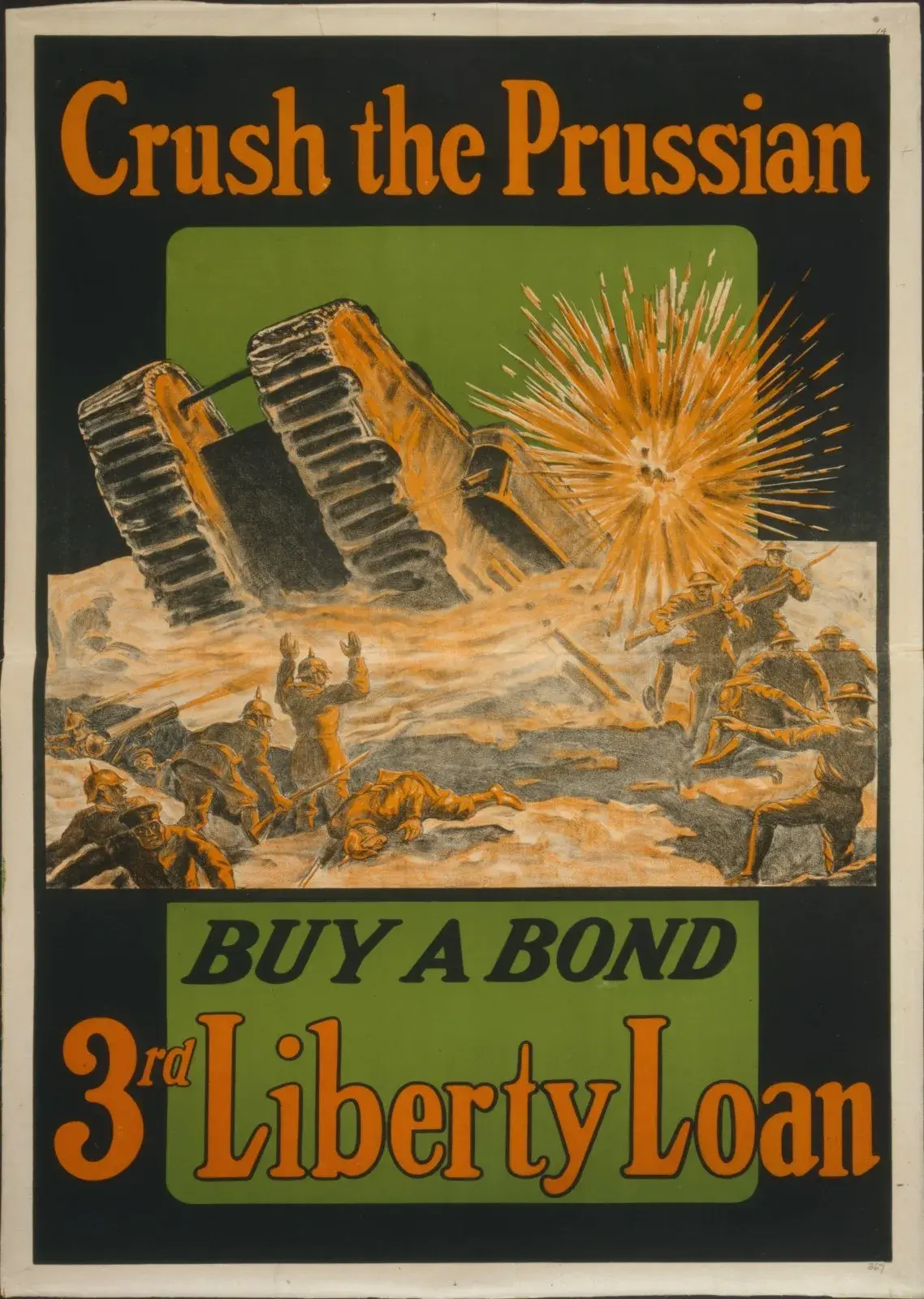
We prepared our edition from the Library of Congress scan of an original 1918 lithograph. We repaired surface damage and the uneven fading of the paper, and corrected the colour balance to the ink colours of the period, but the drawing, the lettering and the layout are as printed. It is available as a paper print in three sizes or framed in black, white or natural wood.
Drag the divider to compare the Library of Congress scan with our restored edition. The original paper has yellowed unevenly and a horizontal fold runs across the middle of the sheet; the navy background had faded towards grey-green. We took the colours back to the printed inks and left the drawing alone.
Frequently asked questions
Who designed the Crush the Prussian poster?
Nobody knows. The Library of Congress record lists no artist or printer, and no signature appears on the sheet. Many Liberty Loan posters were produced by commercial lithographers for local loan committees, and this one carries no committee or city name either.
When was it printed?
In the spring of 1918, for the Third Liberty Loan, which ran from 6 April to 4 May 1918. Some dealers and archives date it to 1917, but the third loan did not exist until April 1918.
What tank is on the poster?
A British rhomboid heavy tank of the Mark IV type, drawn from the front at a dramatic angle. The United States had no tanks of its own design in combat in 1918; American crews fought in French Renault light tanks and British heavies, and poster artists almost always drew the British shape because it was the one the public knew.
Why "Prussian" and not "German"?
President Wilson drew a line between the German people and what he called "the Prussian military and commercial autocracy" that ruled them. In his December 1917 message to Congress he said that power "must be crushed". Posters, films and speeches in 1918 followed his lead, so "Prussian" became the standard name for the enemy.
How much did the Third Liberty Loan raise?
The Treasury asked for three billion dollars and received subscriptions of $4,176,516,850 from more than 18 million people. The bonds paid 4.25 per cent and matured in 1928.
Where does the original come from?
The Library of Congress holds a copy in the Willard and Dorothy Straight Collection of World War I posters, catalogued as LC-USZC4-8892, a colour lithograph 106 by 72 centimetres. The Library lists no known restrictions on reproduction. The Detroit Historical Society holds another copy.
Is the print edition faithful to the original?
Our edition was prepared from the Library of Congress scan of an original 1918 lithograph. We repaired surface damage and corrected the faded paper tone, but kept the artist's colours, lettering and composition as printed.
Historical sources
- Library of Congress: Crush the Prussian, Buy a bond, 3rd Liberty Loan (LC-USZC4-8892)
- Library of Congress, Teaching with the Library: The Many Emotions of Purchasing a Liberty Bond
- Annual Report of the Secretary of the Treasury, 1918: Third Liberty Loan results
- Federal Reserve History: Liberty Bonds
- Woodrow Wilson, address opening the Third Liberty Loan, Baltimore, 6 April 1918
- Woodrow Wilson, Fifth Annual Message to Congress, 4 December 1917
- Detroit Historical Society: Crush the Prussian poster, object 1958.182.077
- U.S. Army: The birth of the armored forces