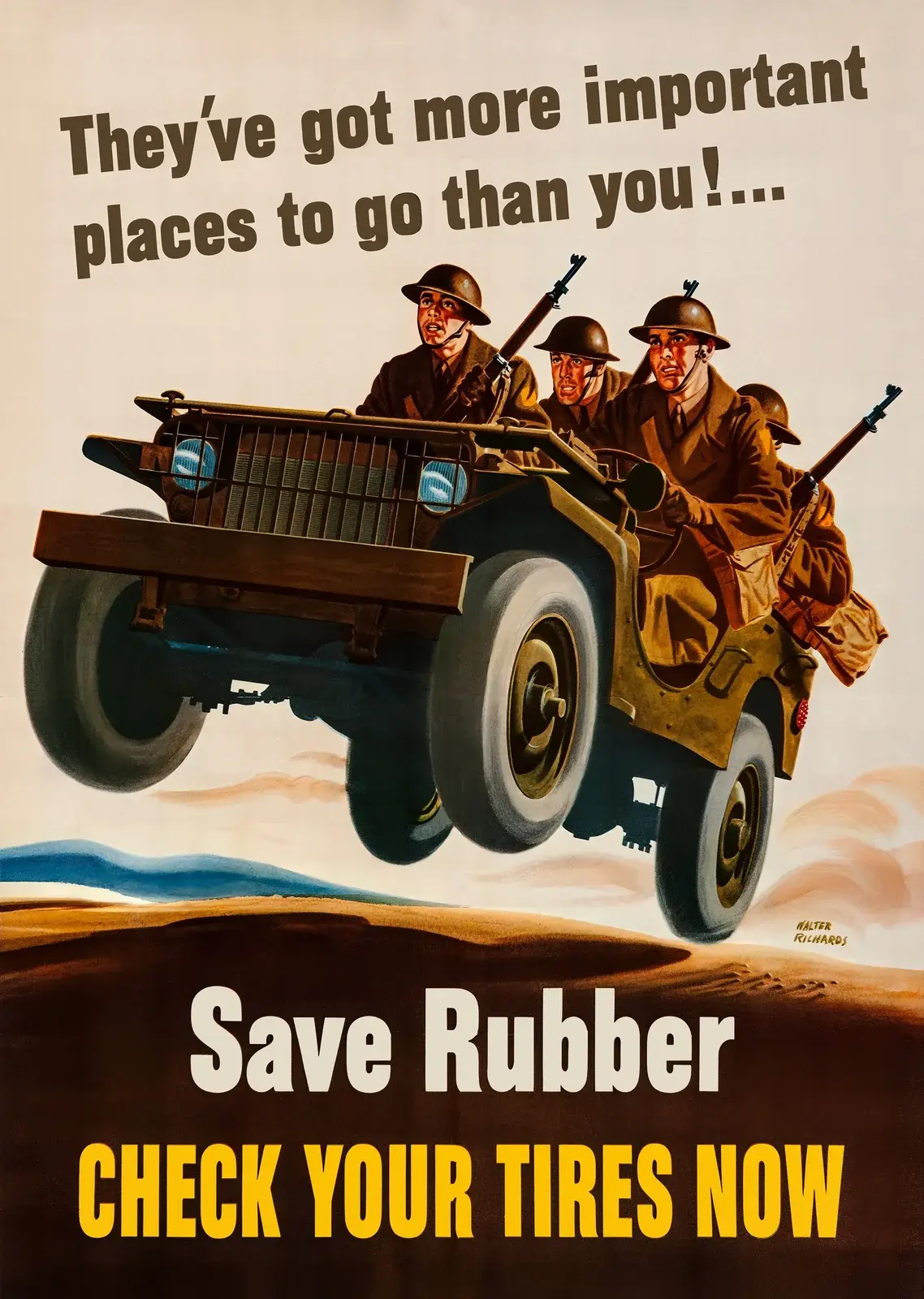
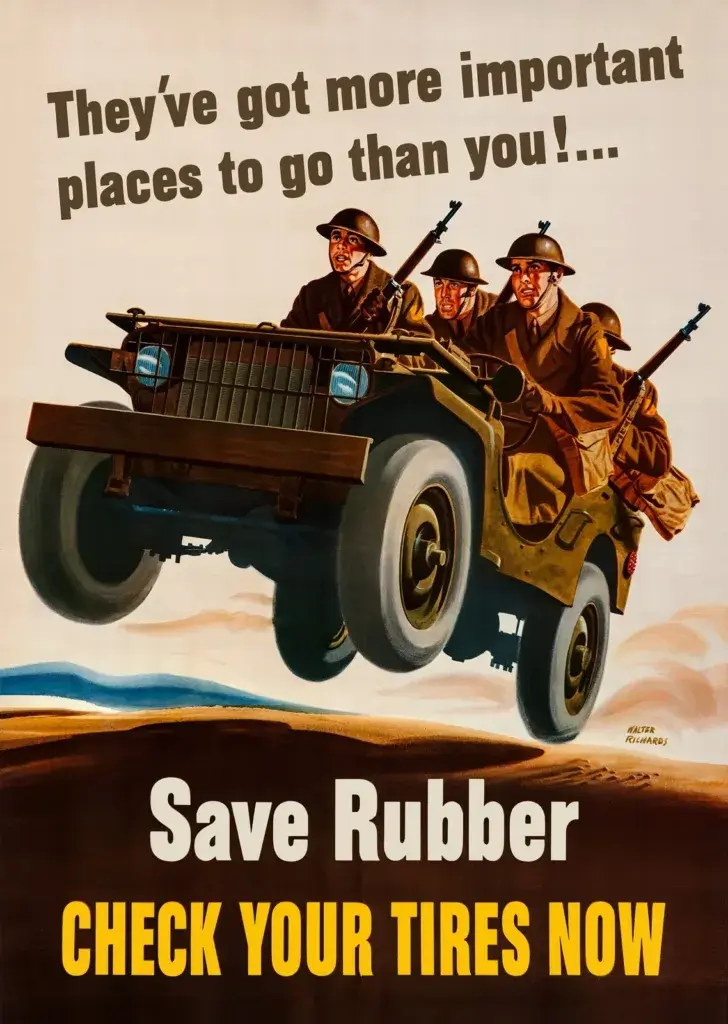
A jeep bursts over the brow of a sand ridge with every wheel off the ground. Four soldiers in steel helmets and olive drab hang on, rifles pointing at the sky, the driver’s face set and the men behind him braced against the jolt. The headline across the pale sky is almost conversational: They’ve got more important places to go than you!… Below, in white and then in yellow capitals on a brown band, the instruction: Save Rubber. Check your tires now. Walter Richards’ signature sits in the sand at the right.
Ninety per cent of the rubber, gone
In 1941 almost all of America’s rubber came from plantations in British Malaya and the Dutch East Indies. Within weeks of Pearl Harbor the Japanese army had overrun both, and the United States, which needed rubber for every tyre, hose, gasket and boot in its growing forces, found itself cut off from more than nine-tenths of its supply. The synthetic rubber industry barely existed; the country made about 8,000 tons of it in 1941. The government’s first act of civilian rationing, on 27 December 1941, was to stop the sale of new tyres. Drivers would have to make the tyres they had last the war.
Check your tires now
That is what this poster asks. Through 1942 the Office of Price Administration and the Office for Emergency Management’s Division of Information, which became the Office of War Information in June, told motorists to keep tyres properly inflated, rotate them, avoid fast starts and hard corners, share rides and drive less. In June 1942 President Roosevelt went on the radio to launch a national scrap rubber drive, and Americans brought old tyres, hot-water bottles, garden hoses and rubber boots to filling stations for a cent a pound. In the autumn a national Victory Speed of 35 miles an hour was imposed, and on 1 December 1942 petrol was rationed across the country, less to save fuel than to keep cars, and their tyres, off the road.
The jeep
Richards chose the vehicle that stood for the whole mobile war. The quarter-ton 4×4 built by Willys-Overland and Ford, the jeep, had only gone into mass production in 1941, and by 1942 it was already the Army’s favourite machine, carrying officers, messages, wounded men and machine guns anywhere a road or no road would take it. Every one of them ran on four rubber tyres with a spare on the back. The poster’s logic is simple: the rubber a civilian wears out on an unnecessary drive is rubber the jeep in the picture will not have.
Walter Richards
Walter DuBois Richards was born in Ohio in 1907 and published his first drawings in his Rocky River high school yearbook. He trained at the Cleveland School of Art, moved to New York in 1936 and became one of the busiest commercial illustrators of his generation, painting for Madison Avenue advertising accounts, for Life magazine and for the Air Force, and working as a draughtsman, watercolourist and lithographer. After the war he designed thirty-seven United States postage stamps, including a series on American architecture; his last, in 1987, showed Timberline Lodge in Oregon. His work is held by the Whitney Museum of American Art and the Pentagon. He died in 2006.
The poster
The poster was issued by the Division of Information, Office for Emergency Management, Washington, and printed in 1942 by the U.S. Government Printing Office in a 40 × 28 inch format, with the GPO job number 1942-O-498482 along the lower edge. Copies are held by the Hoover Institution Library and Archives at Stanford and by Washington State University.
The restored edition
Our edition was restored from a photograph of an original print. The colour was cleaned and brought back, with folds, stains and wear removed, while the lettering, the artist’s signature and the printing line are kept from the original. You can compare the archival source with the restored edition in the before and after slider on the product page. It is available as a paper print in three sizes or framed in black, white or natural wood, printed to order in the USA.
Frequently asked questions
Who painted the Save Rubber poster?
Walter DuBois Richards (1907–2006), a Cleveland-trained New York illustrator who later designed thirty-seven U.S. postage stamps. It was issued in 1942 by the Office for Emergency Management.
Why was rubber short in 1942?
Japan’s conquest of Malaya and the Dutch East Indies cut off more than ninety per cent of America’s natural rubber. Tyres were the first thing rationed, on 27 December 1941, and petrol rationing in December 1942 was imposed mainly to save tyres.
What vehicle is in the poster?
The quarter-ton 4×4 jeep built by Willys-Overland and Ford, the Army’s all-purpose vehicle of the war.
How big was the original?
40 × 28 inches, printed by the U.S. Government Printing Office.
What sizes are the prints?
Paper prints are 11.7 × 16.5, 20 × 28 or 23.4 × 33.1 inches; framed prints are 12 × 17, 20 × 28 or 23 × 33 inches, in black, white or natural wood.
Historical sources
- Hoover Institution Library and Archives: They’ve got more important places to go than you! (Poster US 6238)
- Washington State University Libraries: Save Rubber, Check Your Tires Now
- Walter DuBois Richards biography (UConn Health campus art collection)
- Google Arts & Culture: The Art of Persuasion, World War II propaganda and rationing