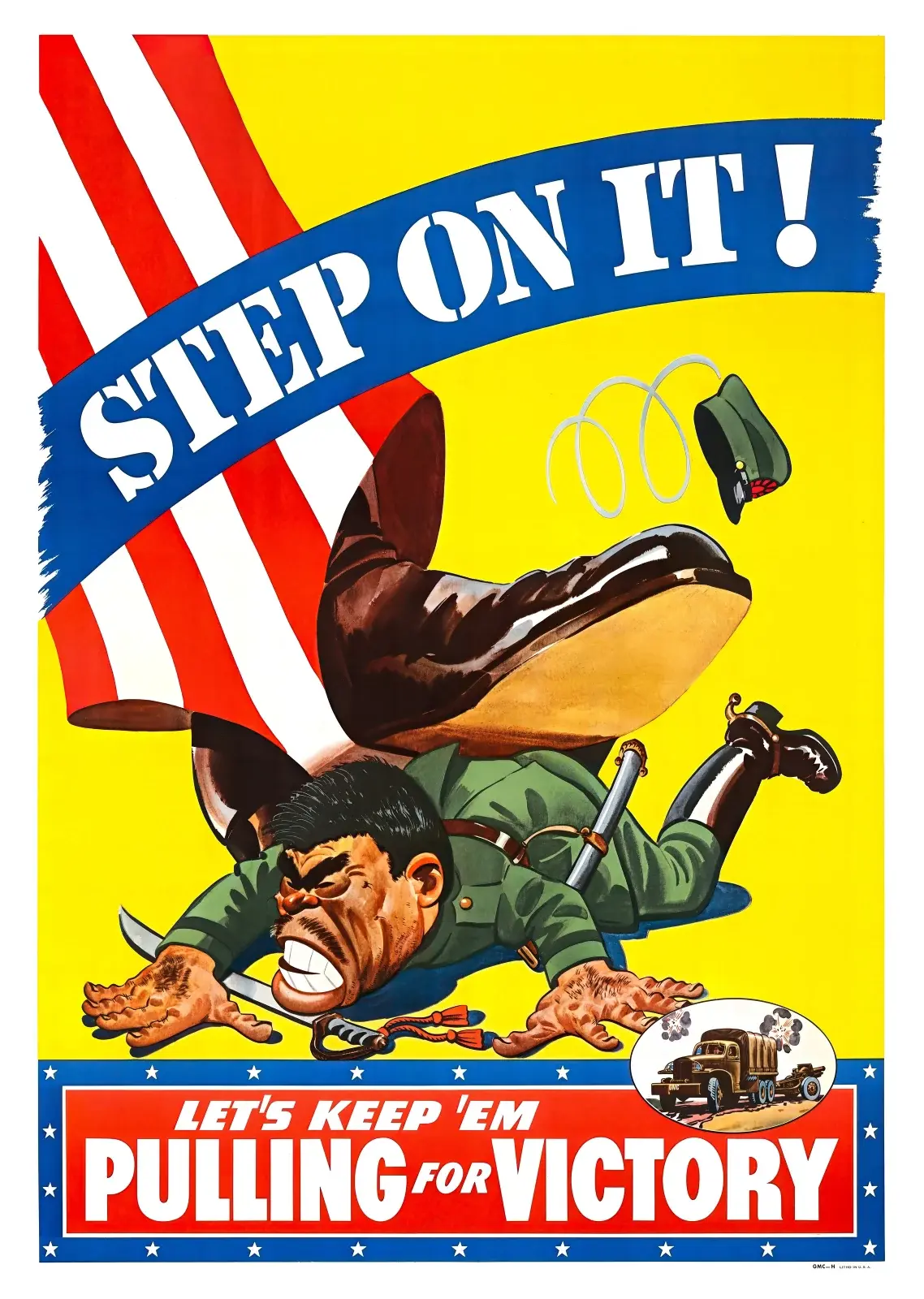
Step On It! Let’s Keep ’Em Pulling for Victory. General Motors, sheet GMC—H, about 1942–1943, artist not recorded (restored print edition). A copy is held by the University of Minnesota Libraries.
A boot the size of a truck comes down out of the sky. Above it are the red and white stripes of Uncle Sam’s trousers; under it, flattened into the yellow ground, is an enemy soldier, his cap springing off his head and his sword knocked from his hand. Across the top, in white stencil capitals on a band of blue: STEP ON IT! Across the bottom, in a red panel framed with stars: Let’s Keep ’Em Pulling for Victory.
This was not a poster for the street. It was made by General Motors to hang inside its own plants, where men and women built the trucks that pulled the American army across the world. The little oval at the lower right shows what they were making.
Keep ’em pulling
General Motors produced a whole series of posters under the slogan Let’s Keep ’Em Pulling for Victory. The University of Minnesota Libraries hold about forty of them, each marked with a sheet code: a lettered run from GMC-A to GMC-X, then a numbered run from GMC-27 to GMC-42. This one is GMC—H. Its neighbours in the series include Beat the Promised Date!, Set ’Em on Their Axis!, Let’s Pull Together and Fire Power Depends on Truck Power. Every sheet in the series is about the same size, roughly 40 by 30 inches, and printed in a few strong flat colours that would read across a factory floor.
No library has a firm date for it; the records say only “1939–1945”. A sheet just before it in the run, GMC-D, names the Philippines, Pearl Harbor and Wake Island, the defeats of the winter of 1941–42, and the truck in the inset still has the early steel cab. About 1942–1943 is the most likely date. The artist did not sign it, and the only printing line is “Litho in U.S.A.”
Step on it
The headline is a pun. “Step on it” was everyday American slang for hurry up, step on the gas. To a worker on a truck line it meant speed up production. In the picture it also means exactly what it says: stamp on the enemy. The slogan at the bottom works the same way. Trucks pull guns and loads; a workforce pulls together; everyone keeps pulling for victory.
In March 1942 the War Production Board, at President Roosevelt’s request, launched the War Production Drive, asking every war plant to form a joint labor-management committee to raise output. By June more than 800 such committees were at work. Posters were one of their main tools, for speed, for attendance, for safety and for quality, and many big manufacturers printed their own. The best-known of all, the “We Can Do It!” poster of a woman in a red bandana, was made for Westinghouse’s plants in the same way. Step On It! belongs to that world: a company poster, for a company workforce, in the language of the shop floor.
The truck in the oval
The vehicle in the inset is a GMC 2½-ton 6×6, the CCKW, with GMC on its front bumper and a canvas cover over its bed. It is towing a two-wheeled field howitzer through bursting shells. The short-wheelbase version of the CCKW was used for exactly that job, as a tractor for 75 mm and 105 mm howitzers.
Production began in 1941 at the Yellow Truck & Coach plant in Pontiac, Michigan, which General Motors controlled and took over completely in 1943 as its GMC Truck & Coach Division. GM’s Chevrolet plant in St. Louis was added later. Sources differ on the total, but more than half a million were built by 1945, counting variants such as the DUKW amphibious truck. Soldiers called it the “Jimmy” or the “Deuce and a Half”. After D-Day it was the backbone of the Red Ball Express, the round-the-clock truck convoys that fed the armies racing across France.
The caricature
The soldier under the boot is drawn as a racist caricature: buck teeth, a brutish face, dark claw-like hands. It was not unusual. American posters, cartoons and films of the Pacific War routinely portrayed the Japanese in this way, and historians such as John W. Dower, in War Without Mercy, have shown how this imagery fed the hatred on both sides of that war. It is also part of the same history that saw about 120,000 people of Japanese ancestry, most of them American citizens, removed from their homes on the West Coast and incarcerated from 1942.
We reproduce the poster as it was printed, because it is an honest record of how the war was sold to the people who built its machines. It should be read in that light.
What to look for
The striped trousers
The red and white stripes above the boot are not a flag. They are Uncle Sam’s trouser leg, and the boot is his.
The flying cap
The cap leaving the soldier’s head trails a white spring of motion lines, a cartoonist’s device that gives the whole picture its comic-strip energy.
The sheet code
Down in the bottom right corner, in tiny type: GMC—H, Litho in U.S.A. It is the only printed clue to where the poster came from, and we kept it in our edition.
Our print edition
Our edition was restored from a photograph of an original print. The yellow had faded towards mustard and the white areas had gone to cream; we took the colours back to the printed inks and removed wear and marks, but kept the drawing, the lettering and the sheet code as printed. Drag the divider to compare.
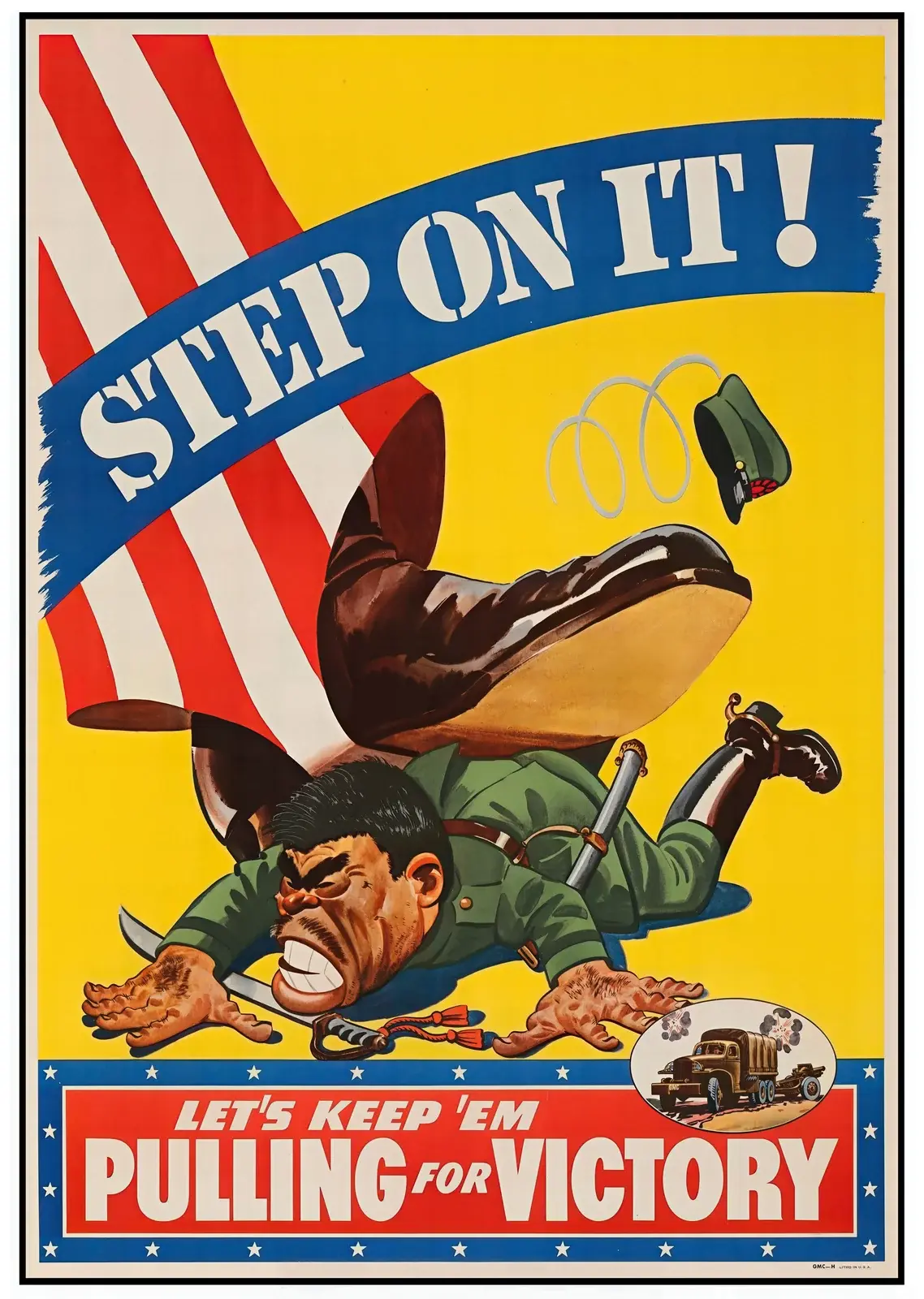
It is available as a paper print in three sizes or framed in black, white or natural wood, printed to order in the USA.
Frequently asked questions
Who made the Step On It! poster?
General Motors, for its Let’s Keep ’Em Pulling for Victory series of posters for the plants that built its army trucks. The sheet carries the code GMC—H and the line “Litho in U.S.A.” The artist and the printer are not recorded.
When was it printed?
Library collections date it only to 1939–1945. Its place early in the series’ lettered run, next to posters about the Philippines, Pearl Harbor and Wake Island, and the early closed-cab truck in the inset, point to about 1942–1943.
What does GMC—H mean?
It is the sheet’s code within the series. The University of Minnesota holds about forty of these posters, coded from GMC-A to GMC-X and then from GMC-27 to GMC-42. H is the eighth letter of the lettered run.
What truck is in the oval?
A GMC 2½-ton 6×6 cargo truck of the CCKW family, the Army’s “Jimmy” or “Deuce and a Half”, with GMC on its bumper. It is towing a two-wheeled field howitzer, a job the short-wheelbase version did as an artillery tractor.
Why is the enemy drawn this way?
American wartime propaganda routinely portrayed Japanese people through racist caricature, as historians such as John W. Dower have documented. We reproduce the poster unchanged as a historical document, not as an endorsement of its imagery.
How big was the original?
About 40 × 30 inches, the size of the series as recorded by the University of Minnesota and the University of Tokyo.
Historical sources
- University of Minnesota Libraries, World War Poster Collection: Step on it! Let’s keep ’em pulling for victory (GMC-H)
- University of Tokyo Digital Archives: General Motors Corporation “GMC series” war posters
- GMC CCKW 2½-ton 6×6 truck: production, plants and service
- The American Automobile Industry in World War Two: GMC Truck & Coach Division
- War Production Board, Labor Production Division: the War Production Drive, June 1942
- History Matters (George Mason University): racial imagery in American anti-Japanese propaganda
- The National WWII Museum: WWII propaganda and the factory floor